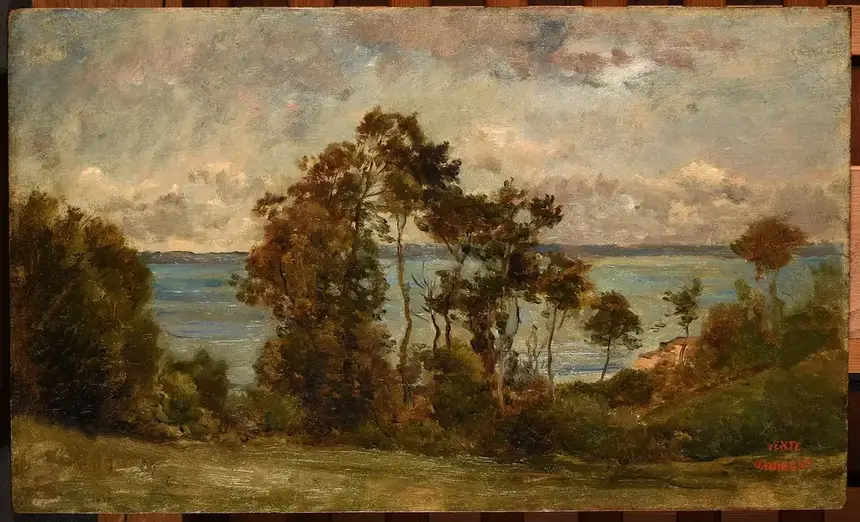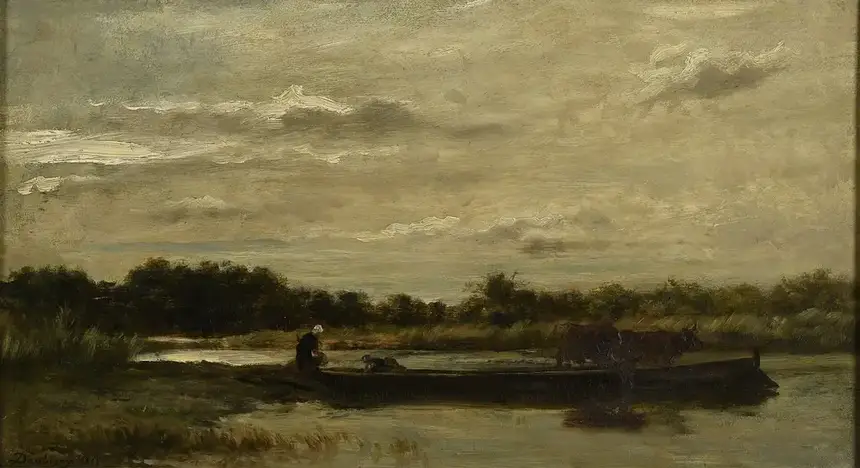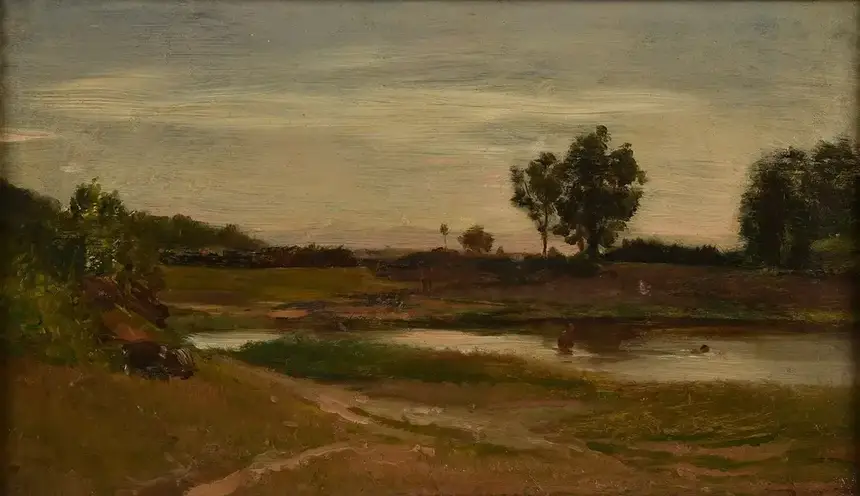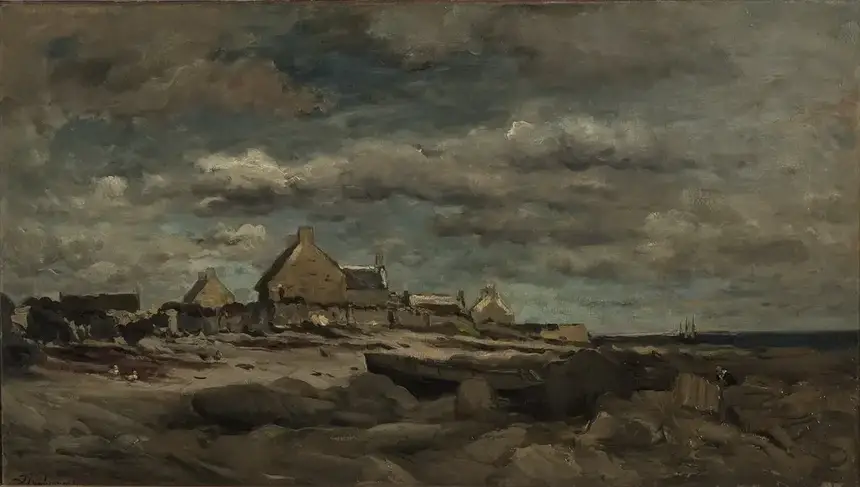
Where this painting comes from
Charles-François Daubigny died in 1878, so the work has been in the public domain for decades. Reproducing it by hand is legal, and so is owning one.
Ours is a painting made with brushes. There is no giclée, no canvas transfer and no digital underlayer anywhere in the process.
The painting was made in the years before 1878, and what we reproduce is the record of it, not the object.
What arrives is a canvas with paint on it, made by a person. That is the only thing we sell.
Where the painting lives
Painted by hand, Charles-François Entrée de keeps the hesitation in the brushwork that gives the place its scale.
Nothing in Charles-François Entrée de is centred for the sake of being centred; the weight sits where the painter wanted it.
The light in Charles-François Entrée de has a direction, and the painter keeps it consistent across every object in the picture.
Colour here is mixed for the passage, not for the object, which is why nothing looks like it was filled in.
The last marks are the ones that are left alone. Overworking is the enemy.
Getting Charles-François Entrée de right means painting it in the right order, and the order is not obvious.
It works best on a wall you pass rather than one you sit and stare at — the paint rewards a moving eye.
| Artist | Charles-François Daubigny |
|---|---|
| Title | Charles-François Entrée de |
| Created (original) | 1871 |
| Medium | Oil on canvas, hand-painted to order |
| What you receive | A hand-painted oil painting on canvas |
| Original status | Public domain (artist deceased) |
Why hand-painting matters here
The difference is not subtle when the two hang side by side. Ink sits on the surface; oil stands off it.
Edges are left soft where the form turns away and sharp where it does not. That single habit is what separates a painting from a copy.
| Aspect | Hand-painted oil | Printed canvas |
|---|---|---|
| Impasto | Real paint standing off the canvas | Flat ink, sometimes embossed to imitate |
| Depth | Built in layers, catches light from the side | Flat; highlights are printed as pale ink |
| Size | Any size, painted to your wall | Limited by the printer |
| Time to make | Days of one painter's working time | Minutes |
| The surface | Built up with brushes and knives | Printed flat in one pass |
The risk with a landscape is overworking, and the way to avoid it is knowing when to stop.
Every canvas is painted to order, so the quote follows your size, frame and destination rather than a fixed list. Tell us what you need on WhatsApp and we reply with an exact figure, usually within the hour. You deal directly with the studio that paints it — no reseller layer.
The sequence on our floor
The order of work matters as much as the work itself. Ours runs like this:
- We start with the canvas itself — stretched, sized and left to settle before any colour is mixed.
- The drawing goes down — charcoal or thin paint, done by eye rather than traced from a printout.
- The big shapes are blocked in — thin paint, one colour at a time, the whole canvas at once.
- Getting the values right — the stage that decides whether the finished painting holds together.
- Colour is built up — warmer and cooler versions of each passage, laid over the underpainting.
- Finishing passes — the loaded highlights go on at the end and stay there.
- It dries, then gets varnished — and only then is it photographed for you.
This one repaints badly, so our painter gets the values right early and leaves them.
Framing
If you are shipping, an unframed canvas rolled in a tube is considerably cheaper to move than a framed one.
We can supply a simple floater frame, a traditional gilt, or nothing at all. It is your call.
What goes into it
We use a neutral-sized ground so the whites stay warm rather than going blue over time. Linen is worth the extra cost above about a metre across, because it holds tension better in humid rooms.
We buy pigment in tubes from the same suppliers the village has used for years, not in bulk drums. Stretcher bars are kiln-dried and wedged, so the canvas can be re-tensioned years later.
Looking after it
Do not wipe it with anything wet. Dust lightly, hang it somewhere stable, and forget about it.
Getting the size right
The canvas is cut to your wall, not the other way round. For reference, these are the dimensions most often requested:
| Size (inches) | Size (cm) | Best for |
|---|---|---|
| 48 × 36 in | 122 × 91 cm | Large living room, stairwell, loft |
| 40 × 30 in | 102 × 76 cm | Living room focal wall, above a sofa |
| 32 × 24 in | 81 × 61 cm | Living room, above a sideboard |
| 30 × 24 in | 76 × 61 cm | Dining room, bedroom feature wall |
Anything outside this table is fine — we paint to the number you give us. We quote DAP, so any duty or tax your country charges is settled by you at import. We do not add a tax line of our own.
It wants a wall where the light rakes across it, because the surface is part of the picture.
Send the wall, the size and whether you want a frame, and we will quote.
💬 Get a Quote for Charles-François Entrée de Kérity Huile sur toileTimeline and shipping
Painting takes 9–15 days. Freight is quoted as its own line on the quote, agreed before you pay anything, and never added afterwards.
Transit is usually 7–10 business days, tracked all the way. We send photographs of the finished painting before it is packed, and again once it is boxed.
Nothing ships before you have seen it. Photographs of the finished painting go to you first. Changes are handled by telling us what to change; we change it and send new photographs.
DAP terms: we pay the freight, you settle any duty or tax your country applies. We do not collect taxes on anyone's behalf.
You pay a deposit to start and the remainder before shipping. Nothing is hidden in between. Report any transit damage within 48 hours with photographs and we will deal with the carrier. We will not promise a payout, but we will not leave you to argue alone either.
Before you order
What size should I order?
You choose the size. Each canvas is cut to your measurements rather than pulled from stock, so tell us the wall dimensions and we will tell you what proportion works.
Is there a rush option?
It depends on the canvas and what else is in the studio. Ask on WhatsApp with your size and we will tell you straight what is possible.
Do you frame it?
Framing is quoted separately, so you can decide once you have seen the finished canvas in photographs.
Is it really painted by hand?
Yes. One painter, oil paint, brushes. We do not own a printer that touches canvas.
Can you change the colours to suit my room?
We can shift the palette, but we will tell you honestly when a change would spoil the painting.
Do you sell prints?
No prints at all — no giclée, no canvas transfer, nothing machine-made.
How do I hang it?
Centre it at about 145 cm from the floor, or two-thirds the width of the furniture below it. We will tell you the exact number for your wall.
What does it cost?
Every canvas is quoted on size, frame and destination rather than a fixed list. Tell us what you need and we reply with an exact figure.
How long does it take?
Allow 9–15 days for the painting itself, then roughly 7–10 business days in transit.
Can you paint a different work by Charles-François Daubigny?
Yes. Send the image and we will quote it, or browse the other paintings we have listed.
Do you ship to my country?
We export to more than 20 countries. Tell us where you are and we will quote the freight as a separate line.
What is the canvas made of?
Cotton or linen, oil colour, and varnish. Stretcher bars are wedged so the canvas can be re-tensioned later.