About the original
Because Edvard Munch died in 1944, this work is in the public domain. We are painting a copy of a painting — we never pass it off as the original, and neither should anyone selling you one.
Every version we make is oil on canvas, painted by one painter from start to finish. No printing is involved at any stage.
It is an original composition painted before 1944, and our version is painted from the surviving image of it.
You are buying a painting, not a file. That distinction is the whole business we are in.
What to look at
Most reproductions of a landscape flatten it into a view. This one keeps the weather in it.
We keep the original proportions rather than cropping to a standard frame, so an unusually wide composition stays honest.
The brightest passage is kept small. That is what makes it read as bright.
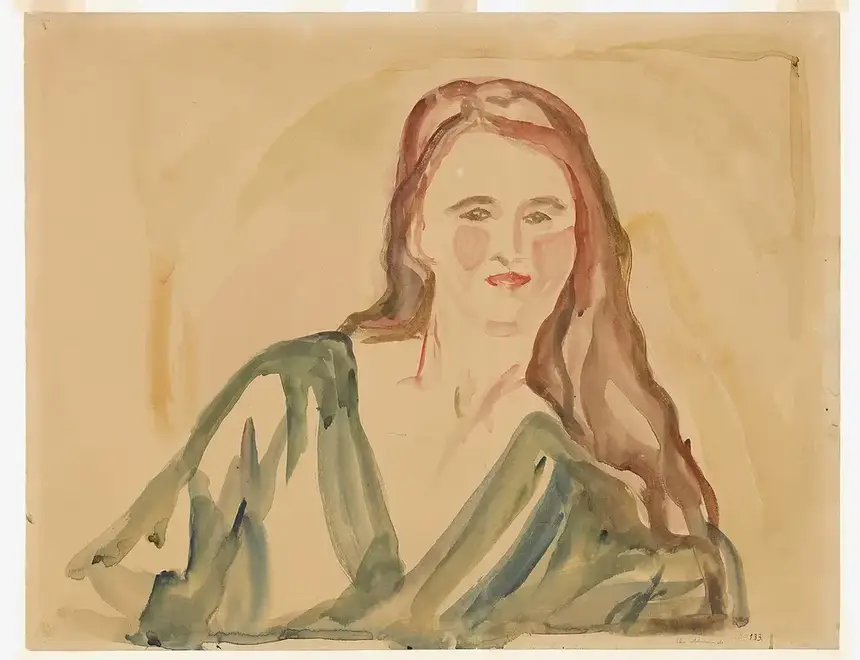
Every colour in Kvinneportrett, 1918-1923 has a warm version and a cool version, and the painter chooses between them passage by passage.
Our painter loads the brush differently for the near and far passages, and you can read the difference.
Anyone can copy the shapes. The skill is in the transitions, and that is what takes the days.
It is a picture for a room you use, not a corridor you walk through.
| Artist | Edvard Munch |
|---|---|
| Title | Kvinneportrett, 1918-1923 |
| Medium | Oil on canvas, hand-painted to order |
| Year | 1918 |
| What you receive | A hand-painted oil painting on canvas |
| Original status | Public domain (artist deceased) |
Hand-painted, not printed
Prints are good at information and bad at paint. This subject is mostly paint.
Where the original is loaded, ours is loaded. Where it is thin, ours is thin. Matching the weight of the paint matters more than matching the colour.
| Aspect | Hand-painted oil | Printed canvas |
|---|---|---|
| Time to make | Days of one painter's working time | Minutes |
| Edge quality | Soft where the form turns, sharp where it does not | Uniformly sharp or uniformly blurred |
| Depth | Built in layers, catches light from the side | Flat; highlights are printed as pale ink |
| How it ages | Warms and settles; cleanable by a conservator | Fades, then cracks at the stretcher |
| Impasto | Real paint standing off the canvas | Flat ink, sometimes embossed to imitate |
The difficulty is restraint: leaving out most of what a photograph would show.
Every canvas is painted to order, so the quote follows your size, frame and destination rather than a fixed list. Tell us what you need on WhatsApp and we reply with an exact figure, usually within the hour. You deal directly with the studio that paints it — no reseller layer.
From blank canvas to finished painting
The order of work matters as much as the work itself. Ours runs like this:
- We start with the canvas itself — stretched, sized and left to settle before any colour is mixed.
- Laying in the drawing — done by eye from the reference, not traced or projected.
- The big shapes are blocked in — thin paint, one colour at a time, the whole canvas at once.
- The values are established — this is the stage that decides whether the painting works.
- Colour is built up — warmer and cooler versions of each passage, laid over the underpainting.
- The detail and highlights go on — last, loaded, and left alone once they are down.
- It dries, then gets varnished — and only then is it photographed for you.
Matching the original's degree of finish is harder than matching its colours.
Frames
Frames are priced once you have chosen them, not estimated in advance.
Frames are priced once you have chosen them, not estimated in advance.
What goes into it
The paint is built in layers, fat over lean, which is what stops it cracking later. The varnish is removable, so a conservator can clean the painting in fifty years without touching the paint.
We use a neutral-sized ground so the whites stay warm rather than going blue over time. Pigment is artist-grade oil colour, not acrylic and not house paint. It behaves differently and it lasts.
Living with it
Dust it with a dry, soft brush. Keep it out of direct sun and away from radiators, and it will outlive you.
Sizing it
You are not choosing from a list; you are telling us a measurement. These are the common ones:
| Size (inches) | Size (cm) | Best for |
|---|---|---|
| 48 × 36 in | 122 × 91 cm | Large living room, stairwell, loft |
| 40 × 30 in | 102 × 76 cm | Living room focal wall, above a sofa |
| 32 × 24 in | 81 × 61 cm | Living room, above a sideboard |
| 30 × 24 in | 76 × 61 cm | Dining room, bedroom feature wall |
We will size the canvas to the room, not to a stock list. Send us the measurement. Duties and import taxes are the buyer's account (DAP). Your customs authority sets them; we do not.
It wants a wall where the light rakes across it, because the surface is part of the picture.
Send the wall, the size and whether you want a frame, and we will quote.
💬 Get a Quote for Kvinneportrett, 1918-1923, RES.B.0From order to your wall
From order to finished canvas is 9–15 days. Freight appears as a separate line on the quote and is fixed before you pay.
Transit is usually 7–10 business days, tracked all the way. Rolled in a tube it travels cheaper and safer than framed; most overseas clients take it that way.
Nothing ships before you have seen it. Photographs of the finished painting go to you first. Adjustments are part of the process. Say what you want different and it gets done.
Our terms are DAP, meaning the freight is paid by us and any import charges are yours to settle. We will not estimate them, because the figure is your customs authority's to set.
You pay a deposit to start and the remainder before shipping. Nothing is hidden in between. If a crate arrives damaged, send us photographs within 48 hours and contact us directly — we will sort it out with you.
Before you order
What size should I order?
You choose the size. Each canvas is cut to your measurements rather than pulled from stock, so tell us the wall dimensions and we will tell you what proportion works.
Is there a rush option?
It depends on the canvas and what else is in the studio. Ask on WhatsApp with your size and we will tell you straight what is possible.
Do you take a deposit?
Work begins on a deposit and ships once the balance is paid. Nothing is charged that is not on the quote.
Can I change the size?
Any size you like. We paint to the number you give us rather than to a standard range.
What does it cost?
Every canvas is quoted on size, frame and destination rather than a fixed list. Tell us what you need and we reply with an exact figure.
What is the canvas made of?
Cotton duck as standard, linen on request, artist-grade oil paint, and a final varnish once the paint is fully dry.
What if it arrives damaged?
Report damage within 48 hours with photographs. We deal with the carrier rather than leaving you to argue alone.
Who pays the import duty?
The buyer does. Terms are DAP: duties and taxes, where they apply, are paid on arrival. We never add a tax line of our own.
Will I see it before it ships?
Yes. We send photographs of the finished canvas and wait for your reply before packing.
Do you sell prints?
No prints at all — no giclée, no canvas transfer, nothing machine-made.
Is owning a reproduction legal?
Yes. The painting is out of copyright because Edvard Munch died more than 70 years ago. We paint copies honestly and never claim they are originals.