What you are buying into
Frank Weston Benson died in 1951, so the work has been in the public domain for decades. Reproducing it by hand is legal, and so is owning one.
Every version we make is oil on canvas, painted by one painter from start to finish. No printing is involved at any stage.
The painting was made in the years before 1951, and what we reproduce is the record of it, not the object.
You are buying a painting, not a file. That distinction is the whole business we are in.
What to look at
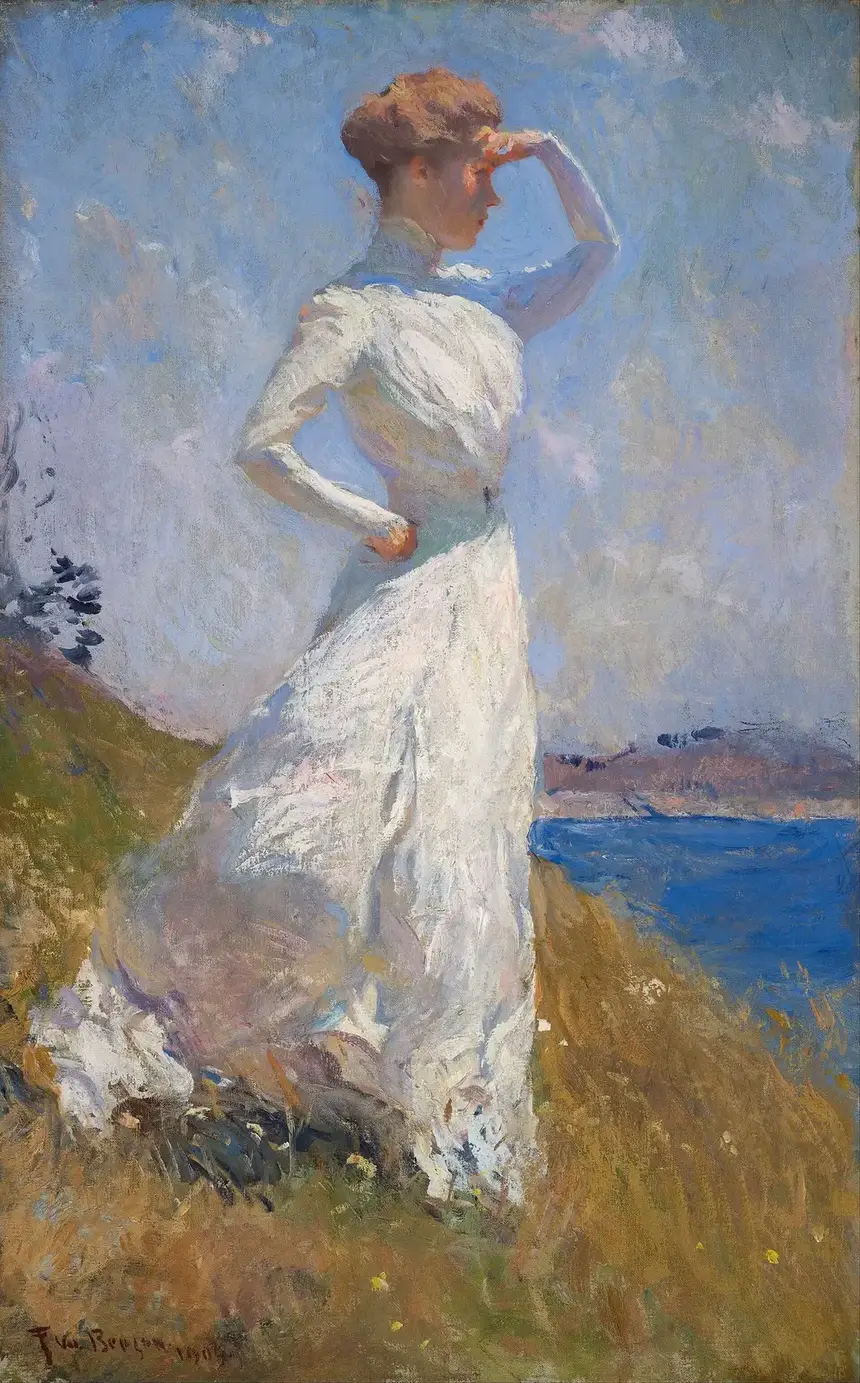
The subject is ordinary. What is not ordinary is how the paint is loaded — that is the part a press cannot reproduce.
We keep the original proportions rather than cropping to a standard frame, so an unusually wide composition stays honest.
The light in Sunlight has a direction, and the painter keeps it consistent across every object in the picture.
Our painter mixes on the palette but finishes on the canvas, which is where the small variations come from.
The brushwork is left visible, which is the whole argument for painting it by hand.
This one repaints badly, so our painter gets the values right early and leaves them.
It is a picture for a room you use, not a corridor you walk through.
| Artist | Frank Weston Benson |
|---|---|
| Title | Sunlight |
| Created (original) | 1909 |
| Medium | Oil on canvas, hand-painted to order |
| Reproduction | Hand-painted oil on canvas, made to order |
| Copyright | Public domain; the original is out of copyright |
What a print loses
Prints are good at information and bad at paint. This subject is mostly paint.
Edges are left soft where the form turns away and sharp where it does not. That single habit is what separates a painting from a copy.
| Aspect | Hand-painted oil | Printed canvas |
|---|---|---|
| How it ages | Warms and settles; cleanable by a conservator | Fades, then cracks at the stretcher |
| Value over time | Can be re-stretched, cleaned and re-framed | Little value beyond the print |
| Depth | Built in layers, catches light from the side | Flat; highlights are printed as pale ink |
| Handling of colour | Mixed on the palette and finished on the canvas | Fixed by the colour profile |
| Corrections | We adjust it and repaint the passage | The file is reprinted or it is not |
The risk with a sky study is overworking, and the way to avoid it is knowing when to stop.
Every canvas is painted to order, so the quote follows your size, frame and destination rather than a fixed list. Tell us what you need on WhatsApp and we reply with an exact figure, usually within the hour. There is no agency in between; the studio that paints your canvas is the one answering your messages.
How the canvas is built
The order of work matters as much as the work itself. Ours runs like this:
- Stretching and priming the support — cotton duck or linen goes onto the bars and gets its ground.
- Laying in the drawing — done by eye from the reference, not traced or projected.
- The first colour pass — thin and simple, establishing the main shapes only.
- Getting the values right — the stage that decides whether the finished painting holds together.
- The colour passes — each area gets its own mixture rather than one colour used throughout.
- Finishing passes — the loaded highlights go on at the end and stay there.
- It dries, then gets varnished — and only then is it photographed for you.
Anyone can copy the shapes. The skill is in the transitions, and that is what takes the days.
What it is made of
We buy pigment in tubes from the same suppliers the village has used for years, not in bulk drums. We use cotton duck for most sizes and linen where the canvas is large or the client asks for it.
Brushes, knives and rags. That is the equipment list; there is no machine in the process. Nothing is sprayed, sealed or laminated. The surface you see is paint and varnish, and that is all.
Keeping it
Once the varnish has cured the surface can be cleaned by a conservator, but in a normal house it will not need it for decades.
Whether to frame it
We can supply a simple floater frame, a traditional gilt, or nothing at all. It is your call.
If you are shipping, an unframed canvas rolled in a tube is considerably cheaper to move than a framed one.
What size works
You are not choosing from a list; you are telling us a measurement. These are the common ones:
| Size (inches) | Size (cm) | Best for |
|---|---|---|
| 30 × 24 in | 76 × 61 cm | Dining room, bedroom feature wall |
| 24 × 20 in | 60 × 50 cm | Study, home office, above a desk |
| 20 × 16 in | 50 × 40 cm | Bedroom, hallway, above a console |
| 16 × 12 in | 40 × 30 cm | A shelf, a small wall, a gallery group |
| 64 × 48 in | 163 × 122 cm | Villa scale, lobby, hospitality wall |
| 48 × 36 in | 122 × 91 cm | Large living room, stairwell, loft |
If your wall is an odd shape, send the measurement and we will work to it. Proportions from the original are kept unless you ask us to change them. We quote DAP, so any duty or tax your country charges is settled by you at import. We do not add a tax line of our own.
This reads well above a sofa or a sideboard, where it will be seen from two to three metres.
Tell us where it will hang and how big it needs to be — we will price it properly.
💬 Get a Quote for SunlightGetting it to you
From order to finished canvas is 9–15 days. Freight appears as a separate line on the quote and is fixed before you pay.
Expect 7–10 business days in transit, with tracking from our door to yours. Unframed canvases are rolled face-out on a tube; framed ones are corner-protected and crated.
You see photographs of the finished painting before it ships, and you tell us what to adjust. Adjustments are part of the process. Say what you want different and it gets done.
Terms are DAP. Import duties and taxes, where they apply, are paid by the buyer on arrival — we never collect them in advance and never guess at the amount.
You pay a deposit to start and the remainder before shipping. Nothing is hidden in between. Damage in transit should be reported to us within 48 hours, with photographs. We pursue it with the carrier rather than promising a refund.
The practical questions
What happens after I message you?
You tell us the painting, size and whether you want a frame. We quote, a painter starts on your canvas, and you get photographs before it ships.
Can I see progress photos while it is being painted?
We send photographs of the finished painting for approval before it ships. Mid-process images are not part of the standard workflow.
Why not just print it?
A print flattens the surface into a poster: the distance collapses and the highlights turn to grey. Paint keeps the depth and the texture the original was built from.
Who pays the import duty?
You do. We sell DAP, so any duty or tax your customs authority charges is settled by you at import. We do not collect it and we do not estimate it.
Is it really painted by hand?
Yes. One painter, oil paint, brushes. We do not own a printer that touches canvas.
Can I change the size?
Any size you like. We paint to the number you give us rather than to a standard range.
What does it cost?
Every canvas is quoted on size, frame and destination rather than a fixed list. Tell us what you need and we reply with an exact figure.
Does it come framed?
Framing is quoted separately, so you can decide once you have seen the finished painting in photographs.
How long does it take?
Painting takes 9–15 days. Air freight is usually 7–10 business days on top of that, tracked.
How do I hang it?
Roughly 145 cm from floor to centre works for most rooms. Tell us your wall and we will give you the measurement.
Is owning a reproduction legal?
Yes. The painting is out of copyright because Frank Weston Benson died more than 70 years ago. We paint copies honestly and never claim they are originals.
Do you sell prints?
No. Hand-painted oil on canvas only. No printing, no giclée, no canvas transfer.