About the original
Because Giovanni Fattori died in 1908, this work is in the public domain. We are painting a copy of a painting — we never pass it off as the original, and neither should anyone selling you one.
Every version we make is oil on canvas, painted by one painter from start to finish. No printing is involved at any stage.
The painting was made in the years before 1908, and what we reproduce is the record of it, not the object.
If you want something printed, we are the wrong workshop. We do not own a printer that touches canvas.
Looking at it properly
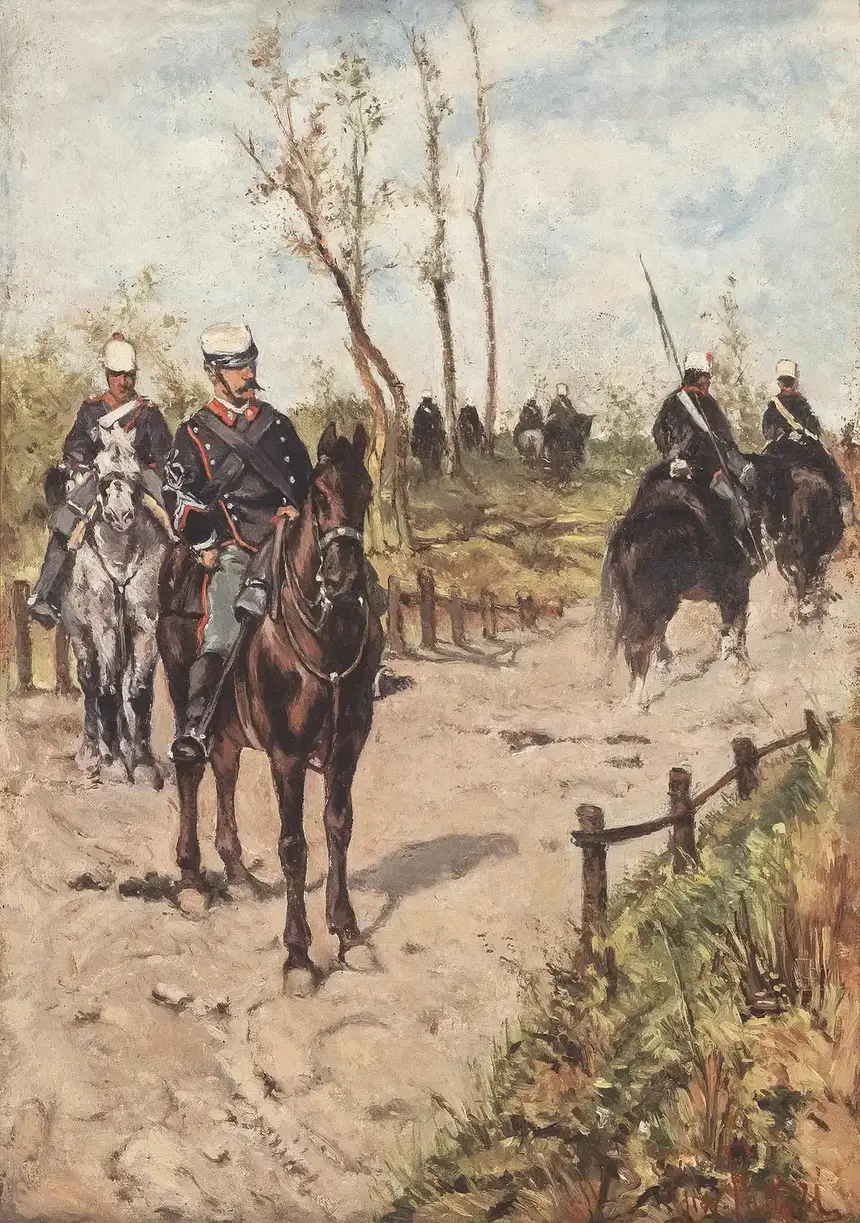
The reason Artillery patrol still works as a painting is that it was built as paint, not as a picture of a place.
The composition is built on a few large masses. Get those right and the rest follows.
The light in Artillery patrol has a direction, and the painter keeps it consistent across every object in the picture.
Temperature does the work of contrast in the quiet areas, where value differences are small.
Nothing here is blended flat. Blending is what makes a painting look printed.
The difficult part is not the detail. It is keeping the whole canvas at the same stage of finish.
For a stairwell or a double-height space, go larger than you think — the composition was built for distance.
| Artist | Giovanni Fattori |
|---|---|
| Title | Artillery patrol |
| Medium | Oil on canvas, hand-painted to order |
| How it is made | Painted by hand in oil on canvas, to your size |
| Copyright | Public domain; the original is out of copyright |
Why this one cannot be printed
A print reproduces the shapes and drops the substance. It is the substance you are buying.
Paint goes on in the original's order — thin first, thick last — so the surface behaves the way the painter intended.
| Aspect | Hand-painted oil | Printed canvas |
|---|---|---|
| Size | Any size, painted to your wall | Limited by the printer |
| The surface | Built up with brushes and knives | Printed flat in one pass |
| Depth | Built in layers, catches light from the side | Flat; highlights are printed as pale ink |
| Edges | Chosen by the painter, passage by passage | Whatever the file happens to contain |
| How it ages | Warms and settles; cleanable by a conservator | Fades, then cracks at the stretcher |
The difficulty is restraint: leaving out most of what a photograph would show.
Every canvas is painted to order, so the quote follows your size, frame and destination rather than a fixed list. Tell us what you need on WhatsApp and we reply with an exact figure, usually within the hour. You deal directly with the studio that paints it — no reseller layer.
How the canvas is built
This is how the painting is built, in the order our painters build it:
- Stretching and priming the support — cotton duck or linen goes onto the bars and gets its ground.
- The drawing goes down — charcoal or thin paint, done by eye rather than traced from a printout.
- The first colour pass — thin and simple, establishing the main shapes only.
- Setting the key — how dark the darks go determines everything that follows.
- Colour is built up — warmer and cooler versions of each passage, laid over the underpainting.
- Detail and highlights last — put on thickly and then not touched again.
- Left to dry before varnish — nothing is photographed or packed until the surface is ready.
Anyone can copy the shapes. The skill is in the transitions, and that is what takes the days.
Canvas, paint and varnish
The ground is a proper acrylic sizing, so the oil does not rot the fabric over time. Nothing is sprayed, sealed or laminated. The surface you see is paint and varnish, and that is all.
We use a neutral-sized ground so the whites stay warm rather than going blue over time. The varnish is removable, so a conservator can clean the painting in fifty years without touching the paint.
Frames
Most clients wait for the photographs before choosing a frame, which is the sensible order.
We can supply a simple floater frame, a traditional gilt, or nothing at all. It is your call.
Keeping it
Dust it with a dry, soft brush. Keep it out of direct sun and away from radiators, and it will outlive you.
Getting the size right
You are not choosing from a list; you are telling us a measurement. These are the common ones:
| Size (inches) | Size (cm) | Best for |
|---|---|---|
| 40 × 30 in | 102 × 76 cm | Living room focal wall, above a sofa |
| 32 × 24 in | 81 × 61 cm | Living room, above a sideboard |
| 30 × 24 in | 76 × 61 cm | Dining room, bedroom feature wall |
| 24 × 20 in | 60 × 50 cm | Study, home office, above a desk |
| 20 × 16 in | 50 × 40 cm | Bedroom, hallway, above a console |
| 16 × 12 in | 40 × 30 cm | A shelf, a small wall, a gallery group |
Anything outside this table is fine — we paint to the number you give us. We quote DAP, so any duty or tax your country charges is settled by you at import. We do not add a tax line of our own.
It works best on a wall you pass rather than one you sit and stare at — the paint rewards a moving eye.
Send the wall, the size and whether you want a frame, and we will quote.
💬 Get a Quote for Artillery patrolFrom order to your wall
The painting takes 9–15 days, and delivery is priced separately on the quote so there is no surprise later.
In transit it is typically 7–10 business days by air, tracked door to door. We send photographs of the finished painting before it is packed, and again once it is boxed.
You approve the painting from photographs before it is packed — that is the checkpoint. If something is not right, tell us what to adjust and we adjust it.
Import charges, where they exist, are the buyer's responsibility (DAP). We never add them to the quote and never guess what they will be.
You pay a deposit to start and the remainder before shipping. Nothing is hidden in between. If a crate arrives damaged, send us photographs within 48 hours and contact us directly — we will sort it out with you.
Before you order
When will it actually arrive?
Studio time is 9–15 days, then a few more days for the oil to set before we can photograph and pack it. We tell you where your canvas is at each stage.
Will it look exactly like the image?
Not exactly, and that is the point — it is a painting, not a scan. Composition, colour and drawing follow the original closely; the surface is where a painter's own decisions show.
Do you sell prints?
No. Hand-painted oil on canvas only. No printing, no giclée, no canvas transfer.
What if it arrives damaged?
Report damage within 48 hours with photographs. We deal with the carrier rather than leaving you to argue alone.
Who pays the import duty?
You do. We sell DAP, so any duty or tax your customs authority charges is settled by you at import. We do not collect it and we do not estimate it.
Do you ship to my country?
We ship to over 20 countries. Give us your city and the freight appears as its own line on the quote.
Can I change the size?
Yes. The canvas is painted to your measurement, not taken from a stock list.
What does it cost?
Every canvas is quoted on size, frame and destination rather than a fixed list. Tell us what you need and we reply with an exact figure.
Is it really painted by hand?
Yes — oil on canvas, brush and knife. There is no printing, no giclée and no canvas transfer at any stage.
Is owning a reproduction legal?
Yes. Giovanni Fattori died more than 70 years ago, so the work is in the public domain and owning a hand-painted version is legal anywhere. We never pass ours off as the original.
How do I hang it?
Centre it at about 145 cm from the floor, or two-thirds the width of the furniture below it. We will tell you the exact number for your wall.