What you are buying into
Giovanni Fattori died in 1908, so the work has been in the public domain for decades. Reproducing it by hand is legal, and so is owning one.
Ours is a painting made with brushes. There is no giclée, no canvas transfer and no digital underlayer anywhere in the process.
It is an original composition painted before 1908, and our version is painted from the surviving image of it.
If you want something printed, we are the wrong workshop. We do not own a printer that touches canvas.
Looking at it properly
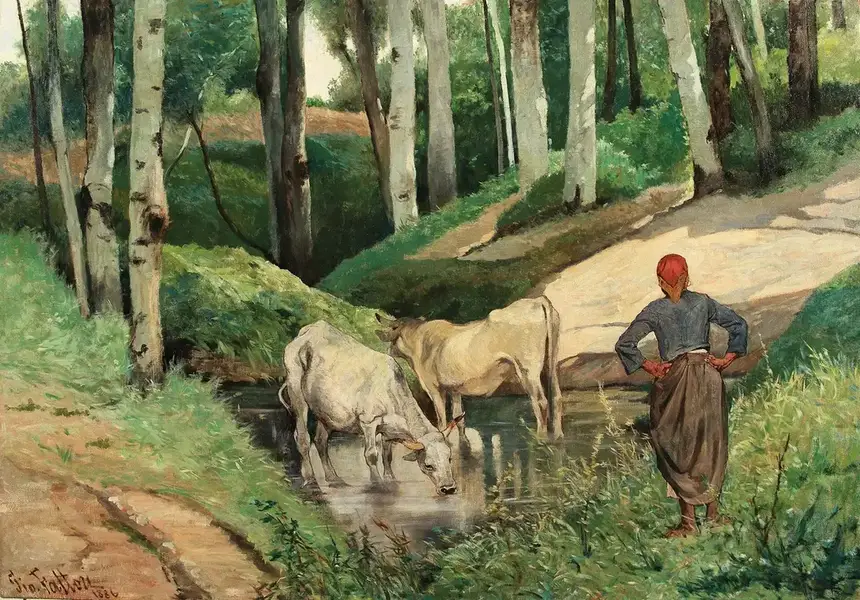
Animals are hard because the edge has to be both accurate and soft. Prints make it hard or soft, never both.
The composition is built on the line of the back or neck, and everything else follows it.
The ground is kept lower in key than the animal so the animal reads first.
We keep the original's palette rather than brightening it, even where a modern eye would.
The last marks are the ones that are left alone. Overworking is the enemy.
This one repaints badly, so our painter gets the values right early and leaves them.
For a stairwell or a double-height space, go larger than you think — the composition was built for distance.
| Artist | Giovanni Fattori |
|---|---|
| Title | Cattle watering up |
| Created (original) | 1886 |
| Medium | Oil on canvas, hand-painted to order |
| How it is made | Painted by hand in oil on canvas, to your size |
| Public domain | Yes — the artist died over 70 years ago |
Why this one cannot be printed
Prints are good at information and bad at paint. This subject is mostly paint.
Our painter follows the same logic rather than copying a photograph of it: the far distances go down cool and weak, the near ground stays loaded, and nothing is blended flat.
| Aspect | Hand-painted oil | Printed canvas |
|---|---|---|
| Later on | Can be restored, re-framed, handed on | Replaceable, and usually replaced |
| Sense of depth | Real, created by layers of paint | Simulated by darker ink |
| Surface | Hand-painted oil on canvas | Ink on canvas, flat |
| Handling of colour | Mixed on the palette and finished on the canvas | Fixed by the colour profile |
| How it ages | Warms and settles; cleanable by a conservator | Fades, then cracks at the stretcher |
The hardest passage is the quiet one, where a small mistake has nowhere to hide.
Every canvas is painted to order, so the quote follows your size, frame and destination rather than a fixed list. Tell us what you need on WhatsApp and we reply with an exact figure, usually within the hour. You are talking to the people who will actually paint it, not a middleman.
How the canvas is built
Here is what actually happens between your message and the crate:
- We start with the canvas itself — stretched, sized and left to settle before any colour is mixed.
- A loose underdrawing — proportions checked by eye against the source image.
- Blocking the masses — thin paint, working the whole surface rather than one corner at a time.
- Setting the key — how dark the darks go determines everything that follows.
- The colour passes — each area gets its own mixture rather than one colour used throughout.
- Detail and highlights last — put on thickly and then not touched again.
- Left to dry before varnish — nothing is photographed or packed until the surface is ready.
Anyone can copy the shapes. The skill is in the transitions, and that is what takes the days.
Frames
A frame is a separate line on the quote, not a bundle. You choose it once the painting exists.
A frame is a separate line on the quote, not a bundle. You choose it once the painting exists.
Materials
We use a neutral-sized ground so the whites stay warm rather than going blue over time. Large canvases get a cross-brace; anything over about a metre and a half needs one.
The varnish is removable, so a conservator can clean the painting in fifty years without touching the paint. We use cotton duck for most sizes and linen where the canvas is large or the client asks for it.
Care and cleaning
Once the varnish has cured the surface can be cleaned by a conservator, but in a normal house it will not need it for decades.
What size works
The canvas is cut to your wall, not the other way round. For reference, these are the dimensions most often requested:
| Size (inches) | Size (cm) | Best for |
|---|---|---|
| 40 × 30 in | 102 × 76 cm | Living room focal wall, above a sofa |
| 32 × 24 in | 81 × 61 cm | Living room, above a sideboard |
| 30 × 24 in | 76 × 61 cm | Dining room, bedroom feature wall |
| 24 × 20 in | 60 × 50 cm | Study, home office, above a desk |
| 20 × 16 in | 50 × 40 cm | Bedroom, hallway, above a console |
If your wall is an odd shape, send the measurement and we will work to it. Proportions from the original are kept unless you ask us to change them. Duties and import taxes are the buyer's account (DAP). Your customs authority sets them; we do not.
It is a picture for a room you use, not a corridor you walk through.
Message us the dimensions you have in mind and we will come back with a figure.
💬 Get a Quote for Cattle watering upTimeline and shipping
Allow 9–15 days for the painting itself. Shipping is a separate line on your quote — you see it before payment, not after.
Expect 7–10 business days in transit, with tracking from our door to yours. Unframed canvases are rolled face-out on a tube; framed ones are corner-protected and crated.
Before anything is packed, you get photographs of the actual canvas and a chance to ask for changes. If something is not right, tell us what to adjust and we adjust it.
Our terms are DAP, meaning the freight is paid by us and any import charges are yours to settle. We will not estimate them, because the figure is your customs authority's to set.
Work begins on a deposit and ships on the balance. Both figures are on the quote. If a crate arrives damaged, send us photographs within 48 hours and contact us directly — we will sort it out with you.
The practical questions
Can I resell the reproduction?
Yes. Because the underlying work is in the public domain, the hand-painted canvas is yours to sell, gift or install commercially.
Does changing the size change the composition?
No — we keep the original's proportions and scale from there, rather than cropping the image to fit a standard frame.
Is it really painted by hand?
Yes — oil on canvas, brush and knife. There is no printing, no giclée and no canvas transfer at any stage.
What does it cost?
There is no price list, because the number depends on your size and frame. Message us and we will quote exactly.
Who pays the import duty?
The buyer does. Terms are DAP: duties and taxes, where they apply, are paid on arrival. We never add a tax line of our own.
Can you paint it from a different photograph of the same work?
Send your own reference image and we will paint from that instead.
Do you sell prints?
No. Hand-painted oil on canvas only. No printing, no giclée, no canvas transfer.
Can you paint a different work by Giovanni Fattori?
Yes. Send the image and we will quote it, or browse the other paintings we have listed.
Is owning a reproduction legal?
Yes. Giovanni Fattori died more than 70 years ago, so the work is in the public domain and owning a hand-painted version is legal anywhere. We never pass ours off as the original.
What is the canvas made of?
Cotton or linen, oil colour, and varnish. Stretcher bars are wedged so the canvas can be re-tensioned later.
Will I see it before it ships?
Yes. We send photographs of the finished canvas and wait for your reply before packing.