About the original
Gustave Boulanger died in 1888. That puts the painting well outside copyright, which is why we can paint it and you can own it anywhere in the world.
Ours is a painting made with brushes. There is no giclée, no canvas transfer and no digital underlayer anywhere in the process.
The painting was made in the years before 1888, and what we reproduce is the record of it, not the object.
What arrives is a canvas with paint on it, made by a person. That is the only thing we sell.
What the painting is doing
There is a reason a landscape is the hardest thing to print and the easiest thing to paint: the paint itself carries the depth.
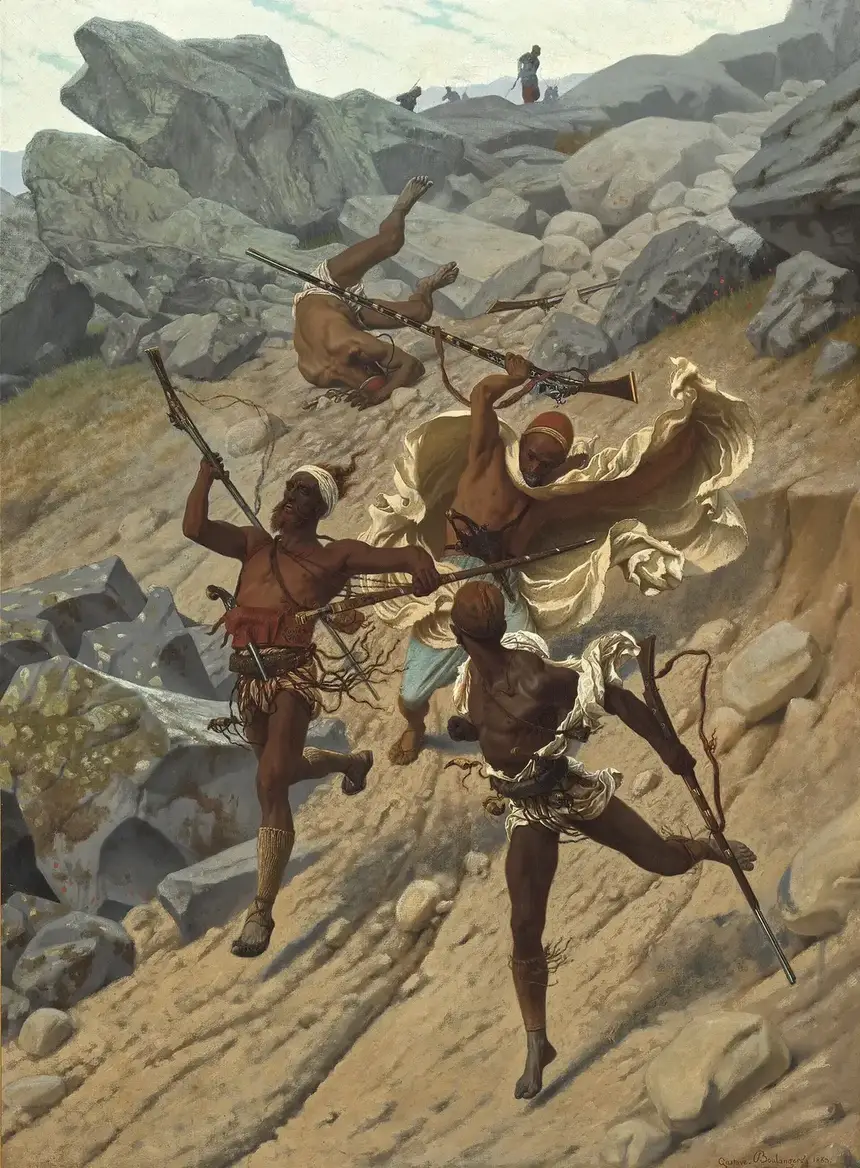
Nothing in la deroute des kabyles is centred for the sake of being centred; the weight sits where the painter wanted it.
Sunlight and shadow are two different temperatures here, not one colour at two strengths.
The darks are mixed, not blackened — black straight from the tube would kill the passage.
Edges are made by the brush, not by an outline, and they are the hardest thing to copy.
What takes time here is the number of separate decisions, not the size of the canvas.
It works best on a wall you pass rather than one you sit and stare at — the paint rewards a moving eye.
| Artist | Gustave Boulanger |
|---|---|
| Title | la deroute des kabyles |
| Created (original) | 1863 |
| Medium | Oil on canvas, hand-painted to order |
| Reproduction | Hand-painted oil on canvas, made to order |
| Public domain | Yes — the artist died over 70 years ago |
Hand-painted, not printed
The difference is not subtle when the two hang side by side. Ink sits on the surface; oil stands off it.
Paint goes on in the original's order — thin first, thick last — so the surface behaves the way the painter intended.
| Aspect | Hand-painted oil | Printed canvas |
|---|---|---|
| Value over time | Can be re-stretched, cleaned and re-framed | Little value beyond the print |
| Lifespan | Slow to change; varnish can be refreshed decades later | Fades and cracks sooner |
| Sense of depth | Real, created by layers of paint | Simulated by darker ink |
| Changing something | Tell us and the passage gets repainted | Usually means starting the file again |
| Edges | Chosen by the painter, passage by passage | Whatever the file happens to contain |
The passage that will take longest is the one that looks simplest.
Every canvas is painted to order, so the quote follows your size, frame and destination rather than a fixed list. Tell us what you need on WhatsApp and we reply with an exact figure, usually within the hour. You are talking to the people who will actually paint it, not a middleman.
How your painting is made
No two canvases are painted the same way, but the sequence is always this:
- The canvas is stretched and primed — cotton or linen, sized and ready before any paint goes near it.
- Laying in the drawing — done by eye from the reference, not traced or projected.
- The first colour pass — thin and simple, establishing the main shapes only.
- Setting the key — how dark the darks go determines everything that follows.
- Colour is built up — warmer and cooler versions of each passage, laid over the underpainting.
- Finishing passes — the loaded highlights go on at the end and stay there.
- It dries, then gets varnished — and only then is it photographed for you.
Matching the original's degree of finish is harder than matching its colours.
On framing
If you are shipping, an unframed canvas rolled in a tube is considerably cheaper to move than a framed one.
We can supply a simple floater frame, a traditional gilt, or nothing at all. It is your call.
Care and cleaning
Oil paint needs very little: no water, no cleaners, no sprays. A dry brush and a stable room.
What goes into it
The varnish is removable, so a conservator can clean the painting in fifty years without touching the paint. We use a neutral-sized ground so the whites stay warm rather than going blue over time.
The ground is a proper acrylic sizing, so the oil does not rot the fabric over time. We use cotton duck for most sizes and linen where the canvas is large or the client asks for it.
Canvas sizes
You are not choosing from a list; you are telling us a measurement. These are the common ones:
| Size (inches) | Size (cm) | Best for |
|---|---|---|
| 30 × 24 in | 76 × 61 cm | Dining room, bedroom feature wall |
| 24 × 20 in | 60 × 50 cm | Study, home office, above a desk |
| 20 × 16 in | 50 × 40 cm | Bedroom, hallway, above a console |
| 16 × 12 in | 40 × 30 cm | A shelf, a small wall, a gallery group |
| 64 × 48 in | 163 × 122 cm | Villa scale, lobby, hospitality wall |
Anything outside this table is fine — we paint to the number you give us. DAP terms: we pay the freight, you settle any duty or tax your country applies. We do not collect taxes on anyone's behalf.
A plain wall is better than a busy one; the painting supplies the interest.
Message us the dimensions you have in mind and we will come back with a figure.
💬 Get a Quote for la deroute des kabylesHow it reaches you
The painting takes 9–15 days, and delivery is priced separately on the quote so there is no surprise later.
In transit it is typically 7–10 business days by air, tracked door to door. Every shipment goes out with tracking. We do not send anything untracked.
Nothing ships before you have seen it. Photographs of the finished painting go to you first. Adjustments are part of the process. Say what you want different and it gets done.
Shipments go out DAP. If your customs office charges duty or tax on arrival, that is between you and them — we do not collect it and we do not put a number on it.
You pay a deposit to start and the remainder before shipping. Nothing is hidden in between. Report any transit damage within 48 hours with photographs and we will deal with the carrier. We will not promise a payout, but we will not leave you to argue alone either.
The practical questions
Can I get this in a size that is not listed?
Yes — the listed sizes are the common requests, not a limit. Very wide or unusually tall proportions are routine for us.
Does it come with a certificate of authenticity?
No, and we would be wary of anyone who issues one for a public-domain reproduction. What you receive is a hand-painted canvas and photographs of it before it ships.
How long does it take?
Painting takes 9–15 days. Air freight is usually 7–10 business days on top of that, tracked.
Does it come framed?
Frames are priced on their own line. Most clients choose after seeing the photographs.
Can I change the size?
Yes. The canvas is painted to your measurement, not taken from a stock list.
What does it cost?
Every canvas is quoted on size, frame and destination rather than a fixed list. Tell us what you need and we reply with an exact figure.
How do I hang it?
Roughly 145 cm from floor to centre works for most rooms. Tell us your wall and we will give you the measurement.
Can you paint it from a different photograph of the same work?
Send your own reference image and we will paint from that instead.
Do you take a deposit?
Work begins on a deposit and ships once the balance is paid. Nothing is charged that is not on the quote.
What if it arrives damaged?
Report damage within 48 hours with photographs. We deal with the carrier rather than leaving you to argue alone.
Do you ship to my country?
We ship to over 20 countries. Give us your city and the freight appears as its own line on the quote.