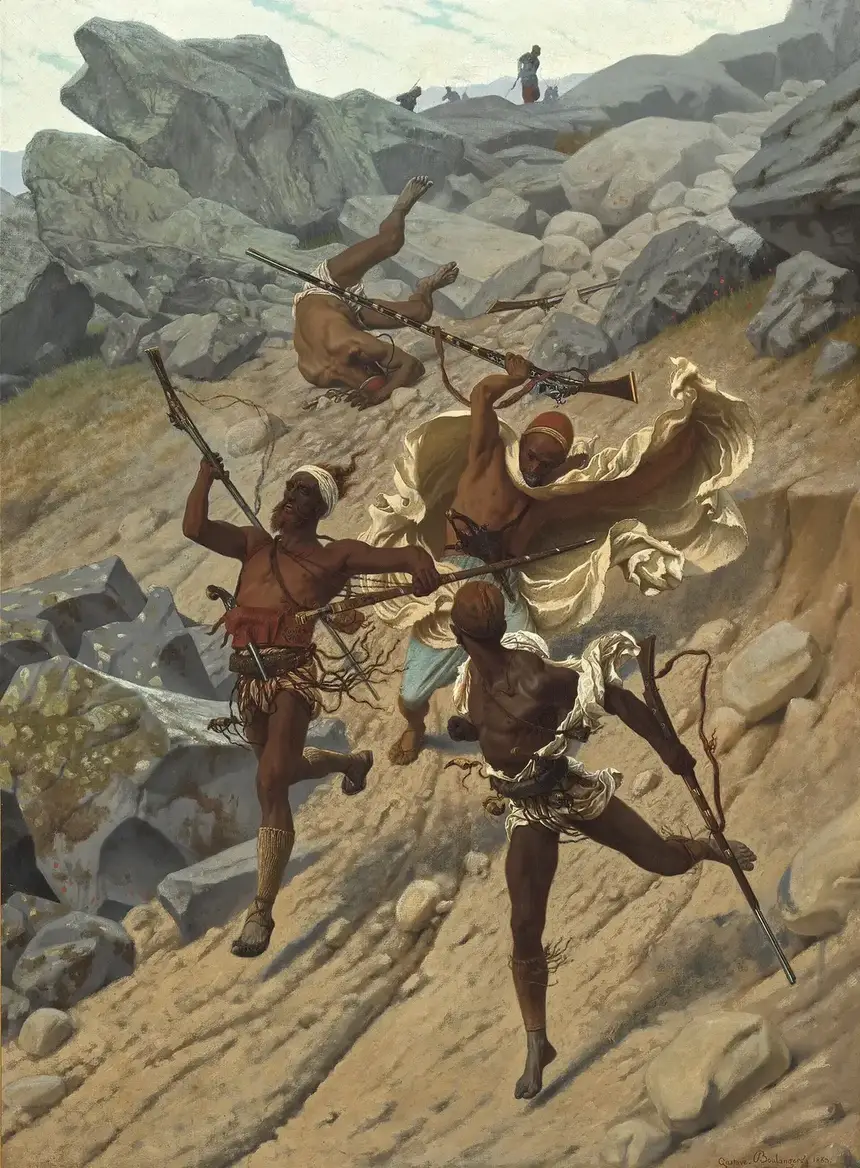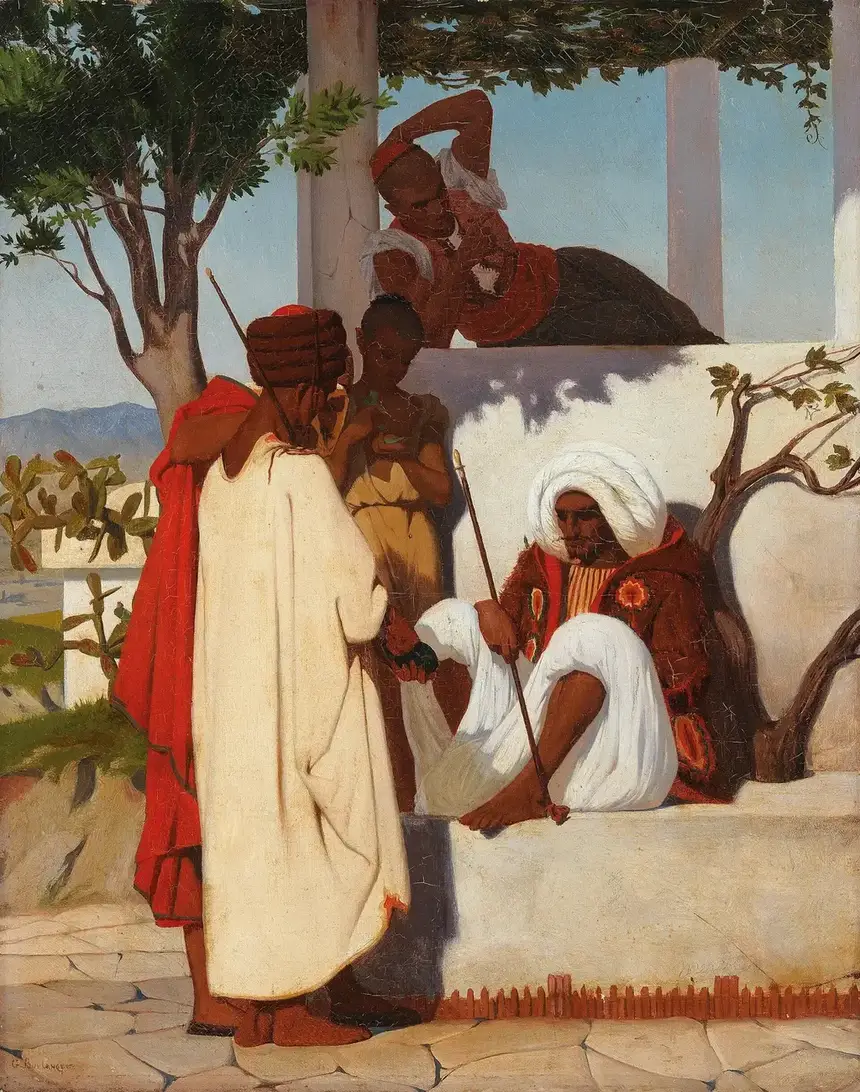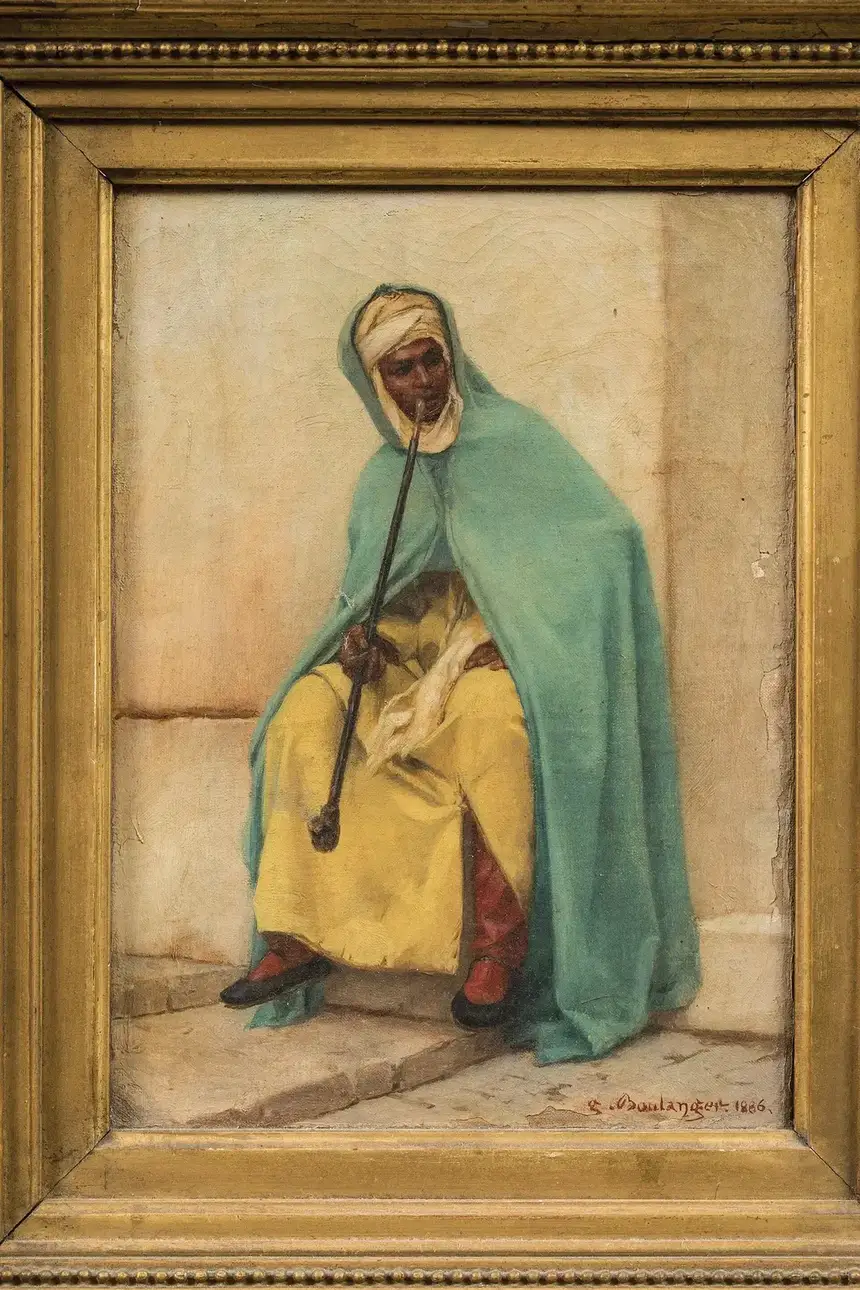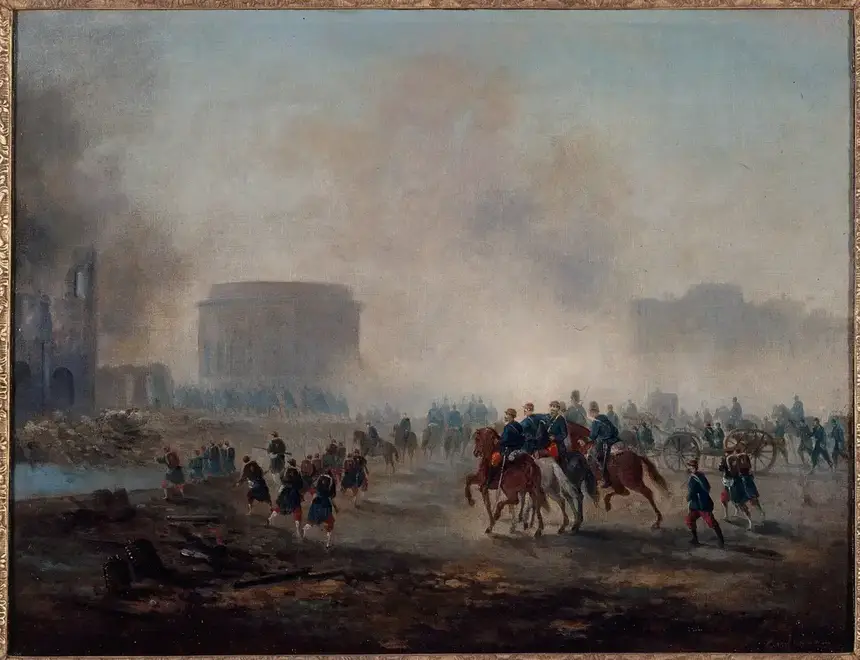
The original, and why we can paint it
Because Gustave Boulanger died in 1888, this work is in the public domain. We are painting a copy of a painting — we never pass it off as the original, and neither should anyone selling you one.
Every version we make is oil on canvas, painted by one painter from start to finish. No printing is involved at any stage.
The painting was made in the years before 1888, and what we reproduce is the record of it, not the object.
You are buying a painting, not a file. That distinction is the whole business we are in.
Looking at it properly
What makes a landscape worth painting by hand is the distance in it — the space between the near ground and the far one.
Depth here is a matter of edges: sharp in front, lost at the back. It is the hardest thing to print and the easiest to paint.
Where the source has light coming through the paint, we glaze rather than paint opaque white.
Our painter keeps the colour relationships rather than the exact hues, because relationships are what survive.
The brushwork is left visible, which is the whole argument for painting it by hand.
The difficult part is not the detail. It is keeping the whole canvas at the same stage of finish.
It is a picture for a room you use, not a corridor you walk through.
| Artist | Gustave Boulanger |
|---|---|
| Title | P1330079 Carnavalet |
| Created (original) | 1871 |
| Medium | Oil on canvas, hand-painted to order |
| Our version | Oil on canvas, painted by hand to order |
| Public domain | Yes — the artist died over 70 years ago |
Hand-painted, not printed
A print reproduces the shapes and drops the substance. It is the substance you are buying.
Edges are left soft where the form turns away and sharp where it does not. That single habit is what separates a painting from a copy.
| Aspect | Hand-painted oil | Printed canvas |
|---|---|---|
| Lifespan | Slow to change; varnish can be refreshed decades later | Fades and cracks sooner |
| Time to make | Days of one painter's working time | Minutes |
| Impasto | Real paint standing off the canvas | Flat ink, sometimes embossed to imitate |
| Value over time | Can be re-stretched, cleaned and re-framed | Little value beyond the print |
| Size | Any size, painted to your wall | Limited by the printer |
The passage that will take longest is the one that looks simplest.
Every canvas is painted to order, so the quote follows your size, frame and destination rather than a fixed list. Tell us what you need on WhatsApp and we reply with an exact figure, usually within the hour. You are talking to the people who will actually paint it, not a middleman.
How it gets painted
The order of work matters as much as the work itself. Ours runs like this:
- Stretching and priming the support — cotton duck or linen goes onto the bars and gets its ground.
- A loose underdrawing — proportions checked by eye against the source image.
- Blocking the masses — thin paint, working the whole surface rather than one corner at a time.
- The values are established — this is the stage that decides whether the painting works.
- Building the colour — a warm and a cool version of each passage, put down in order.
- Detail and highlights last — put on thickly and then not touched again.
- Left to dry before varnish — nothing is photographed or packed until the surface is ready.
The risk with a landscape is overworking, and the way to avoid it is knowing when to stop.
Looking after it
Dust it with a dry, soft brush. Keep it out of direct sun and away from radiators, and it will outlive you.
Canvas, paint and varnish
The varnish is removable, so a conservator can clean the painting in fifty years without touching the paint. Linen is worth the extra cost above about a metre across, because it holds tension better in humid rooms.
Nothing is sprayed, sealed or laminated. The surface you see is paint and varnish, and that is all. Brushes, knives and rags. That is the equipment list; there is no machine in the process.
Whether to frame it
A frame is a separate line on the quote, not a bundle. You choose it once the painting exists.
A frame is a separate line on the quote, not a bundle. You choose it once the painting exists.
What size works
Any size is possible. These are simply the ones that come up most often in quotes:
| Size (inches) | Size (cm) | Best for |
|---|---|---|
| 16 × 12 in | 40 × 30 cm | A shelf, a small wall, a gallery group |
| 64 × 48 in | 163 × 122 cm | Villa scale, lobby, hospitality wall |
| 48 × 36 in | 122 × 91 cm | Large living room, stairwell, loft |
| 40 × 30 in | 102 × 76 cm | Living room focal wall, above a sofa |
| 32 × 24 in | 81 × 61 cm | Living room, above a sideboard |
Anything outside this table is fine — we paint to the number you give us. Duties and import taxes are the buyer's account (DAP). Your customs authority sets them; we do not.
Given the subject, this sits naturally in a living room or a study rather than a hallway.
Message us the dimensions you have in mind and we will come back with a figure.
💬 Get a Quote for P1330079 Carnavalet Boulanger commune Villette P393 rwkTimeline and shipping
From order to finished canvas is 9–15 days. Freight appears as a separate line on the quote and is fixed before you pay.
Transit is usually 7–10 business days, tracked all the way. Unframed canvases are rolled face-out on a tube; framed ones are corner-protected and crated.
Before anything is packed, you get photographs of the actual canvas and a chance to ask for changes. If something is not right, tell us what to adjust and we adjust it.
DAP terms: we pay the freight, you settle any duty or tax your country applies. We do not collect taxes on anyone's behalf.
You pay a deposit to start and the remainder before shipping. Nothing is hidden in between. If a crate arrives damaged, send us photographs within 48 hours and contact us directly — we will sort it out with you.
The practical questions
How long does a hand-painted version take?
9–15 days of studio time, depending mostly on size and how much impasto the surface carries, then several more days for the oil to set before we photograph, pack and send.
Do you work from my own photograph?
Yes, though that is a separate service. This page is for a hand-painted version of {title}; for a photo-to-painting commission, send the image on WhatsApp.
What if my wall is an unusual shape?
That is normal for us. Send the measurements and we will work out a canvas proportion that suits the space.
Do you ship to my country?
We export to more than 20 countries. Tell us where you are and we will quote the freight as a separate line.
What if it arrives damaged?
send us photographs within 48 hours and contact us directly — we will sort it out with you.
Can you change the colours to suit my room?
Sometimes. We will adjust the palette if it can be done without ruining the picture, and say so if it cannot.
Does it come framed?
Frames are priced on their own line. Most clients choose after seeing the photographs.
How do I hang it?
Centre it at about 145 cm from the floor, or two-thirds the width of the furniture below it. We will tell you the exact number for your wall.
What does it cost?
There is no price list, because the number depends on your size and frame. Message us and we will quote exactly.
Is owning a reproduction legal?
Yes. Gustave Boulanger died more than 70 years ago, so the work is in the public domain and owning a hand-painted version is legal anywhere. We never pass ours off as the original.
Do you take a deposit?
A deposit starts the canvas and the balance falls due before it ships. Both figures appear on the quote.
Will I see it before it ships?
Yes — photographs of the actual painting go to you first, and nothing is packed until you have seen them.