What you are buying into
Gustave Guillaumet died in 1887, so the work has been in the public domain for decades. Reproducing it by hand is legal, and so is owning one.
We paint it in oil on canvas, one at a time, in Dafen Village. Nothing is printed, scanned or transferred.
The painting was made in the years before 1887, and what we reproduce is the record of it, not the object.
If you want something printed, we are the wrong workshop. We do not own a printer that touches canvas.
Where the painting lives
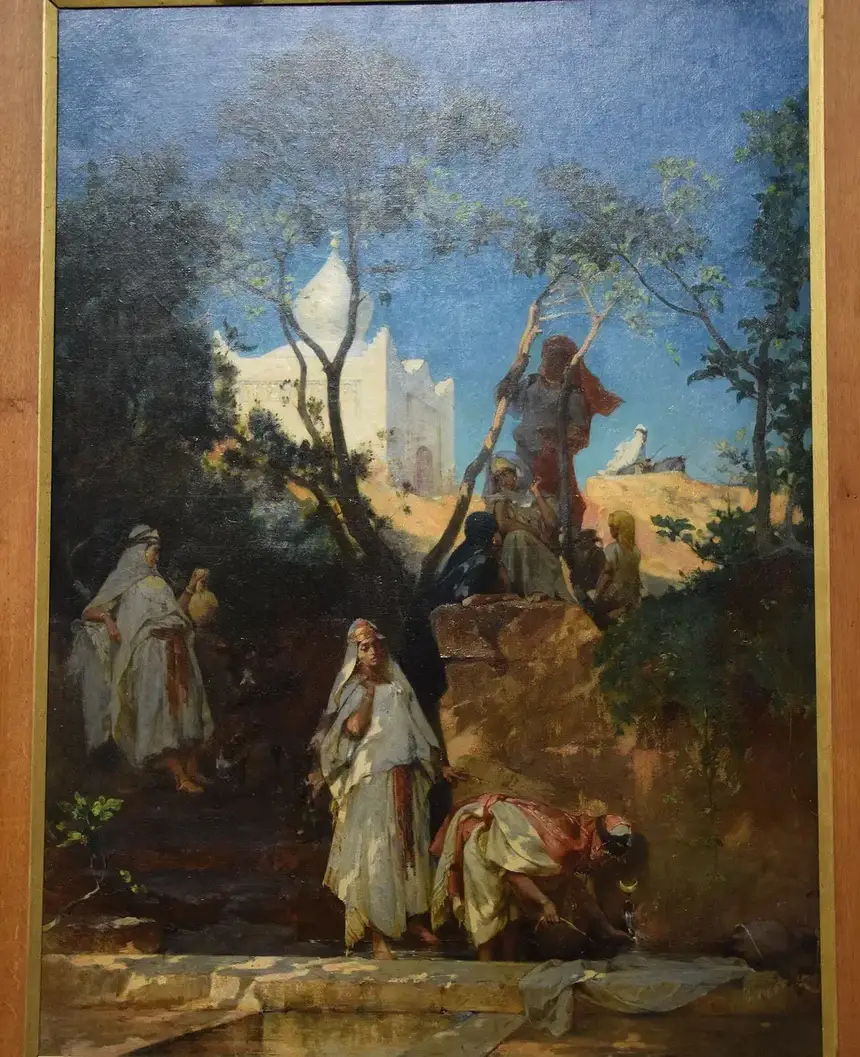
The reason Beni Fera Ferah, PPD still works as a painting is that it was built as paint, not as a picture of a place.
Space in a landscape is made with value, not perspective: things that are further away are painted cooler and weaker.
Light is handled as a value problem: how dark the darkest dark is determines the whole picture.
We keep the original's palette rather than brightening it, even where a modern eye would.
Nothing here is blended flat. Blending is what makes a painting look printed.
Getting Beni Fera Ferah, PPD right means painting it in the right order, and the order is not obvious.
Given the subject, this sits naturally in a living room or a study rather than a hallway.
| Artist | Gustave Guillaumet |
|---|---|
| Title | Beni Fera Ferah, PPD |
| Medium | Oil on canvas, hand-painted to order |
| What you receive | A hand-painted oil painting on canvas |
| Copyright | Public domain; the original is out of copyright |
What a print loses
The difference is not subtle when the two hang side by side. Ink sits on the surface; oil stands off it.
Paint goes on in the original's order — thin first, thick last — so the surface behaves the way the painter intended.
| Aspect | Hand-painted oil | Printed canvas |
|---|---|---|
| How it ages | Warms and settles; cleanable by a conservator | Fades, then cracks at the stretcher |
| Sense of depth | Real, created by layers of paint | Simulated by darker ink |
| What it takes | One painter, several days, start to finish | A machine, a few minutes |
| Later on | Can be restored, re-framed, handed on | Replaceable, and usually replaced |
| Edges | Chosen by the painter, passage by passage | Whatever the file happens to contain |
Matching the original's degree of finish is harder than matching its colours.
Pricing is worked out from three things — the canvas size, the amount of impasto you want, and framing. Send those on WhatsApp and we will quote, usually within the hour. You are talking to the people who will actually paint it, not a middleman.
How the canvas is built
Here is what actually happens between your message and the crate:
- Stretching and priming the support — cotton duck or linen goes onto the bars and gets its ground.
- The drawing goes down — charcoal or thin paint, done by eye rather than traced from a printout.
- The big shapes are blocked in — thin paint, one colour at a time, the whole canvas at once.
- Getting the values right — the stage that decides whether the finished painting holds together.
- Building the colour — a warm and a cool version of each passage, put down in order.
- Detail and highlights last — put on thickly and then not touched again.
- Left to dry before varnish — nothing is photographed or packed until the surface is ready.
The difficulty is restraint: leaving out most of what a photograph would show.
Care and cleaning
Once the varnish has cured the surface can be cleaned by a conservator, but in a normal house it will not need it for decades.
What it is made of
Varnish goes on only once the paint is properly dry, months after the last stroke, not before. We use a neutral-sized ground so the whites stay warm rather than going blue over time.
The varnish is removable, so a conservator can clean the painting in fifty years without touching the paint. Each painter works on one canvas at a time — the painting you ordered is not shared with another order.
On framing
A frame is a separate line on the quote, not a bundle. You choose it once the painting exists.
Framing is quoted separately, so you can decide after you have seen the finished canvas in photographs.
What size works
You are not choosing from a list; you are telling us a measurement. These are the common ones:
| Size (inches) | Size (cm) | Best for |
|---|---|---|
| 24 × 20 in | 60 × 50 cm | Study, home office, above a desk |
| 20 × 16 in | 50 × 40 cm | Bedroom, hallway, above a console |
| 16 × 12 in | 40 × 30 cm | A shelf, a small wall, a gallery group |
| 64 × 48 in | 163 × 122 cm | Villa scale, lobby, hospitality wall |
| 48 × 36 in | 122 × 91 cm | Large living room, stairwell, loft |
| 40 × 30 in | 102 × 76 cm | Living room focal wall, above a sofa |
If your wall is an odd shape, send the measurement and we will work to it. Proportions from the original are kept unless you ask us to change them. Import charges, where they exist, are the buyer's responsibility (DAP). We never add them to the quote and never guess what they will be.
This reads well above a sofa or a sideboard, where it will be seen from two to three metres.
Message us the dimensions you have in mind and we will come back with a figure.
💬 Get a Quote for Beni Fera Ferah, PPDOrder, painting, shipping
Painting takes 9–15 days. Freight is quoted as its own line on the quote, agreed before you pay anything, and never added afterwards.
In transit it is typically 7–10 business days by air, tracked door to door. Every shipment goes out with tracking. We do not send anything untracked.
Nothing ships before you have seen it. Photographs of the finished painting go to you first. If something is not right, tell us what to adjust and we adjust it.
We quote DAP, so any duty or tax your country charges is settled by you at import. We do not add a tax line of our own.
A deposit starts the canvas and books the painter's time; the balance is due before the crate leaves. Report any transit damage within 48 hours with photographs and we will deal with the carrier. We will not promise a payout, but we will not leave you to argue alone either.
Questions worth asking
What size should I order?
You choose the size. Each canvas is cut to your measurements rather than pulled from stock, so tell us the wall dimensions and we will tell you what proportion works.
How do I clean and care for it?
Dust lightly with a dry, soft brush and keep it out of direct sun. Nothing else is needed for decades; oil paint is slow to change and easy to live with.
When will it actually arrive?
Studio time is 9–15 days, then a few more days for the oil to set before we can photograph and pack it. We tell you where your canvas is at each stage.
Will I see it before it ships?
Yes. We send photographs of the finished canvas and wait for your reply before packing.
Is owning a reproduction legal?
Yes. Gustave Guillaumet died more than 70 years ago, so the work is in the public domain and owning a hand-painted version is legal anywhere. We never pass ours off as the original.
How long does it take?
From order to finished canvas is 9–15 days; delivery adds about 7–10 business days by air.
What does it cost?
Every canvas is quoted on size, frame and destination rather than a fixed list. Tell us what you need and we reply with an exact figure.
What is the canvas made of?
Cotton or linen, oil colour, and varnish. Stretcher bars are wedged so the canvas can be re-tensioned later.
Can you paint a different work by Gustave Guillaumet?
Yes — send us the image, or look through the other Gustave Guillaumet works on the site.
Is it really painted by hand?
Yes. One painter, oil paint, brushes. We do not own a printer that touches canvas.
How do I hang it?
Roughly 145 cm from floor to centre works for most rooms. Tell us your wall and we will give you the measurement.
Does it come framed?
Framing is quoted separately, so you can decide once you have seen the finished painting in photographs.