What you are buying into
Henri-Edmond Cross died in 1910. That puts the painting well outside copyright, which is why we can paint it and you can own it anywhere in the world.
Ours is a painting made with brushes. There is no giclée, no canvas transfer and no digital underlayer anywhere in the process.
The painting was made in the years before 1910, and what we reproduce is the record of it, not the object.
What arrives is a canvas with paint on it, made by a person. That is the only thing we sell.
How to read it
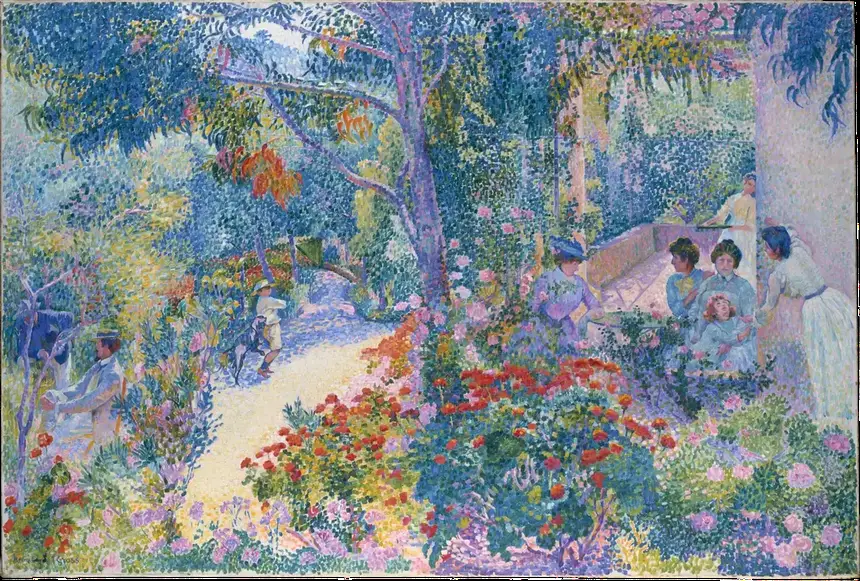
Painted by hand, Afternoon in the Garden keeps the hesitation in the brushwork that gives the place its scale.
We keep the original proportions rather than cropping to a standard frame, so an unusually wide composition stays honest.
We do not brighten the picture for reproduction. The original's key is kept as it is.
Every colour in Afternoon in the Garden has a warm version and a cool version, and the painter chooses between them passage by passage.
Paint is laid on, not pushed around. That is what keeps it fresh.
The risk with a garden scene is overworking, and the way to avoid it is knowing when to stop.
It wants a wall where the light rakes across it, because the surface is part of the picture.
| Artist | Henri-Edmond Cross |
|---|---|
| Title | Afternoon in the Garden |
| Medium | Oil on canvas, hand-painted to order |
| Reproduction | Hand-painted oil on canvas, made to order |
| Copyright | Public domain; the original is out of copyright |
Why this one cannot be printed
A print reproduces the shapes and drops the substance. It is the substance you are buying.
Where the original is loaded, ours is loaded. Where it is thin, ours is thin. Matching the weight of the paint matters more than matching the colour.
| Aspect | Hand-painted oil | Printed canvas |
|---|---|---|
| Lifespan | Slow to change; varnish can be refreshed decades later | Fades and cracks sooner |
| Later on | Can be restored, re-framed, handed on | Replaceable, and usually replaced |
| Surface | Hand-painted oil on canvas | Ink on canvas, flat |
| Depth | Built in layers, catches light from the side | Flat; highlights are printed as pale ink |
| Corrections | We adjust it and repaint the passage | The file is reprinted or it is not |
The difficulty is restraint: leaving out most of what a photograph would show.
Every canvas is painted to order, so the quote follows your size, frame and destination rather than a fixed list. Tell us what you need on WhatsApp and we reply with an exact figure, usually within the hour. No resellers, no drop-shipper. The painter's studio handles your commission from first message to final crate.
How the canvas is built
This is how the painting is built, in the order our painters build it:
- We start with the canvas itself — stretched, sized and left to settle before any colour is mixed.
- The drawing goes down — charcoal or thin paint, done by eye rather than traced from a printout.
- The first colour pass — thin and simple, establishing the main shapes only.
- The values are established — this is the stage that decides whether the painting works.
- The colour passes — each area gets its own mixture rather than one colour used throughout.
- Finishing passes — the loaded highlights go on at the end and stay there.
- Drying and varnishing — the final varnish goes on once the paint has set, before we photograph it.
Anyone can copy the shapes. The skill is in the transitions, and that is what takes the days.
Framing
Framing is quoted separately, so you can decide after you have seen the finished canvas in photographs.
Most clients wait for the photographs before choosing a frame, which is the sensible order.
Living with it
Once the varnish has cured the surface can be cleaned by a conservator, but in a normal house it will not need it for decades.
Canvas, paint and varnish
The ground is a proper acrylic sizing, so the oil does not rot the fabric over time. Varnish goes on only once the paint is properly dry, months after the last stroke, not before.
The paint is built in layers, fat over lean, which is what stops it cracking later. Brushes, knives and rags. That is the equipment list; there is no machine in the process.
Sizing it
The canvas is cut to your wall, not the other way round. For reference, these are the dimensions most often requested:
| Size (inches) | Size (cm) | Best for |
|---|---|---|
| 64 × 48 in | 163 × 122 cm | Villa scale, lobby, hospitality wall |
| 48 × 36 in | 122 × 91 cm | Large living room, stairwell, loft |
| 40 × 30 in | 102 × 76 cm | Living room focal wall, above a sofa |
| 32 × 24 in | 81 × 61 cm | Living room, above a sideboard |
| 30 × 24 in | 76 × 61 cm | Dining room, bedroom feature wall |
| 24 × 20 in | 60 × 50 cm | Study, home office, above a desk |
Tell us the wall width and we will tell you what looks right rather than what is standard. Terms are DAP. Import duties and taxes, where they apply, are paid by the buyer on arrival — we never collect them in advance and never guess at the amount.
For a stairwell or a double-height space, go larger than you think — the composition was built for distance.
Give us your size and framing preference and you will have a quote shortly.
💬 Get a Quote for Afternoon in the GardenFrom order to your wall
Allow 9–15 days for the painting itself. Shipping is a separate line on your quote — you see it before payment, not after.
Transit is usually 7–10 business days, tracked all the way. Every shipment goes out with tracking. We do not send anything untracked.
Before anything is packed, you get photographs of the actual canvas and a chance to ask for changes. Changes are handled by telling us what to change; we change it and send new photographs.
Duties and import taxes are the buyer's account (DAP). Your customs authority sets them; we do not.
You pay a deposit to start and the remainder before shipping. Nothing is hidden in between. If a crate arrives damaged, send us photographs within 48 hours and contact us directly — we will sort it out with you.
What people ask us
Will the dark passages look muddy?
That is the main risk in a night painting and the reason it cannot be printed. The painter mixes darks from colour rather than reaching for black, which keeps them transparent instead of dead.
What happens after I message you?
You tell us the painting, size and whether you want a frame. We quote, a painter starts on your canvas, and you get photographs before it ships.
Can I see progress photos while it is being painted?
We send photographs of the finished painting for approval before it ships. Mid-process images are not part of the standard workflow.
Do you ship to my country?
We ship to over 20 countries. Give us your city and the freight appears as its own line on the quote.
What does it cost?
There is no price list, because the number depends on your size and frame. Message us and we will quote exactly.
How long does it take?
Allow 9–15 days for the painting itself, then roughly 7–10 business days in transit.
Can you paint a different work by Henri-Edmond Cross?
Yes — send us the image, or look through the other Henri-Edmond Cross works on the site.
How do I hang it?
Centre it at about 145 cm from the floor, or two-thirds the width of the furniture below it. We will tell you the exact number for your wall.
Do you sell prints?
No prints at all — no giclée, no canvas transfer, nothing machine-made.
What is the canvas made of?
Cotton or linen, oil colour, and varnish. Stretcher bars are wedged so the canvas can be re-tensioned later.
Is owning a reproduction legal?
Yes. Henri-Edmond Cross died more than 70 years ago, so the work is in the public domain and owning a hand-painted version is legal anywhere. We never pass ours off as the original.
Is it really painted by hand?
Yes. One painter, oil paint, brushes. We do not own a printer that touches canvas.