The original, and why we can paint it
Because János Vaszary died in 1939, this work is in the public domain. We are painting a copy of a painting — we never pass it off as the original, and neither should anyone selling you one.
Every version we make is oil on canvas, painted by one painter from start to finish. No printing is involved at any stage.
The painting was made in the years before 1939, and what we reproduce is the record of it, not the object.
You are buying a painting, not a file. That distinction is the whole business we are in.
Looking at it properly
Our painter works from the reference the way the original painter worked from the motif: in passes, thin first, loaded last.
The structure is simple and the interest is in the surface, which is the hardest combination to reproduce.
Our painter keeps the original's key rather than brightening the picture for reproduction.
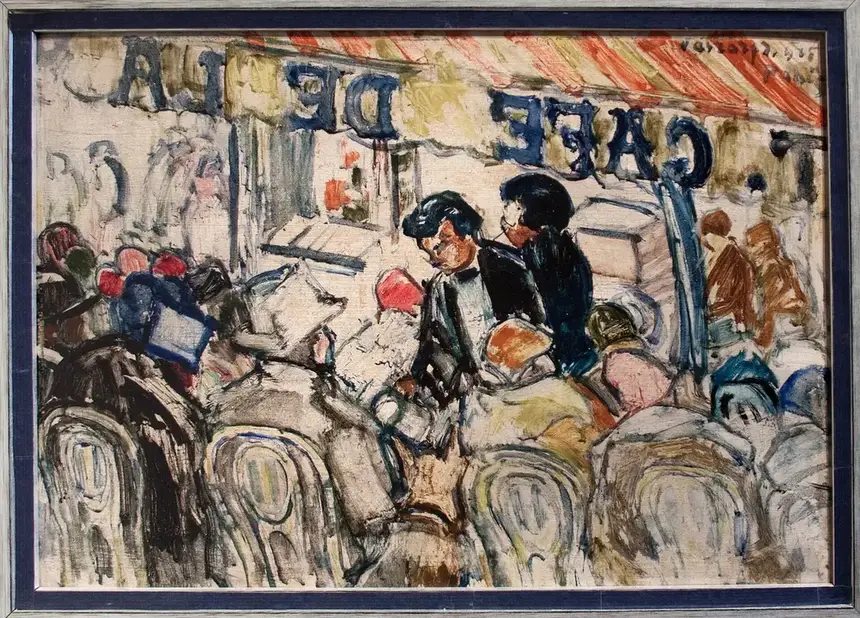
Every colour in Terrace of the Cafe de la Paix, Paris has a warm version and a cool version, and the painter chooses between them passage by passage.
The marks have a direction, and the direction follows the form.
The risk with a figure subject is overworking, and the way to avoid it is knowing when to stop.
In a bedroom it works above a headboard, sized to about two-thirds of the furniture width.
| Artist | János Vaszary |
|---|---|
| Title | Terrace of the Cafe de la Paix, Paris |
| Created (original) | 1925 |
| Medium | Oil on canvas, hand-painted to order |
| Our version | Oil on canvas, painted by hand to order |
| Original status | Public domain (artist deceased) |
The case for painting it by hand
What you lose in a print is the air. A press lays ink flat; a painter builds depth in layers, and the depth is what you actually see.
Edges are left soft where the form turns away and sharp where it does not. That single habit is what separates a painting from a copy.
| Aspect | Hand-painted oil | Printed canvas |
|---|---|---|
| Available sizes | Whatever you need, painted to order | What the printer can output |
| Edges | Chosen by the painter, passage by passage | Whatever the file happens to contain |
| Texture | Ridges and drag you can see from across a room | None, or a printed imitation of it |
| Value over time | Can be re-stretched, cleaned and re-framed | Little value beyond the print |
| Changing something | Tell us and the passage gets repainted | Usually means starting the file again |
This one repaints badly, so our painter gets the values right early and leaves them.
Every canvas is painted to order, so the quote follows your size, frame and destination rather than a fixed list. Tell us what you need on WhatsApp and we reply with an exact figure, usually within the hour. You are buying from the workshop, not a catalogue.
How it gets painted
No two canvases are painted the same way, but the sequence is always this:
- Stretching and priming the support — cotton duck or linen goes onto the bars and gets its ground.
- A loose underdrawing — proportions checked by eye against the source image.
- Blocking the masses — thin paint, working the whole surface rather than one corner at a time.
- The values are established — this is the stage that decides whether the painting works.
- Building the colour — a warm and a cool version of each passage, put down in order.
- Finishing passes — the loaded highlights go on at the end and stay there.
- Drying and varnishing — the final varnish goes on once the paint has set, before we photograph it.
Matching the original's degree of finish is harder than matching its colours.
Canvas, paint and varnish
We use cotton duck for most sizes and linen where the canvas is large or the client asks for it. Each painter works on one canvas at a time — the painting you ordered is not shared with another order.
Oil paint dries by oxidation, not evaporation, which is why a finished canvas needs weeks before it travels. Stretcher bars are kiln-dried and wedged, so the canvas can be re-tensioned years later.
On framing
Frames are priced once you have chosen them, not estimated in advance.
Framing is quoted separately, so you can decide after you have seen the finished canvas in photographs.
Living with it
Dust it with a dry, soft brush. Keep it out of direct sun and away from radiators, and it will outlive you.
Canvas sizes
Any size is possible. These are simply the ones that come up most often in quotes:
| Size (inches) | Size (cm) | Best for |
|---|---|---|
| 32 × 24 in | 81 × 61 cm | Living room, above a sideboard |
| 30 × 24 in | 76 × 61 cm | Dining room, bedroom feature wall |
| 24 × 20 in | 60 × 50 cm | Study, home office, above a desk |
| 20 × 16 in | 50 × 40 cm | Bedroom, hallway, above a console |
If your wall is an odd shape, send the measurement and we will work to it. Proportions from the original are kept unless you ask us to change them. Terms are DAP. Import duties and taxes, where they apply, are paid by the buyer on arrival — we never collect them in advance and never guess at the amount.
A plain wall is better than a busy one; the painting supplies the interest.
Tell us the size and frame — exact quote back, usually within the hour.
💬 Get a Quote for Terrace of the Cafe de la Paix, ParisHow it reaches you
From order to finished canvas is 9–15 days. Freight appears as a separate line on the quote and is fixed before you pay.
Expect 7–10 business days in transit, with tracking from our door to yours. Every shipment goes out with tracking. We do not send anything untracked.
You approve the painting from photographs before it is packed — that is the checkpoint. If something is not right, tell us what to adjust and we adjust it.
Shipments go out DAP. If your customs office charges duty or tax on arrival, that is between you and them — we do not collect it and we do not put a number on it.
You pay a deposit to start and the remainder before shipping. Nothing is hidden in between. Report any transit damage within 48 hours with photographs and we will deal with the carrier. We will not promise a payout, but we will not leave you to argue alone either.
The practical questions
How do I know what size will look right?
Measure the wall and send a photograph. We will say honestly if the canvas you have in mind is too small for the space, which is the most common mistake.
How close will it be to the original?
The composition, colour and drawing follow the original closely; the brushwork carries the painter's own hand. The painter works freehand on a blank canvas, following the same logic as the original rather than copying a photograph.
What if my wall is an unusual shape?
That is normal for us. Send the measurements and we will work out a canvas proportion that suits the space.
Do you take a deposit?
Work begins on a deposit and ships once the balance is paid. Nothing is charged that is not on the quote.
Can you change the colours to suit my room?
Sometimes. We will adjust the palette if it can be done without ruining the picture, and say so if it cannot.
Who pays the import duty?
You do. We sell DAP, so any duty or tax your customs authority charges is settled by you at import. We do not collect it and we do not estimate it.
Do you sell prints?
No. Hand-painted oil on canvas only. No printing, no giclée, no canvas transfer.
Do you ship to my country?
We ship to over 20 countries. Give us your city and the freight appears as its own line on the quote.
Does it come framed?
Frames are priced on their own line. Most clients choose after seeing the photographs.
Will I see it before it ships?
Yes. We send photographs of the finished canvas and wait for your reply before packing.
How do I hang it?
Roughly 145 cm from floor to centre works for most rooms. Tell us your wall and we will give you the measurement.
What is the canvas made of?
Cotton or linen, oil colour, and varnish. Stretcher bars are wedged so the canvas can be re-tensioned later.