What you are buying into
Juan Gris died in 1927, so the work has been in the public domain for decades. Reproducing it by hand is legal, and so is owning one.
Ours is a painting made with brushes. There is no giclée, no canvas transfer and no digital underlayer anywhere in the process.
The painting was made in the years before 1927, and what we reproduce is the record of it, not the object.
You are buying a painting, not a file. That distinction is the whole business we are in.
Where the painting lives
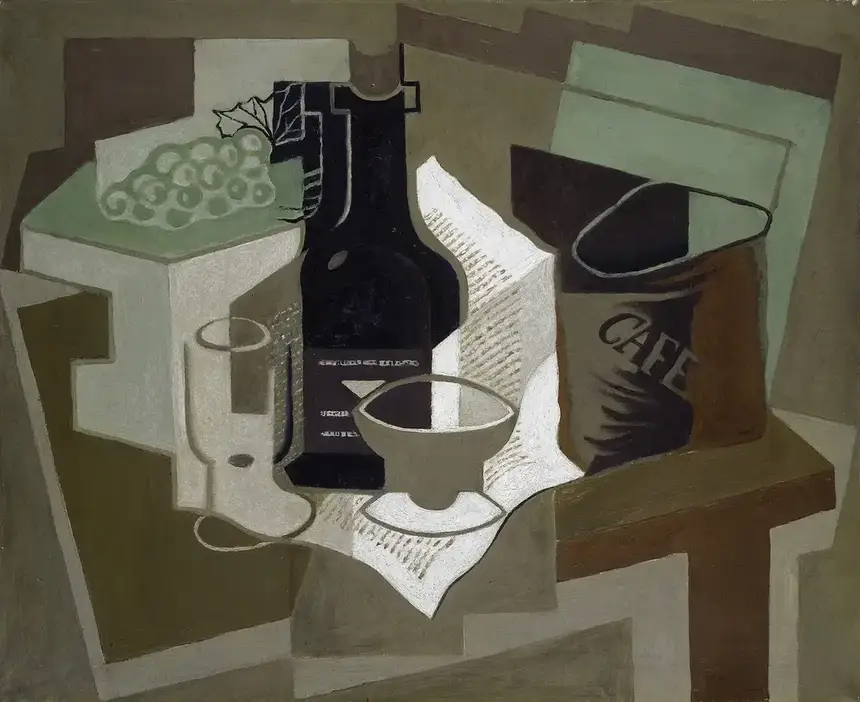
Le sac de café depends on warm and cool shifting across the same surface. Ink cannot do that; oil can.
Value does the modelling: the figure separates from the ground because it is lighter or darker, not because it is outlined.
The shadow side is painted with warm reflected light, not with black.
Whites here are never white. They are warm or cool depending on the light, and that is what makes them read.
Edges are made by the brush, not by an outline, and they are the hardest thing to copy.
Getting Le sac de café right means painting it in the right order, and the order is not obvious.
It is a picture for a room you use, not a corridor you walk through.
| Artist | Juan Gris |
|---|---|
| Title | Le sac de café |
| Created (original) | 1920 |
| Medium | Oil on canvas, hand-painted to order |
| Reproduction | Hand-painted oil on canvas, made to order |
| Copyright | Public domain; the original is out of copyright |
Why hand-painting matters here
A print reproduces the shapes and drops the substance. It is the substance you are buying.
Paint goes on in the original's order — thin first, thick last — so the surface behaves the way the painter intended.
| Aspect | Hand-painted oil | Printed canvas |
|---|---|---|
| Size | Any size, painted to your wall | Limited by the printer |
| Changing something | Tell us and the passage gets repainted | Usually means starting the file again |
| Edge quality | Soft where the form turns, sharp where it does not | Uniformly sharp or uniformly blurred |
| Handling of colour | Mixed on the palette and finished on the canvas | Fixed by the colour profile |
| Surface | Hand-painted oil on canvas | Ink on canvas, flat |
The risk with a figure subject is overworking, and the way to avoid it is knowing when to stop.
Every canvas is painted to order, so the quote follows your size, frame and destination rather than a fixed list. Tell us what you need on WhatsApp and we reply with an exact figure, usually within the hour. No resellers, no drop-shipper. The painter's studio handles your commission from first message to final crate.
How your painting is made
The order of work matters as much as the work itself. Ours runs like this:
- Stretching and priming the support — cotton duck or linen goes onto the bars and gets its ground.
- The drawing goes down — charcoal or thin paint, done by eye rather than traced from a printout.
- The first colour pass — thin and simple, establishing the main shapes only.
- Setting the key — how dark the darks go determines everything that follows.
- Colour is built up — warmer and cooler versions of each passage, laid over the underpainting.
- Detail and highlights last — put on thickly and then not touched again.
- Drying and varnishing — the final varnish goes on once the paint has set, before we photograph it.
The difficult part is not the detail. It is keeping the whole canvas at the same stage of finish.
Looking after it
Once the varnish has cured the surface can be cleaned by a conservator, but in a normal house it will not need it for decades.
Materials
The paint is built in layers, fat over lean, which is what stops it cracking later. Oil paint dries by oxidation, not evaporation, which is why a finished canvas needs weeks before it travels.
We buy pigment in tubes from the same suppliers the village has used for years, not in bulk drums. Varnish goes on only once the paint is properly dry, months after the last stroke, not before.
On framing
Frames are priced once you have chosen them, not estimated in advance.
We can supply a simple floater frame, a traditional gilt, or nothing at all. It is your call.
Sizing it
The canvas is cut to your wall, not the other way round. For reference, these are the dimensions most often requested:
| Size (inches) | Size (cm) | Best for |
|---|---|---|
| 64 × 48 in | 163 × 122 cm | Villa scale, lobby, hospitality wall |
| 48 × 36 in | 122 × 91 cm | Large living room, stairwell, loft |
| 40 × 30 in | 102 × 76 cm | Living room focal wall, above a sofa |
| 32 × 24 in | 81 × 61 cm | Living room, above a sideboard |
| 30 × 24 in | 76 × 61 cm | Dining room, bedroom feature wall |
| 24 × 20 in | 60 × 50 cm | Study, home office, above a desk |
We will size the canvas to the room, not to a stock list. Send us the measurement. DAP terms: we pay the freight, you settle any duty or tax your country applies. We do not collect taxes on anyone's behalf.
It wants a wall where the light rakes across it, because the surface is part of the picture.
Give us your size and framing preference and you will have a quote shortly.
💬 Get a Quote for Le sac de caféGetting it to you
Allow 9–15 days for the painting itself. Shipping is a separate line on your quote — you see it before payment, not after.
Air freight runs about 7–10 business days, tracked, to your door. Unframed canvases are rolled face-out on a tube; framed ones are corner-protected and crated.
Before anything is packed, you get photographs of the actual canvas and a chance to ask for changes. Changes are handled by telling us what to change; we change it and send new photographs.
We sell DAP: the price covers the painting and the freight, and any import duties or taxes are the buyer's to settle with customs. We do not collect them and we do not estimate them.
You pay a deposit to start and the remainder before shipping. Nothing is hidden in between. Damage in transit should be reported to us within 48 hours, with photographs. We pursue it with the carrier rather than promising a refund.
What people ask us
Does it come with a certificate of authenticity?
No, and we would be wary of anyone who issues one for a public-domain reproduction. What you receive is a hand-painted canvas and photographs of it before it ships.
Can I see progress photos while it is being painted?
We send photographs of the finished painting for approval before it ships. Mid-process images are not part of the standard workflow.
What happens after I message you?
You tell us the painting, size and whether you want a frame. We quote, a painter starts on your canvas, and you get photographs before it ships.
Does it come framed?
Framing is quoted separately, so you can decide once you have seen the finished painting in photographs.
What does it cost?
Every canvas is quoted on size, frame and destination rather than a fixed list. Tell us what you need and we reply with an exact figure.
What is the canvas made of?
Cotton or linen, oil colour, and varnish. Stretcher bars are wedged so the canvas can be re-tensioned later.
Is owning a reproduction legal?
Yes. Juan Gris died more than 70 years ago, so the work is in the public domain and owning a hand-painted version is legal anywhere. We never pass ours off as the original.
Who pays the import duty?
The buyer does. Terms are DAP: duties and taxes, where they apply, are paid on arrival. We never add a tax line of our own.
Can I change the size?
Yes. The canvas is painted to your measurement, not taken from a stock list.
Can you paint it from a different photograph of the same work?
Send your own reference image and we will paint from that instead.
Will I see it before it ships?
Yes. We send photographs of the finished canvas and wait for your reply before packing.
How do I hang it?
Centre it at about 145 cm from the floor, or two-thirds the width of the furniture below it. We will tell you the exact number for your wall.