The original, and why we can paint it
Juan Gris died in 1927. That puts the painting well outside copyright, which is why we can paint it and you can own it anywhere in the world.
Ours is a painting made with brushes. There is no giclée, no canvas transfer and no digital underlayer anywhere in the process.
It is an original composition painted before 1927, and our version is painted from the surviving image of it.
You are buying a painting, not a file. That distinction is the whole business we are in.
How to read it
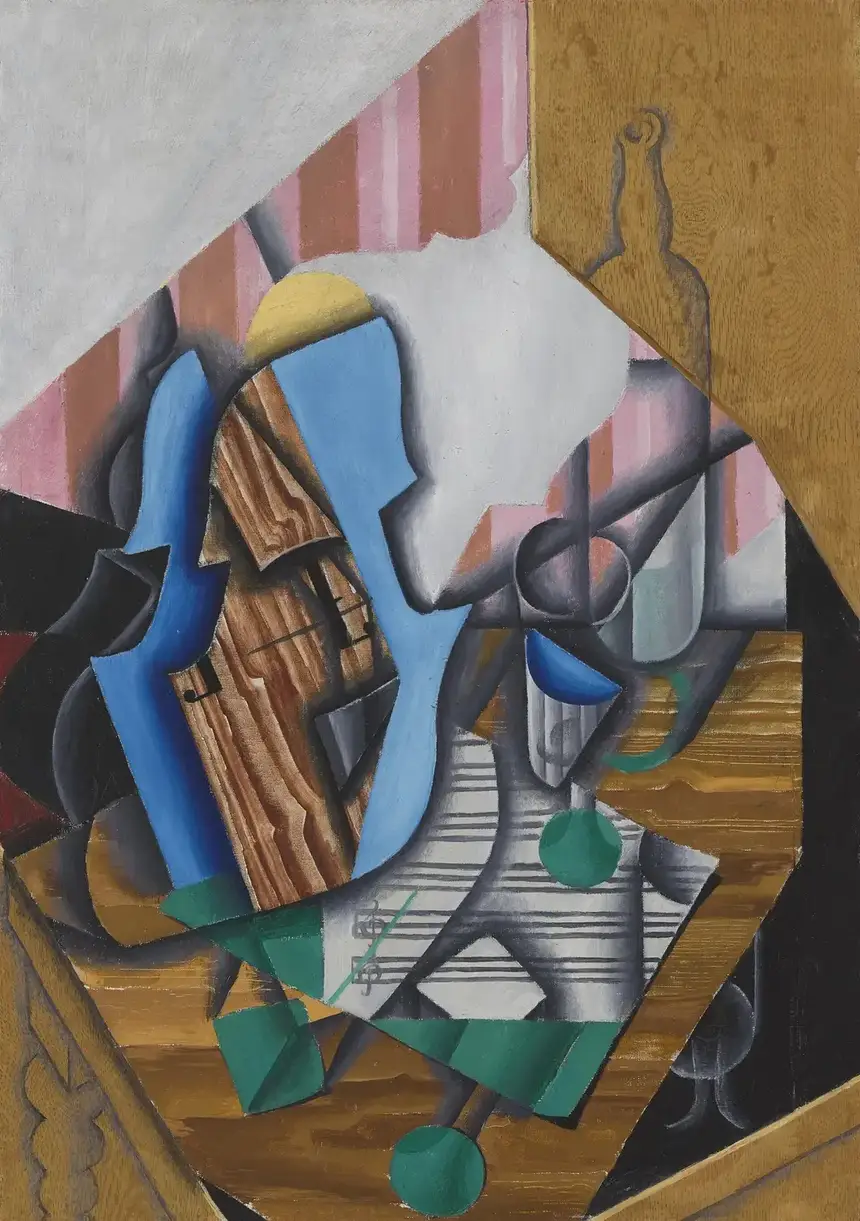
Still Life with Violin and Music Sheet was painted wet into wet in places and left to dry in others. We follow the same order.
Our painter keeps the background thin and worked wet, so it stays behind the objects.
Our painter paints the cast shadows first, so the objects sit down.
Saturated colour is kept for a small area; the rest is deliberately knocked back.
The brushwork is left visible, which is the whole argument for painting it by hand.
Anyone can copy the shapes. The skill is in the transitions, and that is what takes the days.
This reads well above a sofa or a sideboard, where it will be seen from two to three metres.
| Artist | Juan Gris |
|---|---|
| Title | Still Life with Violin and Music Sheet |
| Created (original) | 1914 |
| Medium | Oil on canvas, hand-painted to order |
| How it is made | Painted by hand in oil on canvas, to your size |
| Copyright | Public domain; the original is out of copyright |
What a print loses
The difference is not subtle when the two hang side by side. Ink sits on the surface; oil stands off it.
Our painter follows the same logic rather than copying a photograph of it: the far distances go down cool and weak, the near ground stays loaded, and nothing is blended flat.
| Aspect | Hand-painted oil | Printed canvas |
|---|---|---|
| Colour | Mixed for each passage, warm and cool versions | One flat value per area |
| Time to make | Days of one painter's working time | Minutes |
| Later on | Can be restored, re-framed, handed on | Replaceable, and usually replaced |
| Corrections | We adjust it and repaint the passage | The file is reprinted or it is not |
| The surface | Built up with brushes and knives | Printed flat in one pass |
Matching the original's degree of finish is harder than matching its colours.
Every canvas is painted to order, so the quote follows your size, frame and destination rather than a fixed list. Tell us what you need on WhatsApp and we reply with an exact figure, usually within the hour. You are buying from the workshop, not a catalogue.
From blank canvas to finished painting
No two canvases are painted the same way, but the sequence is always this:
- The canvas is stretched and primed — cotton or linen, sized and ready before any paint goes near it.
- The drawing goes down — charcoal or thin paint, done by eye rather than traced from a printout.
- The big shapes are blocked in — thin paint, one colour at a time, the whole canvas at once.
- Setting the key — how dark the darks go determines everything that follows.
- The colour passes — each area gets its own mixture rather than one colour used throughout.
- Finishing passes — the loaded highlights go on at the end and stay there.
- Drying and varnishing — the final varnish goes on once the paint has set, before we photograph it.
This one repaints badly, so our painter gets the values right early and leaves them.
On framing
A frame is a separate line on the quote, not a bundle. You choose it once the painting exists.
Most clients wait for the photographs before choosing a frame, which is the sensible order.
Care and cleaning
Oil paint needs very little: no water, no cleaners, no sprays. A dry brush and a stable room.
What goes into it
Nothing is sprayed, sealed or laminated. The surface you see is paint and varnish, and that is all. The varnish is removable, so a conservator can clean the painting in fifty years without touching the paint.
Linen is worth the extra cost above about a metre across, because it holds tension better in humid rooms. The ground is a proper acrylic sizing, so the oil does not rot the fabric over time.
Canvas sizes
You are not choosing from a list; you are telling us a measurement. These are the common ones:
| Size (inches) | Size (cm) | Best for |
|---|---|---|
| 40 × 30 in | 102 × 76 cm | Living room focal wall, above a sofa |
| 32 × 24 in | 81 × 61 cm | Living room, above a sideboard |
| 30 × 24 in | 76 × 61 cm | Dining room, bedroom feature wall |
| 24 × 20 in | 60 × 50 cm | Study, home office, above a desk |
| 20 × 16 in | 50 × 40 cm | Bedroom, hallway, above a console |
| 16 × 12 in | 40 × 30 cm | A shelf, a small wall, a gallery group |
If your wall is an odd shape, send the measurement and we will work to it. Proportions from the original are kept unless you ask us to change them. Duties and import taxes are the buyer's account (DAP). Your customs authority sets them; we do not.
Given the subject, this sits naturally in a living room or a study rather than a hallway.
Tell us the size and frame — exact quote back, usually within the hour.
💬 Get a Quote for Still Life with Violin and Music SheetGetting it to you
Allow 9–15 days for the painting itself. Shipping is a separate line on your quote — you see it before payment, not after.
In transit it is typically 7–10 business days by air, tracked door to door. Unframed canvases are rolled face-out on a tube; framed ones are corner-protected and crated.
You see photographs of the finished painting before it ships, and you tell us what to adjust. Changes are handled by telling us what to change; we change it and send new photographs.
Shipments go out DAP. If your customs office charges duty or tax on arrival, that is between you and them — we do not collect it and we do not put a number on it.
Work begins on a deposit and ships on the balance. Both figures are on the quote. Damage in transit should be reported to us within 48 hours, with photographs. We pursue it with the carrier rather than promising a refund.
The practical questions
When will it actually arrive?
Studio time is 9–15 days, then a few more days for the oil to set before we can photograph and pack it. We tell you where your canvas is at each stage.
Will it look exactly like the image?
Not exactly, and that is the point — it is a painting, not a scan. Composition, colour and drawing follow the original closely; the surface is where a painter's own decisions show.
Can I resell the reproduction?
Yes. Because the underlying work is in the public domain, the hand-painted canvas is yours to sell, gift or install commercially.
Do you ship to my country?
We ship to over 20 countries. Give us your city and the freight appears as its own line on the quote.
How long does it take?
Painting takes 9–15 days. Air freight is usually 7–10 business days on top of that, tracked.
What is the canvas made of?
Cotton or linen, oil colour, and varnish. Stretcher bars are wedged so the canvas can be re-tensioned later.
Can you paint it from a different photograph of the same work?
Send your own reference image and we will paint from that instead.
Can you change the colours to suit my room?
Sometimes. We will adjust the palette if it can be done without ruining the picture, and say so if it cannot.
Who pays the import duty?
You do. We sell DAP, so any duty or tax your customs authority charges is settled by you at import. We do not collect it and we do not estimate it.
How do I hang it?
Centre it at about 145 cm from the floor, or two-thirds the width of the furniture below it. We will tell you the exact number for your wall.
What does it cost?
There is no price list, because the number depends on your size and frame. Message us and we will quote exactly.
Do you take a deposit?
Work begins on a deposit and ships once the balance is paid. Nothing is charged that is not on the quote.