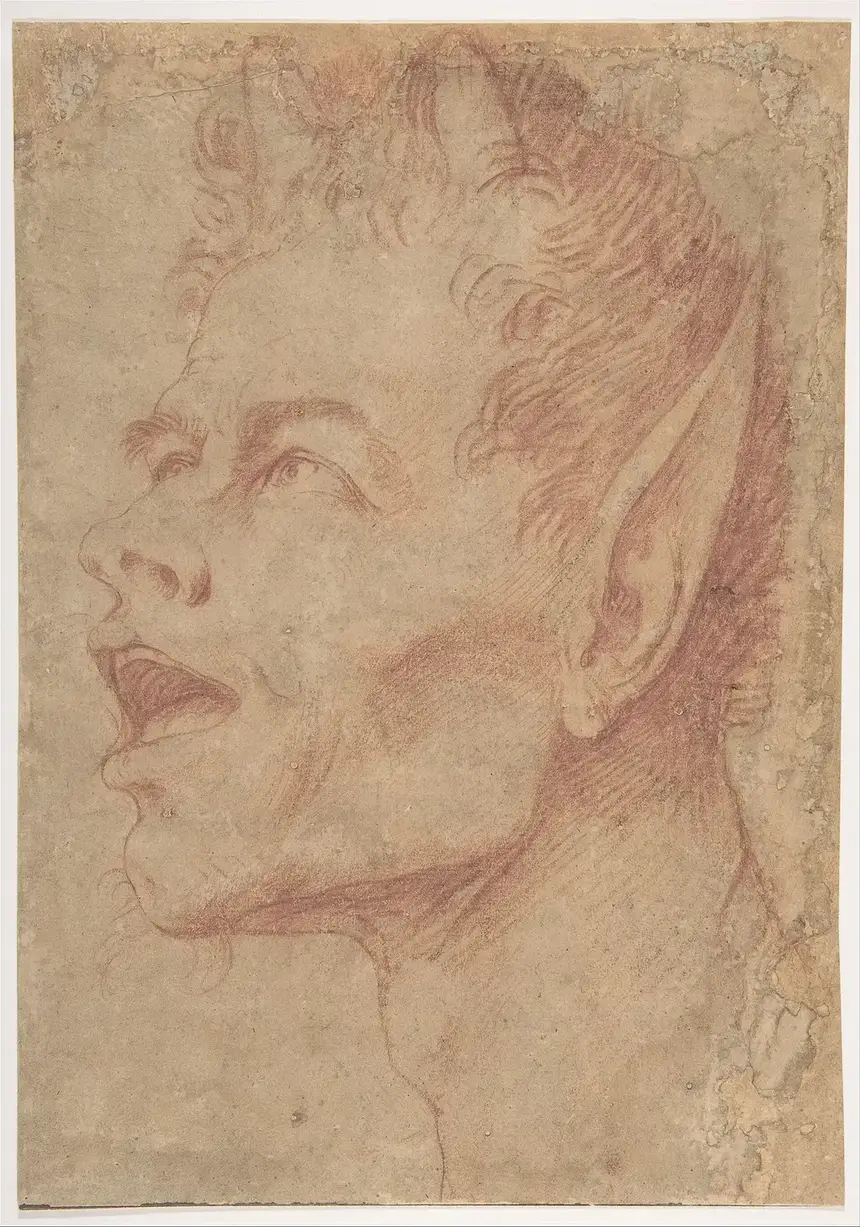
About Head of a Satyr Facing Left MET DP80
Jusepe de Ribera died in 1652, so the work has been in the public domain for decades. Reproducing it by hand is legal, and so is owning one.
Ours is a painting made with brushes. There is no giclée, no canvas transfer and no digital underlayer anywhere in the process.
It is an original composition painted before 1652, and our version is painted from the surviving image of it.
What arrives is a canvas with paint on it, made by a person. That is the only thing we sell.
Looking at it properly
There is no shortcut to the surface of this painting. It is built, and building takes days.
Nothing is traced or projected. The drawing is done by eye, which is what keeps the proportions related.
Where the source relies on reflected light, we put it in. Removing it makes the form look like cardboard.
The saturation is deliberately uneven: strongest at the focal point, weaker everywhere else.
The brushwork is left visible, which is the whole argument for painting it by hand.
Anyone can copy the shapes. The skill is in the transitions, and that is what takes the days.
For a stairwell or a double-height space, go larger than you think — the composition was built for distance.
| Artist | Jusepe de Ribera |
|---|---|
| Title | Head of a Satyr Facing Left MET DP80 |
| Medium | Oil on canvas, hand-painted to order |
| How it is made | Painted by hand in oil on canvas, to your size |
| Original status | Public domain (artist deceased) |
What a print loses
The difference is not subtle when the two hang side by side. Ink sits on the surface; oil stands off it.
Edges are left soft where the form turns away and sharp where it does not. That single habit is what separates a painting from a copy.
| Aspect | Hand-painted oil | Printed canvas |
|---|---|---|
| Colour | Mixed for each passage, warm and cool versions | One flat value per area |
| Impasto | Real paint standing off the canvas | Flat ink, sometimes embossed to imitate |
| Surface | Hand-painted oil on canvas | Ink on canvas, flat |
| Edge quality | Soft where the form turns, sharp where it does not | Uniformly sharp or uniformly blurred |
| Value over time | Can be re-stretched, cleaned and re-framed | Little value beyond the print |
Matching the original's degree of finish is harder than matching its colours.
Every canvas is painted to order, so the quote follows your size, frame and destination rather than a fixed list. Tell us what you need on WhatsApp and we reply with an exact figure, usually within the hour. You deal directly with the studio that paints it — no reseller layer.
How your painting is made
No two canvases are painted the same way, but the sequence is always this:
- Stretching and priming the support — cotton duck or linen goes onto the bars and gets its ground.
- A loose underdrawing — proportions checked by eye against the source image.
- The big shapes are blocked in — thin paint, one colour at a time, the whole canvas at once.
- The values are established — this is the stage that decides whether the painting works.
- Building the colour — a warm and a cool version of each passage, put down in order.
- Detail and highlights last — put on thickly and then not touched again.
- Drying and varnishing — the final varnish goes on once the paint has set, before we photograph it.
What takes time here is the number of separate decisions, not the size of the canvas.
Keeping it
Do not wipe it with anything wet. Dust lightly, hang it somewhere stable, and forget about it.
Frames
Framing is quoted separately, so you can decide after you have seen the finished canvas in photographs.
A frame is a separate line on the quote, not a bundle. You choose it once the painting exists.
What it is made of
We use cotton duck for most sizes and linen where the canvas is large or the client asks for it. Varnish goes on only once the paint is properly dry, months after the last stroke, not before.
Stretcher bars are kiln-dried and wedged, so the canvas can be re-tensioned years later. Each painter works on one canvas at a time — the painting you ordered is not shared with another order.
What size works
The canvas is cut to your wall, not the other way round. For reference, these are the dimensions most often requested:
| Size (inches) | Size (cm) | Best for |
|---|---|---|
| 40 × 30 in | 102 × 76 cm | Living room focal wall, above a sofa |
| 32 × 24 in | 81 × 61 cm | Living room, above a sideboard |
| 30 × 24 in | 76 × 61 cm | Dining room, bedroom feature wall |
| 24 × 20 in | 60 × 50 cm | Study, home office, above a desk |
Tell us the wall width and we will tell you what looks right rather than what is standard. Shipments go out DAP. If your customs office charges duty or tax on arrival, that is between you and them — we do not collect it and we do not put a number on it.
In a bedroom it works above a headboard, sized to about two-thirds of the furniture width.
Send the wall, the size and whether you want a frame, and we will quote.
💬 Get a Quote for Head of a Satyr Facing Left MET DP80How it reaches you
From order to finished canvas is 9–15 days. Freight appears as a separate line on the quote and is fixed before you pay.
Air freight runs about 7–10 business days, tracked, to your door. Rolled in a tube it travels cheaper and safer than framed; most overseas clients take it that way.
You approve the painting from photographs before it is packed — that is the checkpoint. If something is not right, tell us what to adjust and we adjust it.
We quote DAP, so any duty or tax your country charges is settled by you at import. We do not add a tax line of our own.
A deposit starts the canvas and books the painter's time; the balance is due before the crate leaves. Damage in transit should be reported to us within 48 hours, with photographs. We pursue it with the carrier rather than promising a refund.
The practical questions
Can I change something in the composition?
Often yes — background, cropping, or adapting the proportions to your wall. Tell us what you have in mind and we will say honestly whether it will work.
Will it look exactly like the image?
Not exactly, and that is the point — it is a painting, not a scan. Composition, colour and drawing follow the original closely; the surface is where a painter's own decisions show.
Can I resell the reproduction?
Yes. Because the underlying work is in the public domain, the hand-painted canvas is yours to sell, gift or install commercially.
What is the canvas made of?
Cotton duck as standard, linen on request, artist-grade oil paint, and a final varnish once the paint is fully dry.
Can you paint a different work by Jusepe de Ribera?
Yes — send us the image, or look through the other Jusepe de Ribera works on the site.
Will I see it before it ships?
Yes. We send photographs of the finished canvas and wait for your reply before packing.
Can I change the size?
Yes. The canvas is painted to your measurement, not taken from a stock list.
What does it cost?
There is no price list, because the number depends on your size and frame. Message us and we will quote exactly.
Do you sell prints?
No prints at all — no giclée, no canvas transfer, nothing machine-made.
Do you take a deposit?
Work begins on a deposit and ships once the balance is paid. Nothing is charged that is not on the quote.
How long does it take?
Allow 9–15 days for the painting itself, then roughly 7–10 business days in transit.
Can you paint it from a different photograph of the same work?
Send your own reference image and we will paint from that instead.