Where this painting comes from
Because Kobayashi Kiyochika died in 1915, this work is in the public domain. We are painting a copy of a painting — we never pass it off as the original, and neither should anyone selling you one.
Every version we make is oil on canvas, painted by one painter from start to finish. No printing is involved at any stage.
It is an original composition painted before 1915, and our version is painted from the surviving image of it.
You are buying a painting, not a file. That distinction is the whole business we are in.
Where the painting lives
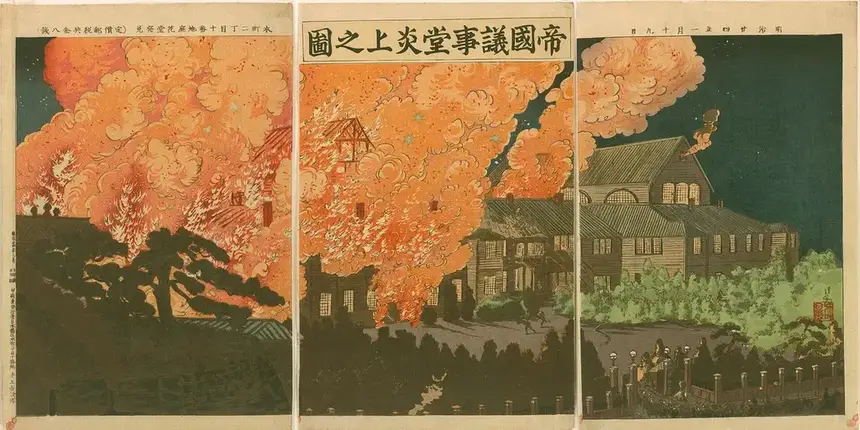
Fire of First National Diet Building is architecture, and architecture is the one subject where a straight line has to stay alive.
Our painter works the whole canvas at once rather than finishing one building at a time, which keeps the light consistent.
We do not correct the exposure. The original's key is part of the picture.
We keep the original's palette rather than brightening it, even where a modern eye would.
The thick paint is kept for the light and the thin paint for the dark, which is the traditional way round.
Matching the original's degree of finish is harder than matching its colours.
In a bedroom it works above a headboard, sized to about two-thirds of the furniture width.
| Artist | Kobayashi Kiyochika |
|---|---|
| Title | Fire of First National Diet Building |
| Created (original) | 1894 |
| Medium | Oil on canvas, hand-painted to order |
| Reproduction | Hand-painted oil on canvas, made to order |
| Original status | Public domain (artist deceased) |
What a print loses
Prints are good at information and bad at paint. This subject is mostly paint.
Our painter follows the same logic rather than copying a photograph of it: the far distances go down cool and weak, the near ground stays loaded, and nothing is blended flat.
| Aspect | Hand-painted oil | Printed canvas |
|---|---|---|
| Later on | Can be restored, re-framed, handed on | Replaceable, and usually replaced |
| Edge quality | Soft where the form turns, sharp where it does not | Uniformly sharp or uniformly blurred |
| Surface | Hand-painted oil on canvas | Ink on canvas, flat |
| Impasto | Real paint standing off the canvas | Flat ink, sometimes embossed to imitate |
| Lifespan | Slow to change; varnish can be refreshed decades later | Fades and cracks sooner |
This one repaints badly, so our painter gets the values right early and leaves them.
Every canvas is painted to order, so the quote follows your size, frame and destination rather than a fixed list. Tell us what you need on WhatsApp and we reply with an exact figure, usually within the hour. No resellers, no drop-shipper. The painter's studio handles your commission from first message to final crate.
How it gets painted
The order of work matters as much as the work itself. Ours runs like this:
- Stretching and priming the support — cotton duck or linen goes onto the bars and gets its ground.
- The drawing goes down — charcoal or thin paint, done by eye rather than traced from a printout.
- Blocking the masses — thin paint, working the whole surface rather than one corner at a time.
- Setting the key — how dark the darks go determines everything that follows.
- Colour is built up — warmer and cooler versions of each passage, laid over the underpainting.
- The detail and highlights go on — last, loaded, and left alone once they are down.
- Left to dry before varnish — nothing is photographed or packed until the surface is ready.
The risk with a city view is overworking, and the way to avoid it is knowing when to stop.
Frames
Frames are priced once you have chosen them, not estimated in advance.
We can supply a simple floater frame, a traditional gilt, or nothing at all. It is your call.
Looking after it
Dust it with a dry, soft brush. Keep it out of direct sun and away from radiators, and it will outlive you.
What goes into it
The ground is a proper acrylic sizing, so the oil does not rot the fabric over time. The varnish is removable, so a conservator can clean the painting in fifty years without touching the paint.
We use a neutral-sized ground so the whites stay warm rather than going blue over time. We buy pigment in tubes from the same suppliers the village has used for years, not in bulk drums.
Sizing it
Because each piece is painted from scratch, you are not limited to stock dimensions. These are the sizes clients ask for most:
| Size (inches) | Size (cm) | Best for |
|---|---|---|
| 64 × 48 in | 163 × 122 cm | Villa scale, lobby, hospitality wall |
| 48 × 36 in | 122 × 91 cm | Large living room, stairwell, loft |
| 40 × 30 in | 102 × 76 cm | Living room focal wall, above a sofa |
| 32 × 24 in | 81 × 61 cm | Living room, above a sideboard |
Anything outside this table is fine — we paint to the number you give us. We quote DAP, so any duty or tax your country charges is settled by you at import. We do not add a tax line of our own.
It suits a room with warm, low light. Strong downlighting flattens the surface.
Give us your size and framing preference and you will have a quote shortly.
💬 Get a Quote for Fire of First National Diet BuildingFrom order to your wall
Allow 9–15 days for the painting itself. Shipping is a separate line on your quote — you see it before payment, not after.
In transit it is typically 7–10 business days by air, tracked door to door. Unframed canvases are rolled face-out on a tube; framed ones are corner-protected and crated.
You see photographs of the finished painting before it ships, and you tell us what to adjust. Changes are handled by telling us what to change; we change it and send new photographs.
DAP terms: we pay the freight, you settle any duty or tax your country applies. We do not collect taxes on anyone's behalf.
Work begins on a deposit and ships on the balance. Both figures are on the quote. Damage in transit should be reported to us within 48 hours, with photographs. We pursue it with the carrier rather than promising a refund.
The practical questions
Why not just print it?
A print flattens the surface into a poster: the distance collapses and the highlights turn to grey. Paint keeps the depth and the texture the original was built from.
What happens after I message you?
You tell us the painting, size and whether you want a frame. We quote, a painter starts on your canvas, and you get photographs before it ships.
Is there a rush option?
It depends on the canvas and what else is in the studio. Ask on WhatsApp with your size and we will tell you straight what is possible.
Do you sell prints?
No prints at all — no giclée, no canvas transfer, nothing machine-made.
Can you paint a different work by Kobayashi Kiyochika?
Yes — send us the image, or look through the other Kobayashi Kiyochika works on the site.
Can you paint it from a different photograph of the same work?
Yes. If you have a better reference, send it on WhatsApp and we will work from yours.
Is it really painted by hand?
Yes — oil on canvas, brush and knife. There is no printing, no giclée and no canvas transfer at any stage.
Do you take a deposit?
Work begins on a deposit and ships once the balance is paid. Nothing is charged that is not on the quote.
Do you ship to my country?
We ship to over 20 countries. Give us your city and the freight appears as its own line on the quote.
How long does it take?
Allow 9–15 days for the painting itself, then roughly 7–10 business days in transit.
Who pays the import duty?
You do. We sell DAP, so any duty or tax your customs authority charges is settled by you at import. We do not collect it and we do not estimate it.
What is the canvas made of?
Cotton duck as standard, linen on request, artist-grade oil paint, and a final varnish once the paint is fully dry.