Where this painting comes from
Kobayashi Kiyochika died in 1915, so the work has been in the public domain for decades. Reproducing it by hand is legal, and so is owning one.
We paint it in oil on canvas, one at a time, in Dafen Village. Nothing is printed, scanned or transferred.
It is an original composition painted before 1915, and our version is painted from the surviving image of it.
You are buying a painting, not a file. That distinction is the whole business we are in.
What to look at
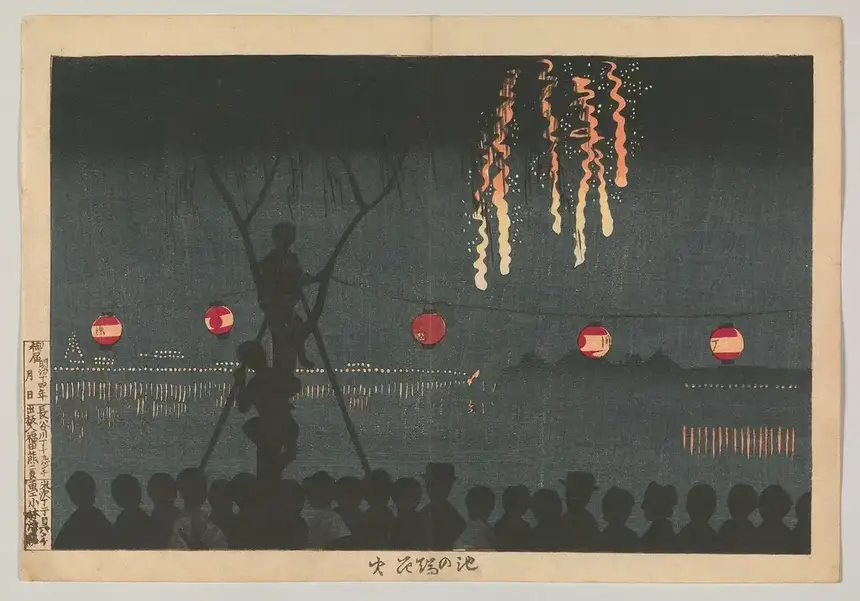
The reason Fireworks at Ikenohata MET DP-603 still works as a painting is that it was built as paint, not as a picture of a place.
We keep the original proportions rather than cropping to a standard frame, so an unusually wide composition stays honest.
Sunlight and shadow are two different temperatures here, not one colour at two strengths.
Temperature does the work of contrast in the quiet areas, where value differences are small.
Where the source has a loaded passage, ours is loaded too — you will feel it from the side.
The difficult part is not the detail. It is keeping the whole canvas at the same stage of finish.
It is a picture for a room you use, not a corridor you walk through.
| Artist | Kobayashi Kiyochika |
|---|---|
| Title | Fireworks at Ikenohata MET DP-603 |
| Created (original) | 1881 |
| Medium | Oil on canvas, hand-painted to order |
| How it is made | Painted by hand in oil on canvas, to your size |
| Public domain | Yes — the artist died over 70 years ago |
Hand-painted, not printed
Prints are good at information and bad at paint. This subject is mostly paint.
Paint goes on in the original's order — thin first, thick last — so the surface behaves the way the painter intended.
| Aspect | Hand-painted oil | Printed canvas |
|---|---|---|
| Texture | Ridges and drag you can see from across a room | None, or a printed imitation of it |
| Colour | Mixed for each passage, warm and cool versions | One flat value per area |
| Sense of depth | Real, created by layers of paint | Simulated by darker ink |
| Available sizes | Whatever you need, painted to order | What the printer can output |
| What it takes | One painter, several days, start to finish | A machine, a few minutes |
The risk with a night subject is overworking, and the way to avoid it is knowing when to stop.
Every canvas is painted to order, so the quote follows your size, frame and destination rather than a fixed list. Tell us what you need on WhatsApp and we reply with an exact figure, usually within the hour. You deal directly with the studio that paints it — no reseller layer.
How your painting is made
Every canvas is painted to order, so nothing is pulled off a shelf. This is the sequence:
- We start with the canvas itself — stretched, sized and left to settle before any colour is mixed.
- Laying in the drawing — done by eye from the reference, not traced or projected.
- Blocking the masses — thin paint, working the whole surface rather than one corner at a time.
- Getting the values right — the stage that decides whether the finished painting holds together.
- Building the colour — a warm and a cool version of each passage, put down in order.
- Detail and highlights last — put on thickly and then not touched again.
- Left to dry before varnish — nothing is photographed or packed until the surface is ready.
This one repaints badly, so our painter gets the values right early and leaves them.
Canvas, paint and varnish
We do not use a printer at any stage. There is no giclée, no canvas transfer, no digital underlayer. The paint is built in layers, fat over lean, which is what stops it cracking later.
We use cotton duck for most sizes and linen where the canvas is large or the client asks for it. Brushes, knives and rags. That is the equipment list; there is no machine in the process.
Living with it
Oil paint needs very little: no water, no cleaners, no sprays. A dry brush and a stable room.
On framing
A frame is a separate line on the quote, not a bundle. You choose it once the painting exists.
A frame is a separate line on the quote, not a bundle. You choose it once the painting exists.
Choosing a size
Any size is possible. These are simply the ones that come up most often in quotes:
| Size (inches) | Size (cm) | Best for |
|---|---|---|
| 20 × 16 in | 50 × 40 cm | Bedroom, hallway, above a console |
| 16 × 12 in | 40 × 30 cm | A shelf, a small wall, a gallery group |
| 64 × 48 in | 163 × 122 cm | Villa scale, lobby, hospitality wall |
| 48 × 36 in | 122 × 91 cm | Large living room, stairwell, loft |
| 40 × 30 in | 102 × 76 cm | Living room focal wall, above a sofa |
Anything outside this table is fine — we paint to the number you give us. We sell DAP: the price covers the painting and the freight, and any import duties or taxes are the buyer's to settle with customs. We do not collect them and we do not estimate them.
Hang it at eye level — roughly 145 cm from the floor to the centre — and it will hold the wall.
Send the wall, the size and whether you want a frame, and we will quote.
💬 Get a Quote for Fireworks at Ikenohata MET DP-603From order to your wall
Allow 9–15 days for the painting itself. Shipping is a separate line on your quote — you see it before payment, not after.
Air freight runs about 7–10 business days, tracked, to your door. Rolled in a tube it travels cheaper and safer than framed; most overseas clients take it that way.
Nothing ships before you have seen it. Photographs of the finished painting go to you first. Changes are handled by telling us what to change; we change it and send new photographs.
Shipments go out DAP. If your customs office charges duty or tax on arrival, that is between you and them — we do not collect it and we do not put a number on it.
A deposit starts the canvas and books the painter's time; the balance is due before the crate leaves. If a crate arrives damaged, send us photographs within 48 hours and contact us directly — we will sort it out with you.
Questions worth asking
Can I resell the reproduction?
Yes. Because the underlying work is in the public domain, the hand-painted canvas is yours to sell, gift or install commercially.
What is the canvas made of?
Cotton or linen, oil colour, and varnish. Stretcher bars are wedged so the canvas can be re-tensioned later.
Can you paint a different work by Kobayashi Kiyochika?
Yes — send us the image, or look through the other Kobayashi Kiyochika works on the site.
Do you sell prints?
No prints at all — no giclée, no canvas transfer, nothing machine-made.
How long does it take?
Allow 9–15 days for the painting itself, then roughly 7–10 business days in transit.
Can you change the colours to suit my room?
Sometimes. We will adjust the palette if it can be done without ruining the picture, and say so if it cannot.
Can I change the size?
Any size you like. We paint to the number you give us rather than to a standard range.
How do I hang it?
Centre it at about 145 cm from the floor, or two-thirds the width of the furniture below it. We will tell you the exact number for your wall.
What if it arrives damaged?
send us photographs within 48 hours and contact us directly — we will sort it out with you.
Can you paint it from a different photograph of the same work?
Yes. If you have a better reference, send it on WhatsApp and we will work from yours.