About the original
Because Louis Valtat died in 1952, this work is in the public domain. We are painting a copy of a painting — we never pass it off as the original, and neither should anyone selling you one.
Ours is a painting made with brushes. There is no giclée, no canvas transfer and no digital underlayer anywhere in the process.
It is an original composition painted before 1952, and our version is painted from the surviving image of it.
What arrives is a canvas with paint on it, made by a person. That is the only thing we sell.
How to read it
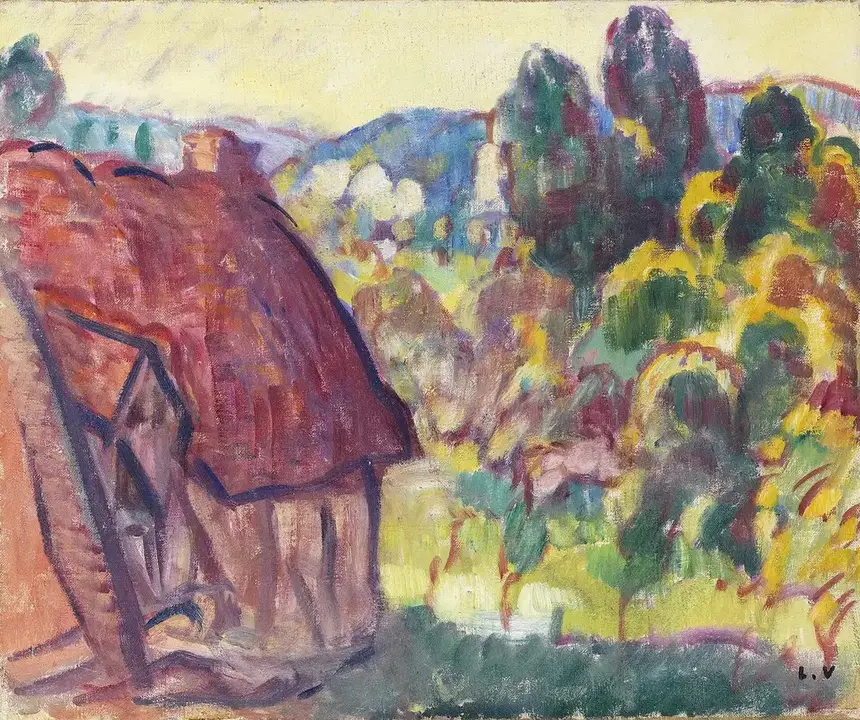
What makes a landscape worth painting by hand is the distance in it — the space between the near ground and the far one.
Our painter works freehand on a blank canvas, so the scale of the original survives the enlargement.
Our painter leaves the highlights until last and puts them on thickly, so they stand off the surface.
The darks are mixed, not blackened — black straight from the tube would kill the passage.
Our painter loads the brush differently for the near and far passages, and you can read the difference.
The difficult part is not the detail. It is keeping the whole canvas at the same stage of finish.
It wants a wall where the light rakes across it, because the surface is part of the picture.
| Artist | Louis Valtat |
|---|---|
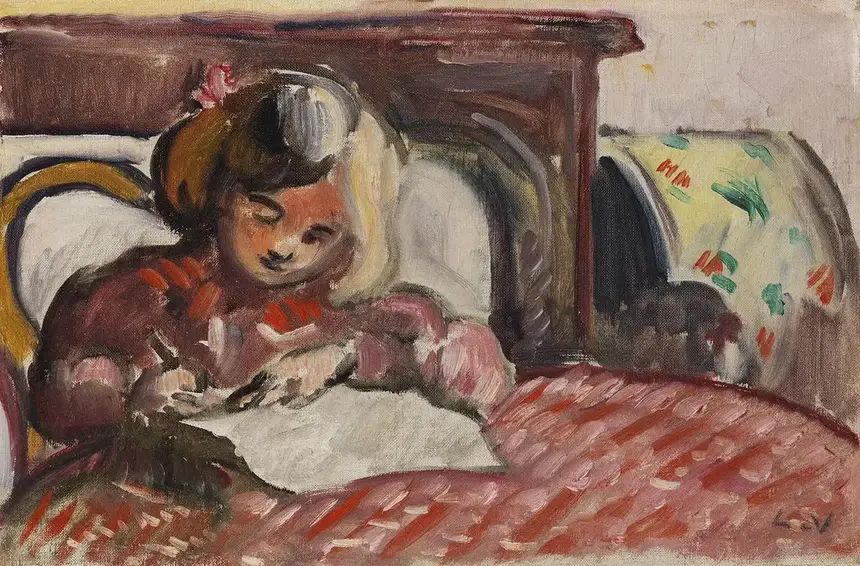
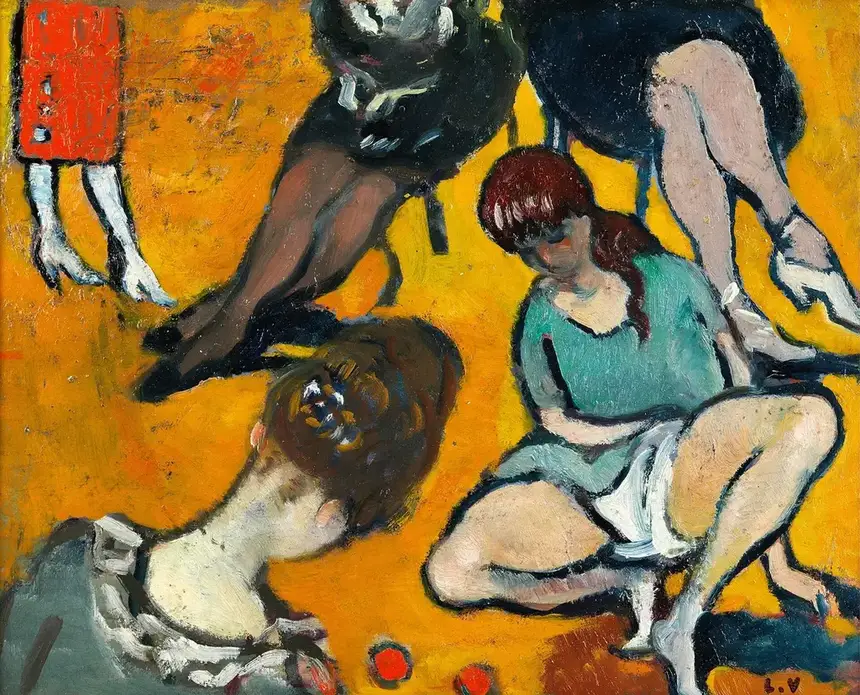
| Title | Fillette jouant au bois |
| Created (original) | 1919 |
| Medium | Oil on canvas, hand-painted to order |
| What you receive | A hand-painted oil painting on canvas |
| Original status | Public domain (artist deceased) |
The case for painting it by hand
Prints are good at information and bad at paint. This subject is mostly paint.
Paint goes on in the original's order — thin first, thick last — so the surface behaves the way the painter intended.
| Aspect | Hand-painted oil | Printed canvas |
|---|---|---|
| Size | Any size, painted to your wall | Limited by the printer |
| Impasto | Real paint standing off the canvas | Flat ink, sometimes embossed to imitate |
| Surface | Hand-painted oil on canvas | Ink on canvas, flat |
| Sense of depth | Real, created by layers of paint | Simulated by darker ink |
| Changing something | Tell us and the passage gets repainted | Usually means starting the file again |
The risk with a landscape is overworking, and the way to avoid it is knowing when to stop.
Every canvas is painted to order, so the quote follows your size, frame and destination rather than a fixed list. Tell us what you need on WhatsApp and we reply with an exact figure, usually within the hour. You are talking to the people who will actually paint it, not a middleman.
How your painting is made
This is how the painting is built, in the order our painters build it:
- We start with the canvas itself — stretched, sized and left to settle before any colour is mixed.
- Laying in the drawing — done by eye from the reference, not traced or projected.
- Blocking the masses — thin paint, working the whole surface rather than one corner at a time.
- Setting the key — how dark the darks go determines everything that follows.
- Building the colour — a warm and a cool version of each passage, put down in order.
- The detail and highlights go on — last, loaded, and left alone once they are down.
- It dries, then gets varnished — and only then is it photographed for you.
The difficulty is restraint: leaving out most of what a photograph would show.
Materials
The varnish is removable, so a conservator can clean the painting in fifty years without touching the paint. Stretcher bars are kiln-dried and wedged, so the canvas can be re-tensioned years later.
Brushes, knives and rags. That is the equipment list; there is no machine in the process. We buy pigment in tubes from the same suppliers the village has used for years, not in bulk drums.
Looking after it
Once the varnish has cured the surface can be cleaned by a conservator, but in a normal house it will not need it for decades.
Framing
If you are shipping, an unframed canvas rolled in a tube is considerably cheaper to move than a framed one.
A frame is a separate line on the quote, not a bundle. You choose it once the painting exists.
Canvas sizes
Any size is possible. These are simply the ones that come up most often in quotes:
| Size (inches) | Size (cm) | Best for |
|---|---|---|
| 24 × 20 in | 60 × 50 cm | Study, home office, above a desk |
| 20 × 16 in | 50 × 40 cm | Bedroom, hallway, above a console |
| 16 × 12 in | 40 × 30 cm | A shelf, a small wall, a gallery group |
| 64 × 48 in | 163 × 122 cm | Villa scale, lobby, hospitality wall |
Tell us the wall width and we will tell you what looks right rather than what is standard. Terms are DAP. Import duties and taxes, where they apply, are paid by the buyer on arrival — we never collect them in advance and never guess at the amount.
This reads well above a sofa or a sideboard, where it will be seen from two to three metres.
Message us the dimensions you have in mind and we will come back with a figure.
💬 Get a Quote for Fillette jouant au boisGetting it to you
From order to finished canvas is 9–15 days. Freight appears as a separate line on the quote and is fixed before you pay.
Transit is usually 7–10 business days, tracked all the way. Every shipment goes out with tracking. We do not send anything untracked.
Nothing ships before you have seen it. Photographs of the finished painting go to you first. Changes are handled by telling us what to change; we change it and send new photographs.
DAP terms: we pay the freight, you settle any duty or tax your country applies. We do not collect taxes on anyone's behalf.
You pay a deposit to start and the remainder before shipping. Nothing is hidden in between. Report any transit damage within 48 hours with photographs and we will deal with the carrier. We will not promise a payout, but we will not leave you to argue alone either.
Before you order
What size should I order?
You choose the size. Each canvas is cut to your measurements rather than pulled from stock, so tell us the wall dimensions and we will tell you what proportion works.
How do I clean and care for it?
Dust lightly with a dry, soft brush and keep it out of direct sun. Nothing else is needed for decades; oil paint is slow to change and easy to live with.
What if it does not look right to me?
We send photographs of the actual painting for your approval before anything ships. That is the moment to tell us what to adjust.
Is it really painted by hand?
Yes — oil on canvas, brush and knife. There is no printing, no giclée and no canvas transfer at any stage.
Is owning a reproduction legal?
Yes. The painting is out of copyright because Louis Valtat died more than 70 years ago. We paint copies honestly and never claim they are originals.
Does it come framed?
Frames are priced on their own line. Most clients choose after seeing the photographs.
What does it cost?
Every canvas is quoted on size, frame and destination rather than a fixed list. Tell us what you need and we reply with an exact figure.
Can you paint it from a different photograph of the same work?
Send your own reference image and we will paint from that instead.
Who pays the import duty?
You do. We sell DAP, so any duty or tax your customs authority charges is settled by you at import. We do not collect it and we do not estimate it.
Can you paint a different work by Louis Valtat?
Yes — send us the image, or look through the other Louis Valtat works on the site.
Do you sell prints?
No. Hand-painted oil on canvas only. No printing, no giclée, no canvas transfer.
Will I see it before it ships?
Yes — photographs of the actual painting go to you first, and nothing is packed until you have seen them.