Where this painting comes from
Nasreddine Dinet died in 1929. That puts the painting well outside copyright, which is why we can paint it and you can own it anywhere in the world.
Every version we make is oil on canvas, painted by one painter from start to finish. No printing is involved at any stage.
It is an original composition painted before 1929, and our version is painted from the surviving image of it.
You are buying a painting, not a file. That distinction is the whole business we are in.
What the painting is doing
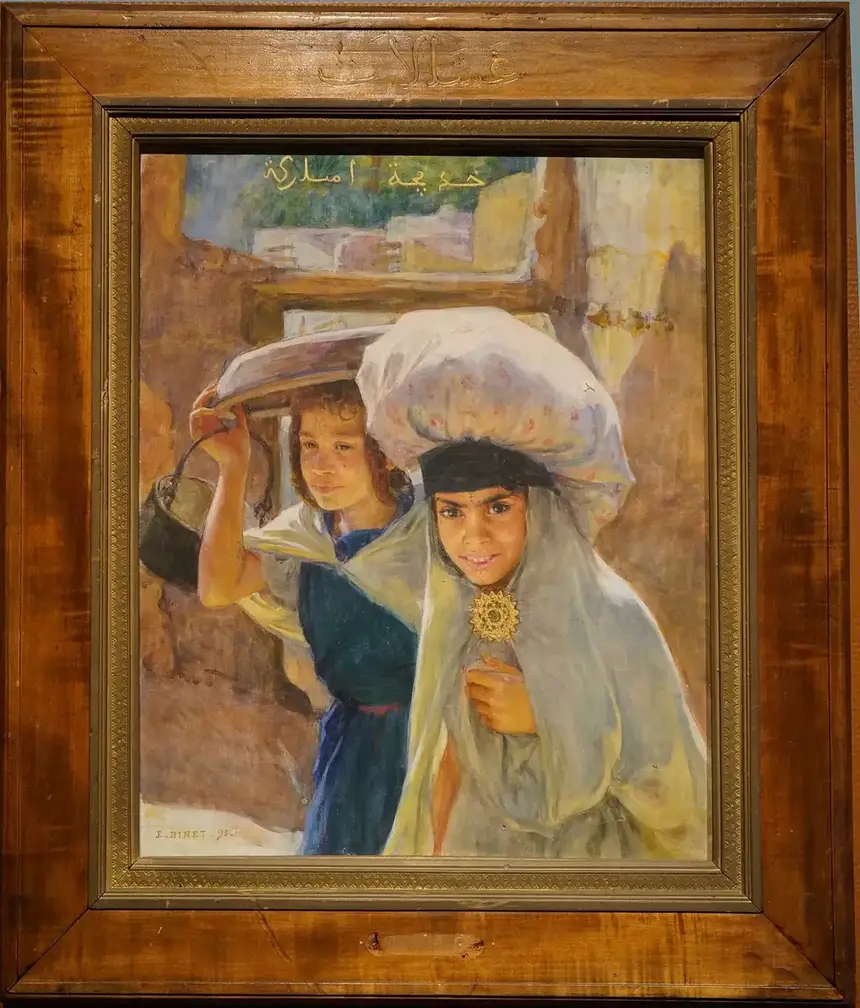
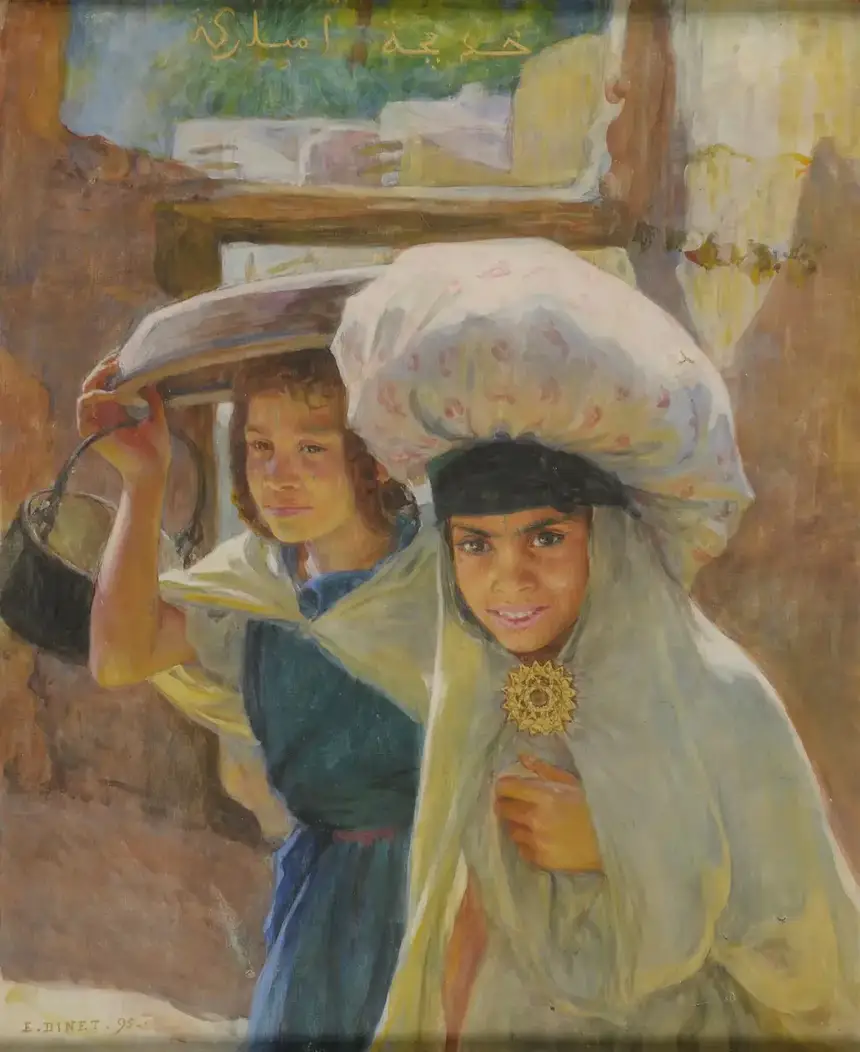
Laveuses d'Etienne Dinet rewards a second look because the light is doing something specific, and it only does it in oil.
Depth here is a matter of edges: sharp in front, lost at the back. It is the hardest thing to print and the easiest to paint.
We do not brighten the picture for reproduction. The original's key is kept as it is.
Whites here are never white. They are warm or cool depending on the light, and that is what makes them read.
The marks have a direction, and the direction follows the form.
The difficult part is not the detail. It is keeping the whole canvas at the same stage of finish.
It works best on a wall you pass rather than one you sit and stare at — the paint rewards a moving eye.
| Artist | Nasreddine Dinet |
|---|---|
| Title | Laveuses d'Etienne Dinet |
| Created (original) | 1895 |
| Medium | Oil on canvas, hand-painted to order |
| Our version | Oil on canvas, painted by hand to order |
| Public domain | Yes — the artist died over 70 years ago |
Why hand-painting matters here
Prints are good at information and bad at paint. This subject is mostly paint.
Our painter follows the same logic rather than copying a photograph of it: the far distances go down cool and weak, the near ground stays loaded, and nothing is blended flat.
| Aspect | Hand-painted oil | Printed canvas |
|---|---|---|
| Changing something | Tell us and the passage gets repainted | Usually means starting the file again |
| Edge quality | Soft where the form turns, sharp where it does not | Uniformly sharp or uniformly blurred |
| Depth | Built in layers, catches light from the side | Flat; highlights are printed as pale ink |
| Handling of colour | Mixed on the palette and finished on the canvas | Fixed by the colour profile |
| Available sizes | Whatever you need, painted to order | What the printer can output |
The risk with a landscape is overworking, and the way to avoid it is knowing when to stop.
Quotes are built from your requirements, not pulled off a table. Message us on WhatsApp with size and framing and we reply with an exact figure. No resellers, no drop-shipper. The painter's studio handles your commission from first message to final crate.
How it gets painted
The order of work matters as much as the work itself. Ours runs like this:
- We start with the canvas itself — stretched, sized and left to settle before any colour is mixed.
- The drawing goes down — charcoal or thin paint, done by eye rather than traced from a printout.
- The first colour pass — thin and simple, establishing the main shapes only.
- Getting the values right — the stage that decides whether the finished painting holds together.
- Colour is built up — warmer and cooler versions of each passage, laid over the underpainting.
- The detail and highlights go on — last, loaded, and left alone once they are down.
- Left to dry before varnish — nothing is photographed or packed until the surface is ready.
Getting Laveuses d'Etienne Dinet right means painting it in the right order, and the order is not obvious.
Keeping it
Oil paint needs very little: no water, no cleaners, no sprays. A dry brush and a stable room.
What goes into it
The ground is a proper acrylic sizing, so the oil does not rot the fabric over time. Each painter works on one canvas at a time — the painting you ordered is not shared with another order.
The paint is built in layers, fat over lean, which is what stops it cracking later. Oil paint dries by oxidation, not evaporation, which is why a finished canvas needs weeks before it travels.
Framing
Most clients wait for the photographs before choosing a frame, which is the sensible order.
Most clients wait for the photographs before choosing a frame, which is the sensible order.
Getting the size right
You are not choosing from a list; you are telling us a measurement. These are the common ones:
| Size (inches) | Size (cm) | Best for |
|---|---|---|
| 32 × 24 in | 81 × 61 cm | Living room, above a sideboard |
| 30 × 24 in | 76 × 61 cm | Dining room, bedroom feature wall |
| 24 × 20 in | 60 × 50 cm | Study, home office, above a desk |
| 20 × 16 in | 50 × 40 cm | Bedroom, hallway, above a console |
| 16 × 12 in | 40 × 30 cm | A shelf, a small wall, a gallery group |
We will size the canvas to the room, not to a stock list. Send us the measurement. DAP terms: we pay the freight, you settle any duty or tax your country applies. We do not collect taxes on anyone's behalf.
For a stairwell or a double-height space, go larger than you think — the composition was built for distance.
Give us your size and framing preference and you will have a quote shortly.
💬 Get a Quote for Laveuses d'Etienne DinetFrom order to your wall
Allow 9–15 days for the painting itself. Shipping is a separate line on your quote — you see it before payment, not after.
Expect 7–10 business days in transit, with tracking from our door to yours. Every shipment goes out with tracking. We do not send anything untracked.
Nothing ships before you have seen it. Photographs of the finished painting go to you first. If something is not right, tell us what to adjust and we adjust it.
We sell DAP: the price covers the painting and the freight, and any import duties or taxes are the buyer's to settle with customs. We do not collect them and we do not estimate them.
You pay a deposit to start and the remainder before shipping. Nothing is hidden in between. Damage in transit should be reported to us within 48 hours, with photographs. We pursue it with the carrier rather than promising a refund.
The practical questions
How long does a hand-painted version take?
9–15 days of studio time, depending mostly on size and how much impasto the surface carries, then several more days for the oil to set before we photograph, pack and send.
Do you work from my own photograph?
Yes, though that is a separate service. This page is for a hand-painted version of Laveuses d Etienne Dinet; for a photo-to-painting commission, send the image on WhatsApp.
How close will it be to the original?
The composition, colour and drawing follow the original closely; the brushwork carries the painter s own hand. The painter works freehand on a blank canvas, following the same logic as the original rather than copying a photograph.
Will I see it before it ships?
Yes. We send photographs of the finished canvas and wait for your reply before packing.
Who pays the import duty?
You do. We sell DAP, so any duty or tax your customs authority charges is settled by you at import. We do not collect it and we do not estimate it.
Does it come framed?
Frames are priced on their own line. Most clients choose after seeing the photographs.
Can I change the size?
Any size you like. We paint to the number you give us rather than to a standard range.
Do you take a deposit?
A deposit starts the canvas and the balance falls due before it ships. Both figures appear on the quote.
Can you change the colours to suit my room?
Sometimes. We will adjust the palette if it can be done without ruining the picture, and say so if it cannot.
Can you paint it from a different photograph of the same work?
Send your own reference image and we will paint from that instead.
Can you paint a different work by Nasreddine Dinet?
Yes — send us the image, or look through the other Nasreddine Dinet works on the site.
Is owning a reproduction legal?
Yes. The painting is out of copyright because Nasreddine Dinet died more than 70 years ago. We paint copies honestly and never claim they are originals.