The original, and why we can paint it
Paul Cézanne died in 1906, so the work has been in the public domain for decades. Reproducing it by hand is legal, and so is owning one.
Ours is a painting made with brushes. There is no giclée, no canvas transfer and no digital underlayer anywhere in the process.
It is an original composition painted before 1906, and our version is painted from the surviving image of it.
You are buying a painting, not a file. That distinction is the whole business we are in.
What the painting is doing
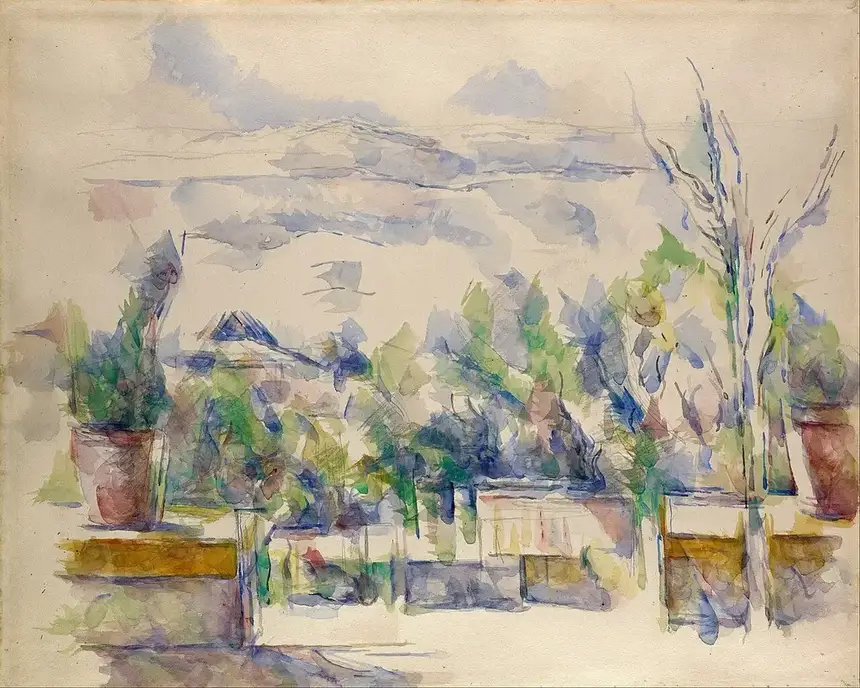
A hand-painted a city view keeps the atmosphere between the buildings, which is most of the picture.
The composition is built on receding planes, each painted a little cooler than the one in front.
Our painter works the light across the whole canvas at once so it stays consistent.
The saturation is deliberately uneven: strongest at the focal point, weaker everywhere else.
The marks have a direction, and the direction follows the form.
Anyone can copy the shapes. The skill is in the transitions, and that is what takes the days.
It suits a room with warm, low light. Strong downlighting flattens the surface.
| Artist | Paul Cézanne |
|---|---|
| Title | The Terrace at the Garden at Les Lauves |
| Created (original) | 1902 |
| Medium | Oil on canvas, hand-painted to order |
| Our version | Oil on canvas, painted by hand to order |
| Copyright | Public domain; the original is out of copyright |
Why this one cannot be printed
The difference is not subtle when the two hang side by side. Ink sits on the surface; oil stands off it.
Paint goes on in the original's order — thin first, thick last — so the surface behaves the way the painter intended.
| Aspect | Hand-painted oil | Printed canvas |
|---|---|---|
| Edge quality | Soft where the form turns, sharp where it does not | Uniformly sharp or uniformly blurred |
| Size | Any size, painted to your wall | Limited by the printer |
| What it takes | One painter, several days, start to finish | A machine, a few minutes |
| Impasto | Real paint standing off the canvas | Flat ink, sometimes embossed to imitate |
| The surface | Built up with brushes and knives | Printed flat in one pass |
The risk with a city view is overworking, and the way to avoid it is knowing when to stop.
Every canvas is painted to order, so the quote follows your size, frame and destination rather than a fixed list. Tell us what you need on WhatsApp and we reply with an exact figure, usually within the hour. No resellers, no drop-shipper. The painter's studio handles your commission from first message to final crate.
How the canvas is built
Here is what actually happens between your message and the crate:
- We start with the canvas itself — stretched, sized and left to settle before any colour is mixed.
- A loose underdrawing — proportions checked by eye against the source image.
- The big shapes are blocked in — thin paint, one colour at a time, the whole canvas at once.
- Setting the key — how dark the darks go determines everything that follows.
- The colour passes — each area gets its own mixture rather than one colour used throughout.
- Detail and highlights last — put on thickly and then not touched again.
- Left to dry before varnish — nothing is photographed or packed until the surface is ready.
Matching the original's degree of finish is harder than matching its colours.
Framing
We can supply a simple floater frame, a traditional gilt, or nothing at all. It is your call.
If you are shipping, an unframed canvas rolled in a tube is considerably cheaper to move than a framed one.
Canvas, paint and varnish
Varnish goes on only once the paint is properly dry, months after the last stroke, not before. We buy pigment in tubes from the same suppliers the village has used for years, not in bulk drums.
We use cotton duck for most sizes and linen where the canvas is large or the client asks for it. Pigment is artist-grade oil colour, not acrylic and not house paint. It behaves differently and it lasts.
Care and cleaning
Dust it with a dry, soft brush. Keep it out of direct sun and away from radiators, and it will outlive you.
Canvas sizes
Any size is possible. These are simply the ones that come up most often in quotes:
| Size (inches) | Size (cm) | Best for |
|---|---|---|
| 16 × 12 in | 40 × 30 cm | A shelf, a small wall, a gallery group |
| 64 × 48 in | 163 × 122 cm | Villa scale, lobby, hospitality wall |
| 48 × 36 in | 122 × 91 cm | Large living room, stairwell, loft |
| 40 × 30 in | 102 × 76 cm | Living room focal wall, above a sofa |
| 32 × 24 in | 81 × 61 cm | Living room, above a sideboard |
| 30 × 24 in | 76 × 61 cm | Dining room, bedroom feature wall |
If your wall is an odd shape, send the measurement and we will work to it. Proportions from the original are kept unless you ask us to change them. DAP terms: we pay the freight, you settle any duty or tax your country applies. We do not collect taxes on anyone's behalf.
In a bedroom it works above a headboard, sized to about two-thirds of the furniture width.
Give us your size and framing preference and you will have a quote shortly.
💬 Get a Quote for The Terrace at the Garden at Les LauvesTimeline and shipping
Allow 9–15 days for the painting itself. Shipping is a separate line on your quote — you see it before payment, not after.
In transit it is typically 7–10 business days by air, tracked door to door. Unframed canvases are rolled face-out on a tube; framed ones are corner-protected and crated.
You approve the painting from photographs before it is packed — that is the checkpoint. Changes are handled by telling us what to change; we change it and send new photographs.
Our terms are DAP, meaning the freight is paid by us and any import charges are yours to settle. We will not estimate them, because the figure is your customs authority's to set.
Work begins on a deposit and ships on the balance. Both figures are on the quote. Damage in transit should be reported to us within 48 hours, with photographs. We pursue it with the carrier rather than promising a refund.
What people ask us
When will it actually arrive?
Studio time is 9–15 days, then a few more days for the oil to set before we can photograph and pack it. We tell you where your canvas is at each stage.
How do I know what size will look right?
Measure the wall and send a photograph. We will say honestly if the canvas you have in mind is too small for the space, which is the most common mistake.
Do you work from my own photograph?
Yes, though that is a separate service. This page is for a hand-painted version of {title}; for a photo-to-painting commission, send the image on WhatsApp.
What is the canvas made of?
Cotton duck as standard, linen on request, artist-grade oil paint, and a final varnish once the paint is fully dry.
How do I hang it?
Centre it at about 145 cm from the floor, or two-thirds the width of the furniture below it. We will tell you the exact number for your wall.
Do you take a deposit?
Work begins on a deposit and ships once the balance is paid. Nothing is charged that is not on the quote.
What if it arrives damaged?
send us photographs within 48 hours and contact us directly — we will sort it out with you.
Is it really painted by hand?
Yes. One painter, oil paint, brushes. We do not own a printer that touches canvas.
Who pays the import duty?
The buyer does. Terms are DAP: duties and taxes, where they apply, are paid on arrival. We never add a tax line of our own.
Can I change the size?
Any size you like. We paint to the number you give us rather than to a standard range.
Can you paint a different work by Paul Cézanne?
Yes — send us the image, or look through the other Paul Cézanne works on the site.
Can you paint it from a different photograph of the same work?
Yes. If you have a better reference, send it on WhatsApp and we will work from yours.