What you are buying into
Because Rembrandt died in 1669, this work is in the public domain. We are painting a copy of a painting — we never pass it off as the original, and neither should anyone selling you one.
Ours is a painting made with brushes. There is no giclée, no canvas transfer and no digital underlayer anywhere in the process.
The painting was made in the years before 1669, and what we reproduce is the record of it, not the object.
You are buying a painting, not a file. That distinction is the whole business we are in.
Where the painting lives
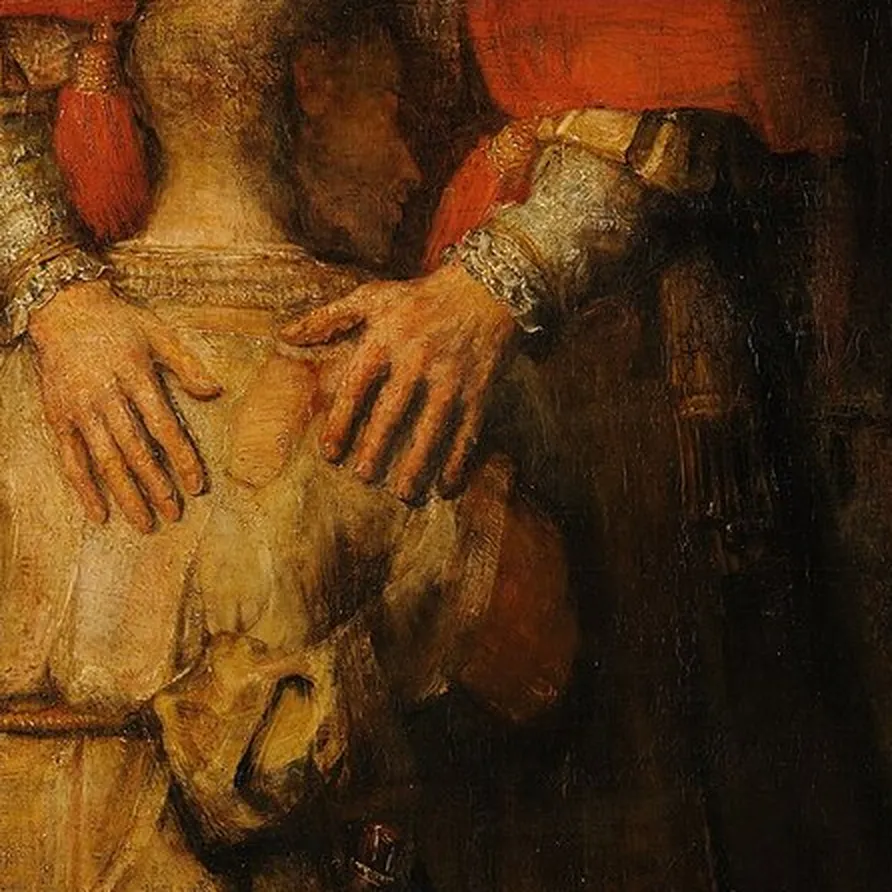
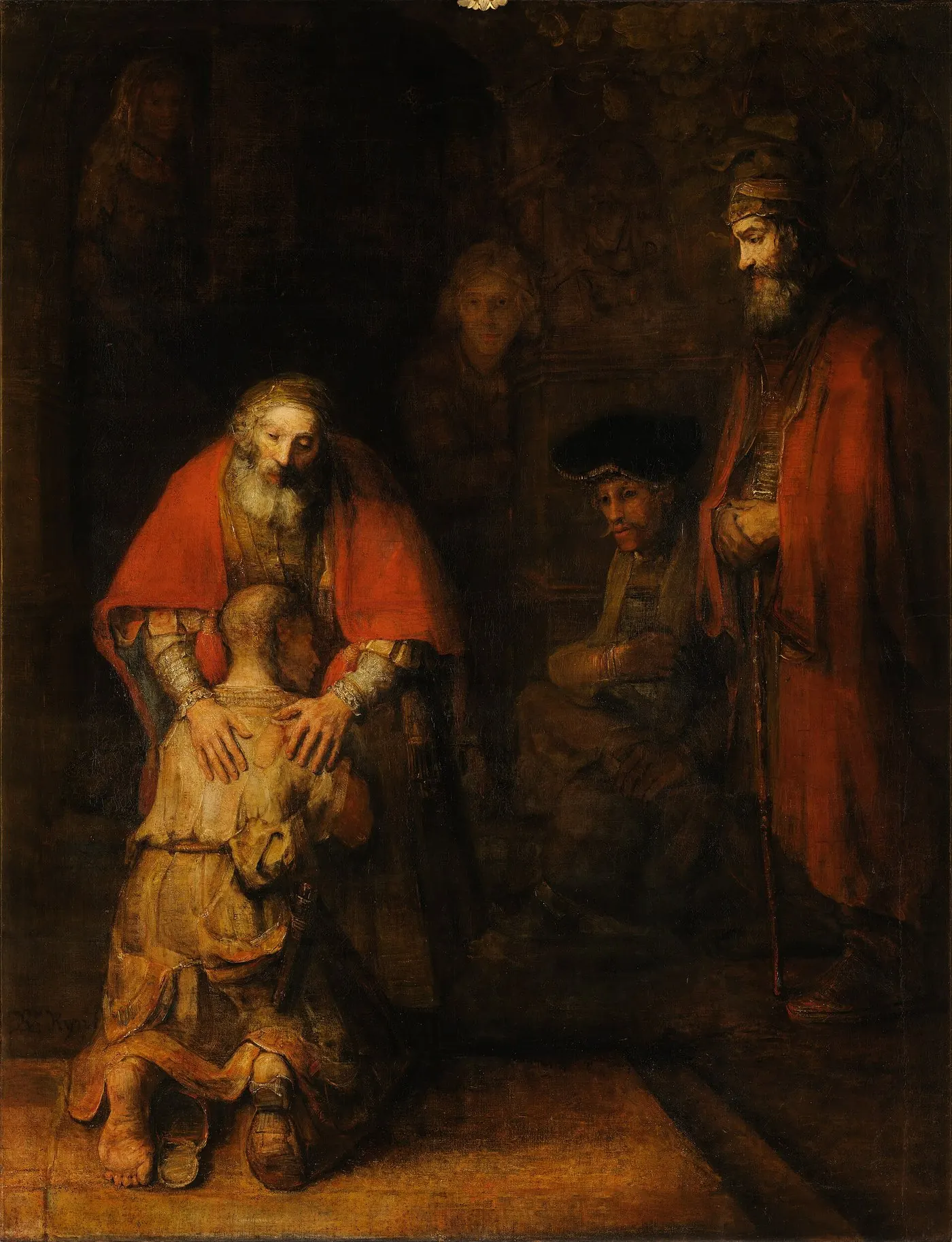
The Return of the Prodigal is carried by the body, and a body is carried by the way the paint turns.
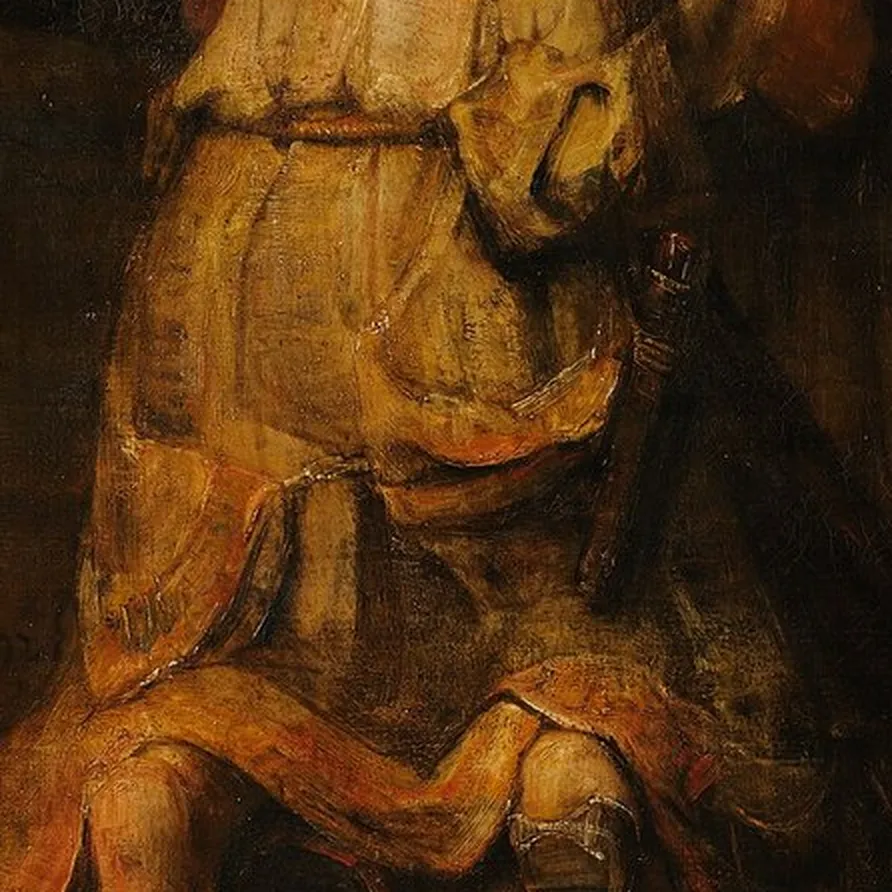
The drapery is painted as fabric over form, not as a pattern.
Fabric takes light differently from skin, and we paint the two differently.
Colour here is mixed for the passage, not for the object, which is why nothing looks like it was filled in.
The last marks are the ones that are left alone. Overworking is the enemy.
The passage that will take longest is the one that looks simplest.
It is a picture for a room you use, not a corridor you walk through.
| Artist | Rembrandt |
|---|---|
| Title | The Return of the Prodigal |
| Medium | Oil on canvas, hand-painted to order |
| What you receive | A hand-painted oil painting on canvas |
| Public domain | Yes — the artist died over 70 years ago |
The case for painting it by hand
A print reproduces the shapes and drops the substance. It is the substance you are buying.
Paint goes on in the original's order — thin first, thick last — so the surface behaves the way the painter intended.
| Aspect | Hand-painted oil | Printed canvas |
|---|---|---|
| Handling of colour | Mixed on the palette and finished on the canvas | Fixed by the colour profile |
| Texture | Ridges and drag you can see from across a room | None, or a printed imitation of it |
| Depth | Built in layers, catches light from the side | Flat; highlights are printed as pale ink |
| Value over time | Can be re-stretched, cleaned and re-framed | Little value beyond the print |
| Lifespan | Slow to change; varnish can be refreshed decades later | Fades and cracks sooner |
The difficult part is not the detail. It is keeping the whole canvas at the same stage of finish.
Every canvas is painted to order, so the quote follows your size, frame and destination rather than a fixed list. Tell us what you need on WhatsApp and we reply with an exact figure, usually within the hour. No resellers, no drop-shipper. The painter's studio handles your commission from first message to final crate.
The sequence on our floor
Here is what actually happens between your message and the crate:
- Stretching and priming the support — cotton duck or linen goes onto the bars and gets its ground.
- Laying in the drawing — done by eye from the reference, not traced or projected.
- The first colour pass — thin and simple, establishing the main shapes only.
- The values are established — this is the stage that decides whether the painting works.
- Building the colour — a warm and a cool version of each passage, put down in order.
- Finishing passes — the loaded highlights go on at the end and stay there.
- Left to dry before varnish — nothing is photographed or packed until the surface is ready.
The difficulty is restraint: leaving out most of what a photograph would show.
What it is made of
We buy pigment in tubes from the same suppliers the village has used for years, not in bulk drums. The paint is built in layers, fat over lean, which is what stops it cracking later.
Pigment is artist-grade oil colour, not acrylic and not house paint. It behaves differently and it lasts. Oil paint dries by oxidation, not evaporation, which is why a finished canvas needs weeks before it travels.
Living with it
Dust it with a dry, soft brush. Keep it out of direct sun and away from radiators, and it will outlive you.
Whether to frame it
If you are shipping, an unframed canvas rolled in a tube is considerably cheaper to move than a framed one.
Framing is quoted separately, so you can decide after you have seen the finished canvas in photographs.
What size works
You are not choosing from a list; you are telling us a measurement. These are the common ones:
| Size (inches) | Size (cm) | Best for |
|---|---|---|
| 12 × 16 in | 30 × 40 cm | A narrow wall between two openings |
| 16 × 24 in | 41 × 61 cm | Hallway end, beside a door |
| 20 × 30 in | 51 × 76 cm | A tight wall that needs height, not width |
| 24 × 36 in | 61 × 91 cm | Stairwell, tall entrance, gallery group |
Anything outside this table is fine — we paint to the number you give us. Import charges, where they exist, are the buyer's responsibility (DAP). We never add them to the quote and never guess what they will be.
It works best on a wall you pass rather than one you sit and stare at — the paint rewards a moving eye.
Tell us your size and frame — we reply with an exact quote, usually within the hour.
💬 Get a The Return of the Prodigal Son Quote on WhatsAppPlanning a wall or comparing options? Save this painting to Pinterest
Getting it to you
The painting takes 9–15 days, and delivery is priced separately on the quote so there is no surprise later.
In transit it is typically 7–10 business days by air, tracked door to door. Unframed canvases are rolled face-out on a tube; framed ones are corner-protected and crated.
Before anything is packed, you get photographs of the actual canvas and a chance to ask for changes. If something is not right, tell us what to adjust and we adjust it.
We sell DAP: the price covers the painting and the freight, and any import duties or taxes are the buyer's to settle with customs. We do not collect them and we do not estimate them.
A deposit starts the canvas and books the painter's time; the balance is due before the crate leaves. If a crate arrives damaged, send us photographs within 48 hours and contact us directly — we will sort it out with you.
Questions worth asking
What size should I order?
You choose the size. Each canvas is cut to your measurements rather than pulled from stock, so tell us the wall dimensions and we will tell you what proportion works.
How do I clean and care for it?
Dust lightly with a dry, soft brush and keep it out of direct sun. Nothing else is needed for decades; oil paint is slow to change and easy to live with.
Is there a rush option?
It depends on the canvas and what else is in the studio. Ask on WhatsApp with your size and we will tell you straight what is possible.
What is the canvas made of?
Cotton duck as standard, linen on request, artist-grade oil paint, and a final varnish once the paint is fully dry.
How long does it take?
From order to finished canvas is 9–15 days; delivery adds about 7–10 business days by air.
Do you sell prints?
No prints at all — no giclée, no canvas transfer, nothing machine-made.
What if it arrives damaged?
send us photographs within 48 hours and contact us directly — we will sort it out with you.
Can you change the colours to suit my room?
Sometimes. We will adjust the palette if it can be done without ruining the picture, and say so if it cannot.
Who pays the import duty?
You do. We sell DAP, so any duty or tax your customs authority charges is settled by you at import. We do not collect it and we do not estimate it.
Will I see it before it ships?
Yes — photographs of the actual painting go to you first, and nothing is packed until you have seen them.
Can I change the size?
Yes. The canvas is painted to your measurement, not taken from a stock list.
Do you ship to my country?
We ship to over 20 countries. Give us your city and the freight appears as its own line on the quote.
Brushwork details
Close-up crops of this 100% hand-painted oil reproduction — real oil texture, never a print.