The original, and why we can paint it
Because Rogier van der Weyden died in 1464, this work is in the public domain. We are painting a copy of a painting — we never pass it off as the original, and neither should anyone selling you one.
Ours is a painting made with brushes. There is no giclée, no canvas transfer and no digital underlayer anywhere in the process.
The painting was made in the years before 1464, and what we reproduce is the record of it, not the object.
You are buying a painting, not a file. That distinction is the whole business we are in.
How to read it
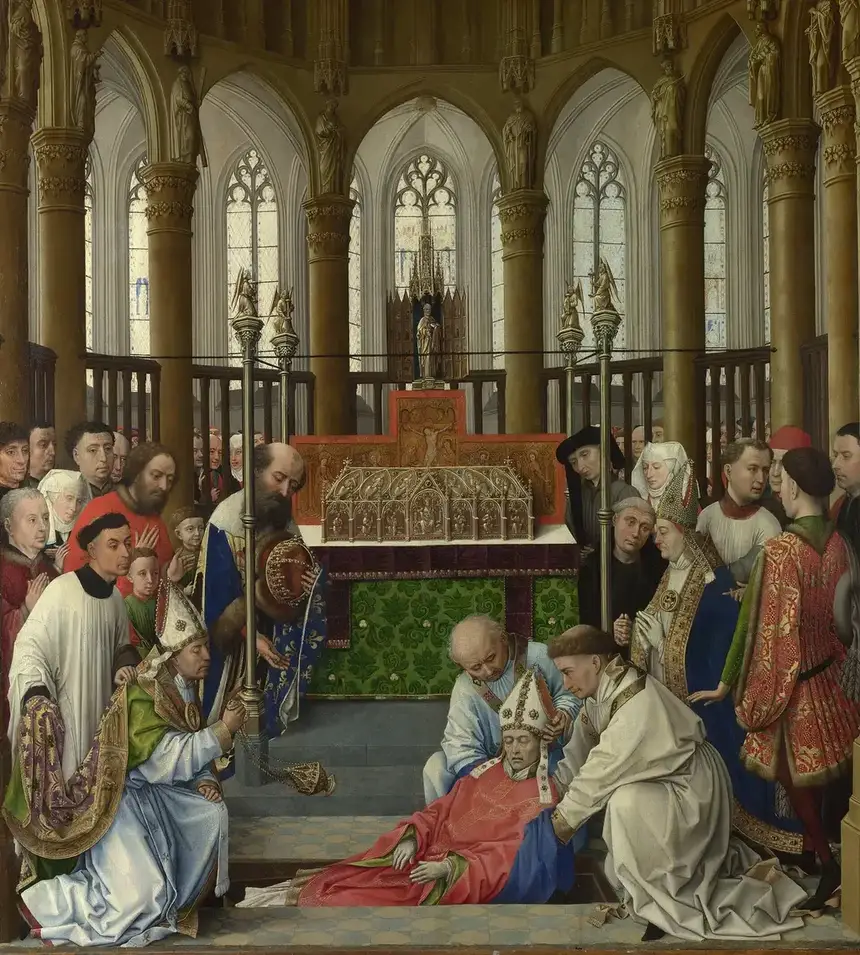
Exhumation of St Hubert is not a postcard. There is a decision in every zone of the canvas, and the decision is visible.
Our painter works freehand on a blank canvas, so the scale of the original survives the enlargement.
Where the source has light coming through the paint, we glaze rather than paint opaque white.
The saturation is deliberately uneven: strongest at the focal point, weaker everywhere else.
The marks have a direction, and the direction follows the form.
Matching the original's degree of finish is harder than matching its colours.
Given the subject, this sits naturally in a living room or a study rather than a hallway.
| Artist | Rogier van der Weyden |
|---|---|
| Title | Exhumation of St Hubert |
| Medium | Oil on canvas, hand-painted to order |
| Reproduction | Hand-painted oil on canvas, made to order |
| Original status | Public domain (artist deceased) |
Why hand-painting matters here
Prints are good at information and bad at paint. This subject is mostly paint.
Edges are left soft where the form turns away and sharp where it does not. That single habit is what separates a painting from a copy.
| Aspect | Hand-painted oil | Printed canvas |
|---|---|---|
| Colour | Mixed for each passage, warm and cool versions | One flat value per area |
| Corrections | We adjust it and repaint the passage | The file is reprinted or it is not |
| Impasto | Real paint standing off the canvas | Flat ink, sometimes embossed to imitate |
| Edge quality | Soft where the form turns, sharp where it does not | Uniformly sharp or uniformly blurred |
| What it takes | One painter, several days, start to finish | A machine, a few minutes |
What takes time here is the number of separate decisions, not the size of the canvas.
Every canvas is painted to order, so the quote follows your size, frame and destination rather than a fixed list. Tell us what you need on WhatsApp and we reply with an exact figure, usually within the hour. There is no agency in between; the studio that paints your canvas is the one answering your messages.
From blank canvas to finished painting
This is how the painting is built, in the order our painters build it:
- The canvas is stretched and primed — cotton or linen, sized and ready before any paint goes near it.
- A loose underdrawing — proportions checked by eye against the source image.
- The big shapes are blocked in — thin paint, one colour at a time, the whole canvas at once.
- The values are established — this is the stage that decides whether the painting works.
- Colour is built up — warmer and cooler versions of each passage, laid over the underpainting.
- Detail and highlights last — put on thickly and then not touched again.
- Drying and varnishing — the final varnish goes on once the paint has set, before we photograph it.
The difficult part is not the detail. It is keeping the whole canvas at the same stage of finish.
Care and cleaning
Once the varnish has cured the surface can be cleaned by a conservator, but in a normal house it will not need it for decades.
On framing
We can supply a simple floater frame, a traditional gilt, or nothing at all. It is your call.
We can supply a simple floater frame, a traditional gilt, or nothing at all. It is your call.
Materials
We use a neutral-sized ground so the whites stay warm rather than going blue over time. The ground is a proper acrylic sizing, so the oil does not rot the fabric over time.
We use cotton duck for most sizes and linen where the canvas is large or the client asks for it. Varnish goes on only once the paint is properly dry, months after the last stroke, not before.
Canvas sizes
You are not choosing from a list; you are telling us a measurement. These are the common ones:
| Size (inches) | Size (cm) | Best for |
|---|---|---|
| 64 × 48 in | 163 × 122 cm | Villa scale, lobby, hospitality wall |
| 48 × 36 in | 122 × 91 cm | Large living room, stairwell, loft |
| 40 × 30 in | 102 × 76 cm | Living room focal wall, above a sofa |
| 32 × 24 in | 81 × 61 cm | Living room, above a sideboard |
Tell us the wall width and we will tell you what looks right rather than what is standard. Duties and import taxes are the buyer's account (DAP). Your customs authority sets them; we do not.
It wants a wall where the light rakes across it, because the surface is part of the picture.
Tell us where it will hang and how big it needs to be — we will price it properly.
💬 Get a Quote for Exhumation of St HubertTimeline and shipping
From order to finished canvas is 9–15 days. Freight appears as a separate line on the quote and is fixed before you pay.
Air freight runs about 7–10 business days, tracked, to your door. Unframed canvases are rolled face-out on a tube; framed ones are corner-protected and crated.
You see photographs of the finished painting before it ships, and you tell us what to adjust. Changes are handled by telling us what to change; we change it and send new photographs.
We quote DAP, so any duty or tax your country charges is settled by you at import. We do not add a tax line of our own.
A deposit starts the canvas and books the painter's time; the balance is due before the crate leaves. If a crate arrives damaged, send us photographs within 48 hours and contact us directly — we will sort it out with you.
What people ask us
Is there a rush option?
It depends on the canvas and what else is in the studio. Ask on WhatsApp with your size and we will tell you straight what is possible.
Can I get this in a size that is not listed?
Yes — the listed sizes are the common requests, not a limit. Very wide or unusually tall proportions are routine for us.
What happens after I message you?
You tell us the painting, size and whether you want a frame. We quote, a painter starts on your canvas, and you get photographs before it ships.
Can I change the size?
Yes. The canvas is painted to your measurement, not taken from a stock list.
Do you take a deposit?
A deposit starts the canvas and the balance falls due before it ships. Both figures appear on the quote.
Do you ship to my country?
We export to more than 20 countries. Tell us where you are and we will quote the freight as a separate line.
Can you paint a different work by Rogier van der Weyden?
Yes. Send the image and we will quote it, or browse the other paintings we have listed.
What does it cost?
Every canvas is quoted on size, frame and destination rather than a fixed list. Tell us what you need and we reply with an exact figure.
Who pays the import duty?
You do. We sell DAP, so any duty or tax your customs authority charges is settled by you at import. We do not collect it and we do not estimate it.
How do I hang it?
Roughly 145 cm from floor to centre works for most rooms. Tell us your wall and we will give you the measurement.
Can you change the colours to suit my room?
We can shift the palette, but we will tell you honestly when a change would spoil the painting.
Is owning a reproduction legal?
Yes. The painting is out of copyright because Rogier van der Weyden died more than 70 years ago. We paint copies honestly and never claim they are originals.