About Portrait of Philip the Good
Rogier van der Weyden died in 1464, so the work has been in the public domain for decades. Reproducing it by hand is legal, and so is owning one.
Ours is a painting made with brushes. There is no giclée, no canvas transfer and no digital underlayer anywhere in the process.
The painting was made in the years before 1464, and what we reproduce is the record of it, not the object.
If you want something printed, we are the wrong workshop. We do not own a printer that touches canvas.
Where the painting lives
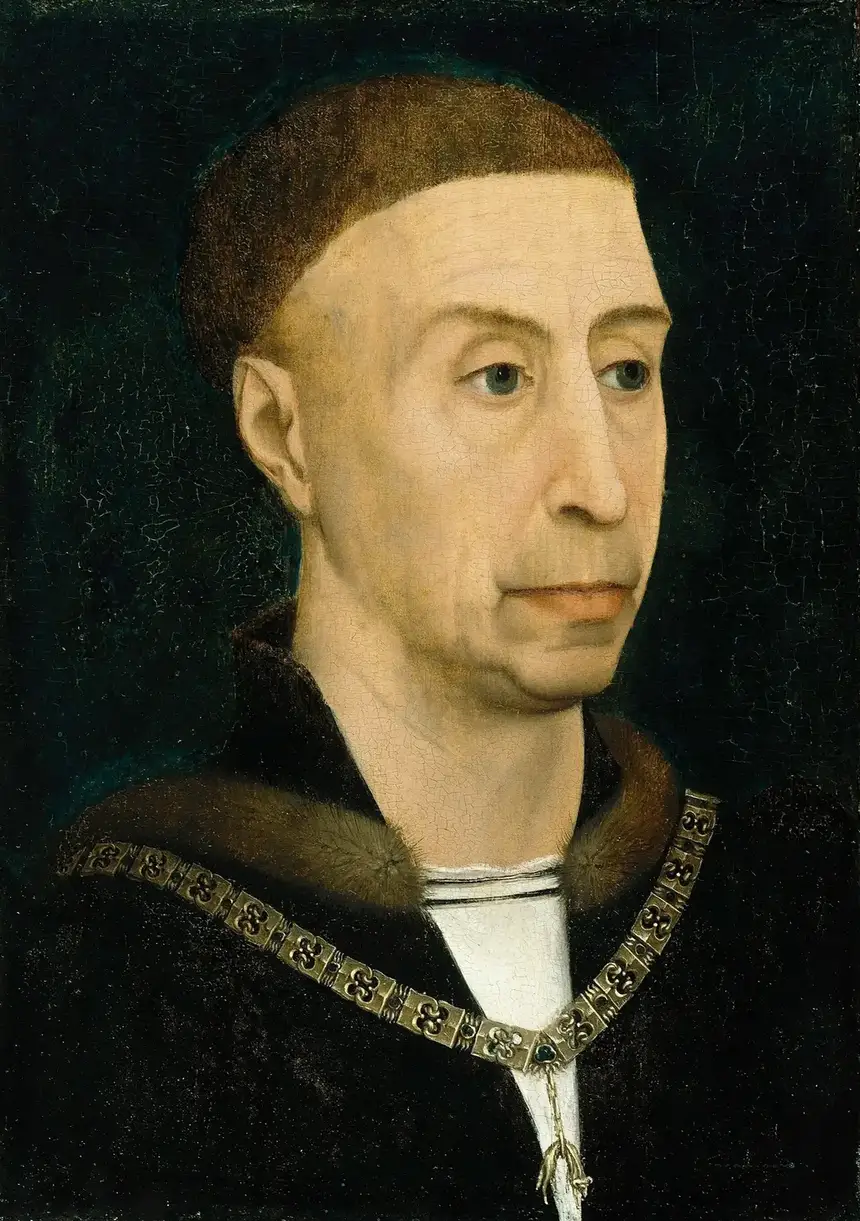
A face is the hardest thing to fake. Portrait of Philip the Good is painted by hand precisely because a machine cannot do the skin.
Hands and costume are kept subordinate to the face, which is where the paint is most worked.
Skin here is translucent: light goes in, bounces, and comes back warm. That is done with thin paint over a lighter ground.
We keep the original's palette rather than brightening it, even where a modern eye would.
Nothing here is blended flat. Blending is what makes a painting look printed.
What takes time here is the number of separate decisions, not the size of the canvas.
A plain wall is better than a busy one; the painting supplies the interest.
| Artist | Rogier van der Weyden |
|---|---|
| Title | Portrait of Philip the Good |
| Medium | Oil on canvas, hand-painted to order |
| What you receive | A hand-painted oil painting on canvas |
| Original status | Public domain (artist deceased) |
What a print loses
A print reproduces the shapes and drops the substance. It is the substance you are buying.
Edges are left soft where the form turns away and sharp where it does not. That single habit is what separates a painting from a copy.
| Aspect | Hand-painted oil | Printed canvas |
|---|---|---|
| Impasto | Real paint standing off the canvas | Flat ink, sometimes embossed to imitate |
| Edge quality | Soft where the form turns, sharp where it does not | Uniformly sharp or uniformly blurred |
| Corrections | We adjust it and repaint the passage | The file is reprinted or it is not |
| Surface | Hand-painted oil on canvas | Ink on canvas, flat |
| Later on | Can be restored, re-framed, handed on | Replaceable, and usually replaced |
Anyone can copy the shapes. The skill is in the transitions, and that is what takes the days.
Every canvas is painted to order, so the quote follows your size, frame and destination rather than a fixed list. Tell us what you need on WhatsApp and we reply with an exact figure, usually within the hour. No resellers, no drop-shipper. The painter's studio handles your commission from first message to final crate.
How the canvas is built
This is how the painting is built, in the order our painters build it:
- We start with the canvas itself — stretched, sized and left to settle before any colour is mixed.
- Laying in the drawing — done by eye from the reference, not traced or projected.
- The first colour pass — thin and simple, establishing the main shapes only.
- Getting the values right — the stage that decides whether the finished painting holds together.
- Building the colour — a warm and a cool version of each passage, put down in order.
- Finishing passes — the loaded highlights go on at the end and stay there.
- Left to dry before varnish — nothing is photographed or packed until the surface is ready.
The passage that will take longest is the one that looks simplest.
Keeping it
Once the varnish has cured the surface can be cleaned by a conservator, but in a normal house it will not need it for decades.
Frames
Most clients wait for the photographs before choosing a frame, which is the sensible order.
Most clients wait for the photographs before choosing a frame, which is the sensible order.
What it is made of
Oil paint dries by oxidation, not evaporation, which is why a finished canvas needs weeks before it travels. Large canvases get a cross-brace; anything over about a metre and a half needs one.
Varnish goes on only once the paint is properly dry, months after the last stroke, not before. Nothing is sprayed, sealed or laminated. The surface you see is paint and varnish, and that is all.
Getting the size right
You are not choosing from a list; you are telling us a measurement. These are the common ones:
| Size (inches) | Size (cm) | Best for |
|---|---|---|
| 24 × 20 in | 60 × 50 cm | Study, home office, above a desk |
| 20 × 16 in | 50 × 40 cm | Bedroom, hallway, above a console |
| 16 × 12 in | 40 × 30 cm | A shelf, a small wall, a gallery group |
| 64 × 48 in | 163 × 122 cm | Villa scale, lobby, hospitality wall |
If your wall is an odd shape, send the measurement and we will work to it. Proportions from the original are kept unless you ask us to change them. Our terms are DAP, meaning the freight is paid by us and any import charges are yours to settle. We will not estimate them, because the figure is your customs authority's to set.
Given the subject, this sits naturally in a living room or a study rather than a hallway.
Give us your size and framing preference and you will have a quote shortly.
💬 Get a Quote for Portrait of Philip the GoodHow it reaches you
Allow 9–15 days for the painting itself. Shipping is a separate line on your quote — you see it before payment, not after.
Expect 7–10 business days in transit, with tracking from our door to yours. Every shipment goes out with tracking. We do not send anything untracked.
Before anything is packed, you get photographs of the actual canvas and a chance to ask for changes. If something is not right, tell us what to adjust and we adjust it.
Duties and import taxes are the buyer's account (DAP). Your customs authority sets them; we do not.
You pay a deposit to start and the remainder before shipping. Nothing is hidden in between. Report any transit damage within 48 hours with photographs and we will deal with the carrier. We will not promise a payout, but we will not leave you to argue alone either.
The practical questions
What size should I order?
You choose the size. Each canvas is cut to your measurements rather than pulled from stock, so tell us the wall dimensions and we will tell you what proportion works.
What if it does not look right to me?
We send photographs of the actual painting for your approval before anything ships. That is the moment to tell us what to adjust.
Do you take a deposit?
Work begins on a deposit and ships once the balance is paid. Nothing is charged that is not on the quote.
Do you ship to my country?
We ship to over 20 countries. Give us your city and the freight appears as its own line on the quote.
How do I hang it?
Centre it at about 145 cm from the floor, or two-thirds the width of the furniture below it. We will tell you the exact number for your wall.
Can you change the colours to suit my room?
We can shift the palette, but we will tell you honestly when a change would spoil the painting.
Is owning a reproduction legal?
Yes. The painting is out of copyright because Rogier van der Weyden died more than 70 years ago. We paint copies honestly and never claim they are originals.
Who pays the import duty?
You do. We sell DAP, so any duty or tax your customs authority charges is settled by you at import. We do not collect it and we do not estimate it.
Can you paint it from a different photograph of the same work?
Send your own reference image and we will paint from that instead.
Does it come framed?
Frames are priced on their own line. Most clients choose after seeing the photographs.
Can you paint a different work by Rogier van der Weyden?
Yes. Send the image and we will quote it, or browse the other paintings we have listed.