What you are buying into
Rogier van der Weyden died in 1464, so the work has been in the public domain for decades. Reproducing it by hand is legal, and so is owning one.
Ours is a painting made with brushes. There is no giclée, no canvas transfer and no digital underlayer anywhere in the process.
The painting was made in the years before 1464, and what we reproduce is the record of it, not the object.
What arrives is a canvas with paint on it, made by a person. That is the only thing we sell.
Where the painting lives
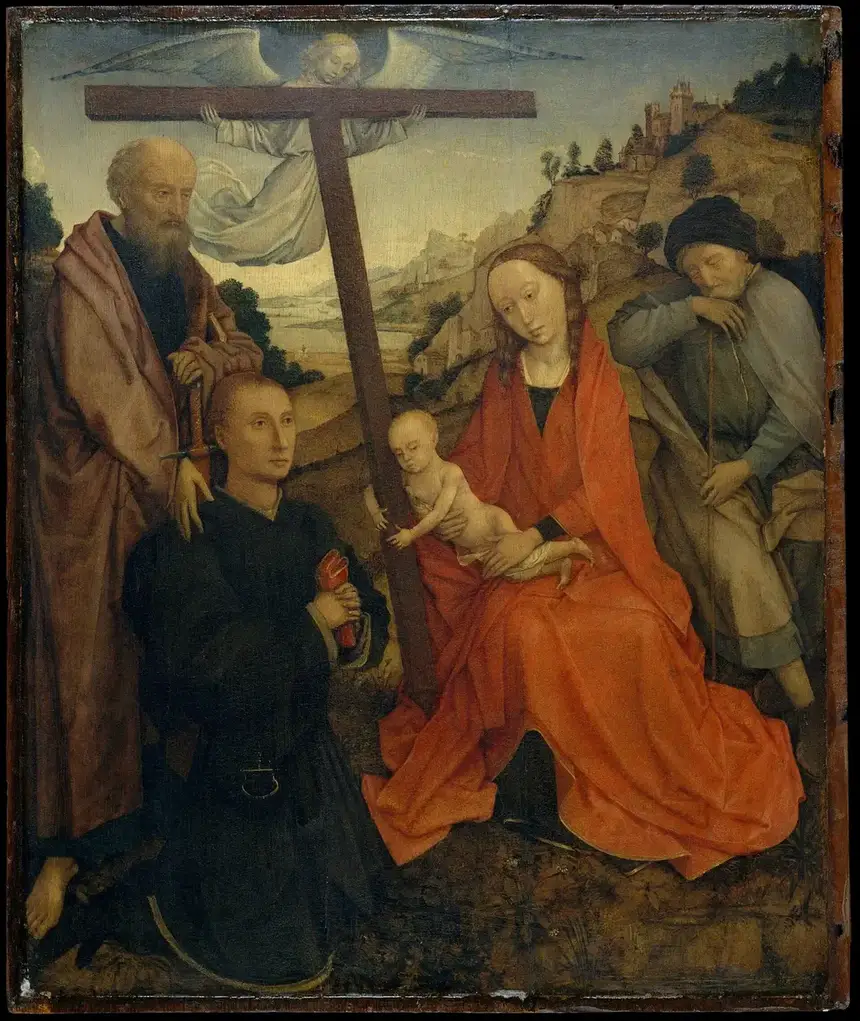
The faces in The Holy Family with Saint are handled softly and the drapery sharply. That contrast is the painting.
The grouping is built so the eye goes to one point, and nothing competes with it.
The darks are painted thin so they stay luminous rather than muddy.
Saturated colour is kept for a small area; the rest is deliberately knocked back.
The brushwork is left visible, which is the whole argument for painting it by hand.
The hardest passage is the quiet one, where a small mistake has nowhere to hide.
A plain wall is better than a busy one; the painting supplies the interest.
| Artist | Rogier van der Weyden |
|---|---|
| Title | The Holy Family with Saint |
| Medium | Oil on canvas, hand-painted to order |
| Our version | Oil on canvas, painted by hand to order |
| Public domain | Yes — the artist died over 70 years ago |
Why this one cannot be printed
A print reproduces the shapes and drops the substance. It is the substance you are buying.
Our painter follows the same logic rather than copying a photograph of it: the far distances go down cool and weak, the near ground stays loaded, and nothing is blended flat.
| Aspect | Hand-painted oil | Printed canvas |
|---|---|---|
| Available sizes | Whatever you need, painted to order | What the printer can output |
| Surface | Hand-painted oil on canvas | Ink on canvas, flat |
| Edges | Chosen by the painter, passage by passage | Whatever the file happens to contain |
| Later on | Can be restored, re-framed, handed on | Replaceable, and usually replaced |
| Sense of depth | Real, created by layers of paint | Simulated by darker ink |
What takes time here is the number of separate decisions, not the size of the canvas.
Every canvas is painted to order, so the quote follows your size, frame and destination rather than a fixed list. Tell us what you need on WhatsApp and we reply with an exact figure, usually within the hour. There is no agency in between; the studio that paints your canvas is the one answering your messages.
How your painting is made
Here is what actually happens between your message and the crate:
- The canvas is stretched and primed — cotton or linen, sized and ready before any paint goes near it.
- A loose underdrawing — proportions checked by eye against the source image.
- Blocking the masses — thin paint, working the whole surface rather than one corner at a time.
- Getting the values right — the stage that decides whether the finished painting holds together.
- Colour is built up — warmer and cooler versions of each passage, laid over the underpainting.
- Detail and highlights last — put on thickly and then not touched again.
- Drying and varnishing — the final varnish goes on once the paint has set, before we photograph it.
The difficulty is restraint: leaving out most of what a photograph would show.
On framing
If you are shipping, an unframed canvas rolled in a tube is considerably cheaper to move than a framed one.
If you are shipping, an unframed canvas rolled in a tube is considerably cheaper to move than a framed one.
What it is made of
We do not use a printer at any stage. There is no giclée, no canvas transfer, no digital underlayer. Large canvases get a cross-brace; anything over about a metre and a half needs one.
The ground is a proper acrylic sizing, so the oil does not rot the fabric over time. We use a neutral-sized ground so the whites stay warm rather than going blue over time.
Keeping it
Once the varnish has cured the surface can be cleaned by a conservator, but in a normal house it will not need it for decades.
Canvas sizes
Any size is possible. These are simply the ones that come up most often in quotes:
| Size (inches) | Size (cm) | Best for |
|---|---|---|
| 16 × 12 in | 40 × 30 cm | A shelf, a small wall, a gallery group |
| 64 × 48 in | 163 × 122 cm | Villa scale, lobby, hospitality wall |
| 48 × 36 in | 122 × 91 cm | Large living room, stairwell, loft |
| 40 × 30 in | 102 × 76 cm | Living room focal wall, above a sofa |
| 32 × 24 in | 81 × 61 cm | Living room, above a sideboard |
If your wall is an odd shape, send the measurement and we will work to it. Proportions from the original are kept unless you ask us to change them. Our terms are DAP, meaning the freight is paid by us and any import charges are yours to settle. We will not estimate them, because the figure is your customs authority's to set.
It suits a room with warm, low light. Strong downlighting flattens the surface.
Tell us where it will hang and how big it needs to be — we will price it properly.
💬 Get a Quote for The Holy Family with Saint Paul and a Donor MET DT24How it reaches you
Allow 9–15 days for the painting itself. Shipping is a separate line on your quote — you see it before payment, not after.
Transit is usually 7–10 business days, tracked all the way. Unframed canvases are rolled face-out on a tube; framed ones are corner-protected and crated.
You see photographs of the finished painting before it ships, and you tell us what to adjust. If something is not right, tell us what to adjust and we adjust it.
Duties and import taxes are the buyer's account (DAP). Your customs authority sets them; we do not.
A deposit starts the canvas and books the painter's time; the balance is due before the crate leaves. Report any transit damage within 48 hours with photographs and we will deal with the carrier. We will not promise a payout, but we will not leave you to argue alone either.
What people ask us
How close will it be to the original?
The composition, colour and drawing follow the original closely; the brushwork carries the painter's own hand. The painter works freehand on a blank canvas, following the same logic as the original rather than copying a photograph.
Do you work from my own photograph?
Yes, though that is a separate service. This page is for a hand-painted version of {title}; for a photo-to-painting commission, send the image on WhatsApp.
What if my wall is an unusual shape?
That is normal for us. Send the measurements and we will work out a canvas proportion that suits the space.
Do you sell prints?
No prints at all — no giclée, no canvas transfer, nothing machine-made.
Do you take a deposit?
Work begins on a deposit and ships once the balance is paid. Nothing is charged that is not on the quote.
How long does it take?
Allow 9–15 days for the painting itself, then roughly 7–10 business days in transit.
Can you change the colours to suit my room?
We can shift the palette, but we will tell you honestly when a change would spoil the painting.
What is the canvas made of?
Cotton duck as standard, linen on request, artist-grade oil paint, and a final varnish once the paint is fully dry.
What if it arrives damaged?
send us photographs within 48 hours and contact us directly — we will sort it out with you.
Can I change the size?
Yes. The canvas is painted to your measurement, not taken from a stock list.
Will I see it before it ships?
Yes. We send photographs of the finished canvas and wait for your reply before packing.
How do I hang it?
Centre it at about 145 cm from the floor, or two-thirds the width of the furniture below it. We will tell you the exact number for your wall.