What you are buying into
Sandro Botticelli died in 1510, so the work has been in the public domain for decades. Reproducing it by hand is legal, and so is owning one.
Every version we make is oil on canvas, painted by one painter from start to finish. No printing is involved at any stage.
It is an original composition painted before 1510, and our version is painted from the surviving image of it.
What arrives is a canvas with paint on it, made by a person. That is the only thing we sell.
What the painting is doing
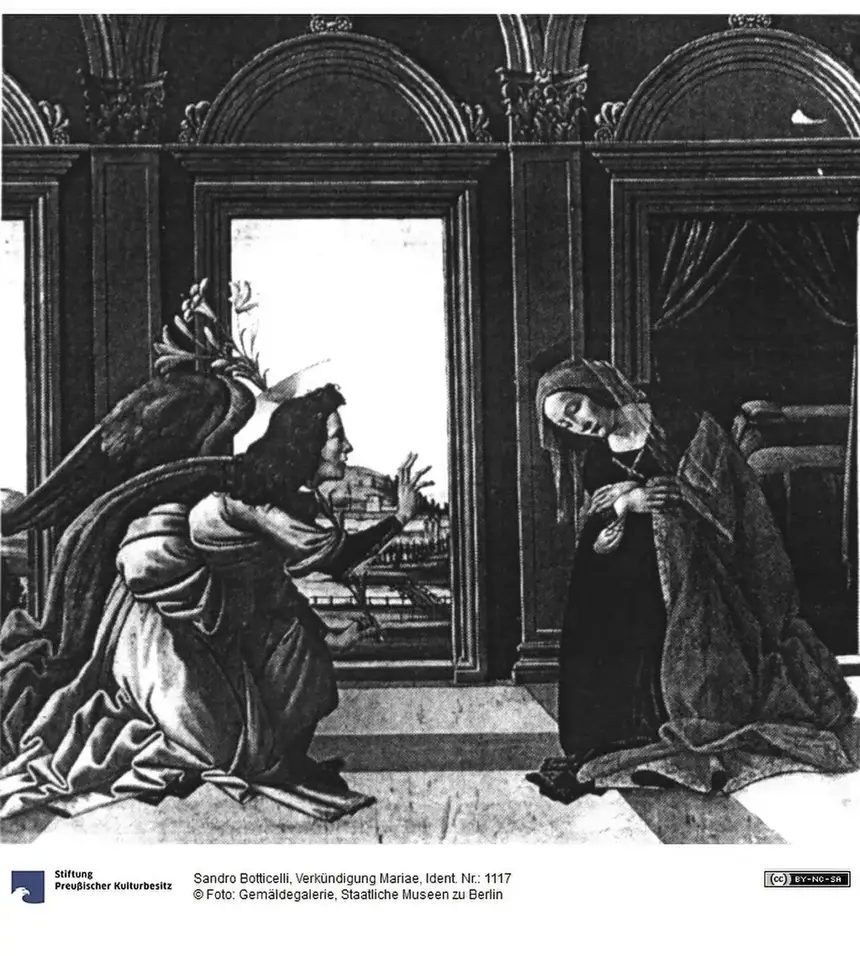
Verkündigung Mariae is not a postcard. There is a decision in every zone of the canvas, and the decision is visible.
Nothing in Verkündigung Mariae is centred for the sake of being centred; the weight sits where the painter wanted it.
The light in Verkündigung Mariae has a direction, and the painter keeps it consistent across every object in the picture.
We keep the original's palette rather than brightening it, even where a modern eye would.
The marks have a direction, and the direction follows the form.
Matching the original's degree of finish is harder than matching its colours.
It suits a room with warm, low light. Strong downlighting flattens the surface.
| Artist | Sandro Botticelli |
|---|---|
| Title | Verkündigung Mariae |
| Medium | Oil on canvas, hand-painted to order |
| Our version | Oil on canvas, painted by hand to order |
| Public domain | Yes — the artist died over 70 years ago |
What a print loses
What you lose in a print is the air. A press lays ink flat; a painter builds depth in layers, and the depth is what you actually see.
Edges are left soft where the form turns away and sharp where it does not. That single habit is what separates a painting from a copy.
| Aspect | Hand-painted oil | Printed canvas |
|---|---|---|
| Depth | Built in layers, catches light from the side | Flat; highlights are printed as pale ink |
| Changing something | Tell us and the passage gets repainted | Usually means starting the file again |
| How it ages | Warms and settles; cleanable by a conservator | Fades, then cracks at the stretcher |
| Size | Any size, painted to your wall | Limited by the printer |
| The surface | Built up with brushes and knives | Printed flat in one pass |
The difficulty is restraint: leaving out most of what a photograph would show.
Every canvas is painted to order, so the quote follows your size, frame and destination rather than a fixed list. Tell us what you need on WhatsApp and we reply with an exact figure, usually within the hour. No resellers, no drop-shipper. The painter's studio handles your commission from first message to final crate.
How it gets painted
No two canvases are painted the same way, but the sequence is always this:
- The canvas is stretched and primed — cotton or linen, sized and ready before any paint goes near it.
- The drawing goes down — charcoal or thin paint, done by eye rather than traced from a printout.
- The first colour pass — thin and simple, establishing the main shapes only.
- The values are established — this is the stage that decides whether the painting works.
- Building the colour — a warm and a cool version of each passage, put down in order.
- Finishing passes — the loaded highlights go on at the end and stay there.
- Drying and varnishing — the final varnish goes on once the paint has set, before we photograph it.
The passage that will take longest is the one that looks simplest.
What it is made of
We use cotton duck for most sizes and linen where the canvas is large or the client asks for it. Varnish goes on only once the paint is properly dry, months after the last stroke, not before.
The paint is built in layers, fat over lean, which is what stops it cracking later. The varnish is removable, so a conservator can clean the painting in fifty years without touching the paint.
Frames
Most clients wait for the photographs before choosing a frame, which is the sensible order.
A frame is a separate line on the quote, not a bundle. You choose it once the painting exists.
Care and cleaning
Once the varnish has cured the surface can be cleaned by a conservator, but in a normal house it will not need it for decades.
Choosing a size
Any size is possible. These are simply the ones that come up most often in quotes:
| Size (inches) | Size (cm) | Best for |
|---|---|---|
| 16 × 12 in | 40 × 30 cm | A shelf, a small wall, a gallery group |
| 64 × 48 in | 163 × 122 cm | Villa scale, lobby, hospitality wall |
| 48 × 36 in | 122 × 91 cm | Large living room, stairwell, loft |
| 40 × 30 in | 102 × 76 cm | Living room focal wall, above a sofa |
| 32 × 24 in | 81 × 61 cm | Living room, above a sideboard |
We will size the canvas to the room, not to a stock list. Send us the measurement. Duties and import taxes are the buyer's account (DAP). Your customs authority sets them; we do not.
This reads well above a sofa or a sideboard, where it will be seen from two to three metres.
Give us your size and framing preference and you will have a quote shortly.
💬 Get a Quote for Verkündigung MariaeFrom order to your wall
Allow 9–15 days for the painting itself. Shipping is a separate line on your quote — you see it before payment, not after.
Expect 7–10 business days in transit, with tracking from our door to yours. We send photographs of the finished painting before it is packed, and again once it is boxed.
You approve the painting from photographs before it is packed — that is the checkpoint. If something is not right, tell us what to adjust and we adjust it.
We sell DAP: the price covers the painting and the freight, and any import duties or taxes are the buyer's to settle with customs. We do not collect them and we do not estimate them.
A deposit starts the canvas and books the painter's time; the balance is due before the crate leaves. Report any transit damage within 48 hours with photographs and we will deal with the carrier. We will not promise a payout, but we will not leave you to argue alone either.
The practical questions
Do you work from my own photograph?
Yes, though that is a separate service. This page is for a hand-painted version of {title}; for a photo-to-painting commission, send the image on WhatsApp.
What about duties and import taxes?
Those are the buyer's responsibility (DAP). The amounts are set by your customs authority, not by us.
How close will it be to the original?
The composition, colour and drawing follow the original closely; the brushwork carries the painter's own hand. The painter works freehand on a blank canvas, following the same logic as the original rather than copying a photograph.
Can you paint a different work by Sandro Botticelli?
Yes — send us the image, or look through the other Sandro Botticelli works on the site.
What if it arrives damaged?
Report damage within 48 hours with photographs. We deal with the carrier rather than leaving you to argue alone.
What is the canvas made of?
Cotton or linen, oil colour, and varnish. Stretcher bars are wedged so the canvas can be re-tensioned later.
Can you paint it from a different photograph of the same work?
Send your own reference image and we will paint from that instead.
Do you ship to my country?
We export to more than 20 countries. Tell us where you are and we will quote the freight as a separate line.
Is owning a reproduction legal?
Yes. The painting is out of copyright because Sandro Botticelli died more than 70 years ago. We paint copies honestly and never claim they are originals.
Can you change the colours to suit my room?
Sometimes. We will adjust the palette if it can be done without ruining the picture, and say so if it cannot.
What does it cost?
Every canvas is quoted on size, frame and destination rather than a fixed list. Tell us what you need and we reply with an exact figure.
Does it come framed?
Frames are priced on their own line. Most clients choose after seeing the photographs.