The original, and why we can paint it
Because Thomas Cole died in 1848, this work is in the public domain. We are painting a copy of a painting — we never pass it off as the original, and neither should anyone selling you one.
We paint it in oil on canvas, one at a time, in Dafen Village. Nothing is printed, scanned or transferred.
The painting was made in the years before 1848, and what we reproduce is the record of it, not the object.
What arrives is a canvas with paint on it, made by a person. That is the only thing we sell.
Looking at it properly
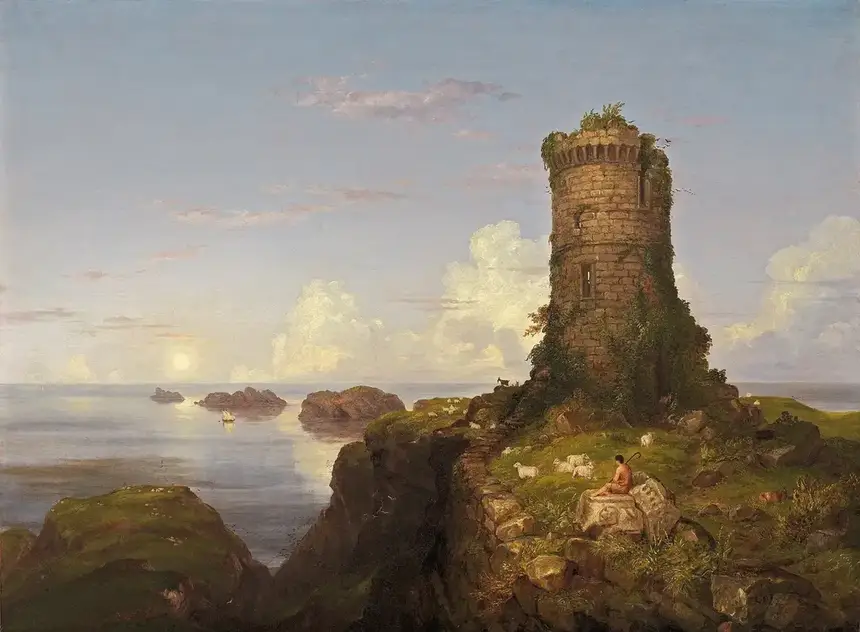
What makes a seascape worth painting by hand is the distance in it — the space between the near ground and the far one.
Our painter works freehand on a blank canvas, so the scale of the original survives the enlargement.
The brightest passage is kept small. That is what makes it read as bright.
Temperature does the work of contrast in the quiet areas, where value differences are small.
Nothing here is blended flat. Blending is what makes a painting look printed.
The difficulty is restraint: leaving out most of what a photograph would show.
In a bedroom it works above a headboard, sized to about two-thirds of the furniture width.
| Artist | Thomas Cole |
|---|---|
| Title | Italian Coast Scene with Ruined Tower |
| Created (original) | 1838 |
| Medium | Oil on canvas, hand-painted to order |
| Reproduction | Hand-painted oil on canvas, made to order |
| Original status | Public domain (artist deceased) |
Why hand-painting matters here
A print reproduces the shapes and drops the substance. It is the substance you are buying.
Paint goes on in the original's order — thin first, thick last — so the surface behaves the way the painter intended.
| Aspect | Hand-painted oil | Printed canvas |
|---|---|---|
| Colour | Mixed for each passage, warm and cool versions | One flat value per area |
| Sense of depth | Real, created by layers of paint | Simulated by darker ink |
| Texture | Ridges and drag you can see from across a room | None, or a printed imitation of it |
| The surface | Built up with brushes and knives | Printed flat in one pass |
| Changing something | Tell us and the passage gets repainted | Usually means starting the file again |
This one repaints badly, so our painter gets the values right early and leaves them.
Every canvas is painted to order, so the quote follows your size, frame and destination rather than a fixed list. Tell us what you need on WhatsApp and we reply with an exact figure, usually within the hour. No resellers, no drop-shipper. The painter's studio handles your commission from first message to final crate.
The sequence on our floor
Every canvas is painted to order, so nothing is pulled off a shelf. This is the sequence:
- The canvas is stretched and primed — cotton or linen, sized and ready before any paint goes near it.
- The drawing goes down — charcoal or thin paint, done by eye rather than traced from a printout.
- Blocking the masses — thin paint, working the whole surface rather than one corner at a time.
- Setting the key — how dark the darks go determines everything that follows.
- Colour is built up — warmer and cooler versions of each passage, laid over the underpainting.
- The detail and highlights go on — last, loaded, and left alone once they are down.
- Drying and varnishing — the final varnish goes on once the paint has set, before we photograph it.
What takes time here is the number of separate decisions, not the size of the canvas.
Whether to frame it
Most clients wait for the photographs before choosing a frame, which is the sensible order.
Framing is quoted separately, so you can decide after you have seen the finished canvas in photographs.
Canvas, paint and varnish
The varnish is removable, so a conservator can clean the painting in fifty years without touching the paint. The ground is a proper acrylic sizing, so the oil does not rot the fabric over time.
Nothing is sprayed, sealed or laminated. The surface you see is paint and varnish, and that is all. Brushes, knives and rags. That is the equipment list; there is no machine in the process.
Keeping it
Once the varnish has cured the surface can be cleaned by a conservator, but in a normal house it will not need it for decades.
Choosing a size
Any size is possible. These are simply the ones that come up most often in quotes:
| Size (inches) | Size (cm) | Best for |
|---|---|---|
| 30 × 24 in | 76 × 61 cm | Dining room, bedroom feature wall |
| 24 × 20 in | 60 × 50 cm | Study, home office, above a desk |
| 20 × 16 in | 50 × 40 cm | Bedroom, hallway, above a console |
| 16 × 12 in | 40 × 30 cm | A shelf, a small wall, a gallery group |
Anything outside this table is fine — we paint to the number you give us. Import charges, where they exist, are the buyer's responsibility (DAP). We never add them to the quote and never guess what they will be.
It suits a room with warm, low light. Strong downlighting flattens the surface.
Give us your size and framing preference and you will have a quote shortly.
💬 Get a Quote for Italian Coast Scene with Ruined TowerFrom order to your wall
The painting takes 9–15 days, and delivery is priced separately on the quote so there is no surprise later.
Air freight runs about 7–10 business days, tracked, to your door. Rolled in a tube it travels cheaper and safer than framed; most overseas clients take it that way.
You see photographs of the finished painting before it ships, and you tell us what to adjust. Adjustments are part of the process. Say what you want different and it gets done.
Shipments go out DAP. If your customs office charges duty or tax on arrival, that is between you and them — we do not collect it and we do not put a number on it.
Work begins on a deposit and ships on the balance. Both figures are on the quote. Damage in transit should be reported to us within 48 hours, with photographs. We pursue it with the carrier rather than promising a refund.
What people ask us
Is there a rush option?
It depends on the canvas and what else is in the studio. Ask on WhatsApp with your size and we will tell you straight what is possible.
Does it come with a certificate of authenticity?
No, and we would be wary of anyone who issues one for a public-domain reproduction. What you receive is a hand-painted canvas and photographs of it before it ships.
Can I see progress photos while it is being painted?
We send photographs of the finished painting for approval before it ships. Mid-process images are not part of the standard workflow.
Can you paint it from a different photograph of the same work?
Send your own reference image and we will paint from that instead.
Can you change the colours to suit my room?
Sometimes. We will adjust the palette if it can be done without ruining the picture, and say so if it cannot.
Can I change the size?
Yes. The canvas is painted to your measurement, not taken from a stock list.
Do you ship to my country?
We ship to over 20 countries. Give us your city and the freight appears as its own line on the quote.
Is owning a reproduction legal?
Yes. Thomas Cole died more than 70 years ago, so the work is in the public domain and owning a hand-painted version is legal anywhere. We never pass ours off as the original.
Who pays the import duty?
The buyer does. Terms are DAP: duties and taxes, where they apply, are paid on arrival. We never add a tax line of our own.
What does it cost?
There is no price list, because the number depends on your size and frame. Message us and we will quote exactly.
Can you paint a different work by Thomas Cole?
Yes. Send the image and we will quote it, or browse the other paintings we have listed.
Will I see it before it ships?
Yes — photographs of the actual painting go to you first, and nothing is packed until you have seen them.