The original, and why we can paint it
Because Thomas Cole died in 1848, this work is in the public domain. We are painting a copy of a painting — we never pass it off as the original, and neither should anyone selling you one.
Every version we make is oil on canvas, painted by one painter from start to finish. No printing is involved at any stage.
It is an original composition painted before 1848, and our version is painted from the surviving image of it.
You are buying a painting, not a file. That distinction is the whole business we are in.
How to read it
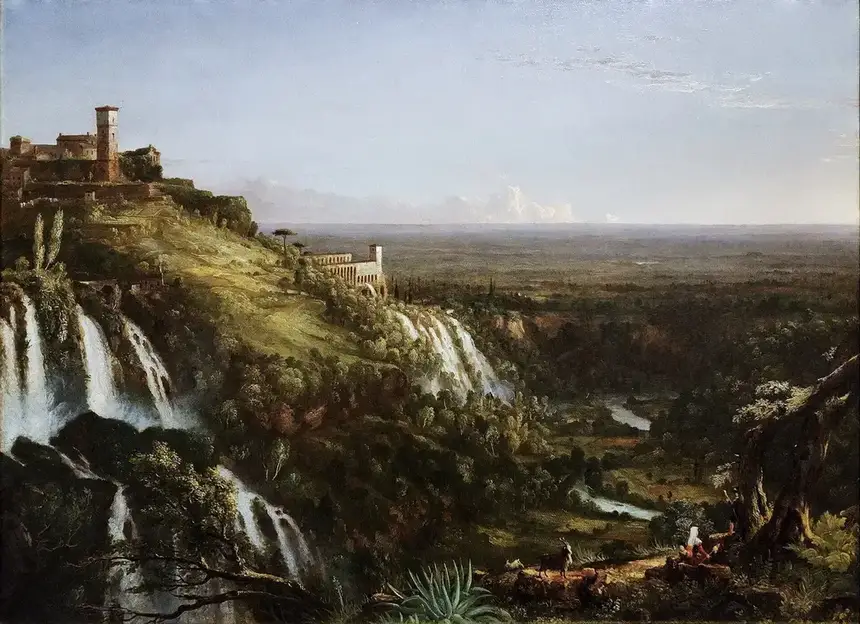
Our painter underdraws the geometry first, then paints freely over it — which is how The Cascatelli, Tivoli, stays both accurate and alive.
The street is painted as a space rather than a wall of facades.
Interior shadows seen through windows are kept dark, which is what makes the exterior read as bright.
Our painter keeps the colour relationships rather than the exact hues, because relationships are what survive.
Nothing here is blended flat. Blending is what makes a painting look printed.
The difficulty is restraint: leaving out most of what a photograph would show.
In a bedroom it works above a headboard, sized to about two-thirds of the furniture width.
| Artist | Thomas Cole |
|---|---|
| Title | The Cascatelli, Tivoli, |
| Medium | Oil on canvas, hand-painted to order |
| What you receive | A hand-painted oil painting on canvas |
| Public domain | Yes — the artist died over 70 years ago |
What a print loses
What you lose in a print is the air. A press lays ink flat; a painter builds depth in layers, and the depth is what you actually see.
Paint goes on in the original's order — thin first, thick last — so the surface behaves the way the painter intended.
| Aspect | Hand-painted oil | Printed canvas |
|---|---|---|
| Time to make | Days of one painter's working time | Minutes |
| Size | Any size, painted to your wall | Limited by the printer |
| Corrections | We adjust it and repaint the passage | The file is reprinted or it is not |
| How it ages | Warms and settles; cleanable by a conservator | Fades, then cracks at the stretcher |
| Impasto | Real paint standing off the canvas | Flat ink, sometimes embossed to imitate |
Getting The Cascatelli, Tivoli, right means painting it in the right order, and the order is not obvious.
Every canvas is painted to order, so the quote follows your size, frame and destination rather than a fixed list. Tell us what you need on WhatsApp and we reply with an exact figure, usually within the hour. You are talking to the people who will actually paint it, not a middleman.
How your painting is made
Every canvas is painted to order, so nothing is pulled off a shelf. This is the sequence:
- Stretching and priming the support — cotton duck or linen goes onto the bars and gets its ground.
- The drawing goes down — charcoal or thin paint, done by eye rather than traced from a printout.
- Blocking the masses — thin paint, working the whole surface rather than one corner at a time.
- The values are established — this is the stage that decides whether the painting works.
- Colour is built up — warmer and cooler versions of each passage, laid over the underpainting.
- Finishing passes — the loaded highlights go on at the end and stay there.
- Drying and varnishing — the final varnish goes on once the paint has set, before we photograph it.
The hardest passage is the quiet one, where a small mistake has nowhere to hide.
Framing
Frames are priced once you have chosen them, not estimated in advance.
Frames are priced once you have chosen them, not estimated in advance.
Care and cleaning
Oil paint needs very little: no water, no cleaners, no sprays. A dry brush and a stable room.
What goes into it
We do not use a printer at any stage. There is no giclée, no canvas transfer, no digital underlayer. Varnish goes on only once the paint is properly dry, months after the last stroke, not before.
Oil paint dries by oxidation, not evaporation, which is why a finished canvas needs weeks before it travels. The ground is a proper acrylic sizing, so the oil does not rot the fabric over time.
Getting the size right
You are not choosing from a list; you are telling us a measurement. These are the common ones:
| Size (inches) | Size (cm) | Best for |
|---|---|---|
| 24 × 20 in | 60 × 50 cm | Study, home office, above a desk |
| 20 × 16 in | 50 × 40 cm | Bedroom, hallway, above a console |
| 16 × 12 in | 40 × 30 cm | A shelf, a small wall, a gallery group |
| 64 × 48 in | 163 × 122 cm | Villa scale, lobby, hospitality wall |
| 48 × 36 in | 122 × 91 cm | Large living room, stairwell, loft |
If your wall is an odd shape, send the measurement and we will work to it. Proportions from the original are kept unless you ask us to change them. Terms are DAP. Import duties and taxes, where they apply, are paid by the buyer on arrival — we never collect them in advance and never guess at the amount.
A plain wall is better than a busy one; the painting supplies the interest.
Message us the dimensions you have in mind and we will come back with a figure.
💬 Get a Quote for The Cascatelli, Tivoli, Looking Towards RomeGetting it to you
Painting takes 9–15 days. Freight is quoted as its own line on the quote, agreed before you pay anything, and never added afterwards.
In transit it is typically 7–10 business days by air, tracked door to door. We send photographs of the finished painting before it is packed, and again once it is boxed.
You see photographs of the finished painting before it ships, and you tell us what to adjust. Changes are handled by telling us what to change; we change it and send new photographs.
Import charges, where they exist, are the buyer's responsibility (DAP). We never add them to the quote and never guess what they will be.
Work begins on a deposit and ships on the balance. Both figures are on the quote. Damage in transit should be reported to us within 48 hours, with photographs. We pursue it with the carrier rather than promising a refund.
The practical questions
What if it does not look right to me?
We send photographs of the actual painting for your approval before anything ships. That is the moment to tell us what to adjust.
Do you frame it?
Framing is quoted separately, so you can decide once you have seen the finished canvas in photographs.
How do I hang it?
Centre it at about 145 cm from the floor, or two-thirds the width of the furniture below it. We will tell you the exact number for your wall.
What is the canvas made of?
Cotton duck as standard, linen on request, artist-grade oil paint, and a final varnish once the paint is fully dry.
Will I see it before it ships?
Yes — photographs of the actual painting go to you first, and nothing is packed until you have seen them.
Is it really painted by hand?
Yes. One painter, oil paint, brushes. We do not own a printer that touches canvas.
Do you sell prints?
No prints at all — no giclée, no canvas transfer, nothing machine-made.
Can you change the colours to suit my room?
Sometimes. We will adjust the palette if it can be done without ruining the picture, and say so if it cannot.
Can I change the size?
Any size you like. We paint to the number you give us rather than to a standard range.
How long does it take?
From order to finished canvas is 9–15 days; delivery adds about 7–10 business days by air.
What does it cost?
Every canvas is quoted on size, frame and destination rather than a fixed list. Tell us what you need and we reply with an exact figure.