The original, and why we can paint it
Thomas Eakins died in 1916, so the work has been in the public domain for decades. Reproducing it by hand is legal, and so is owning one.
Every version we make is oil on canvas, painted by one painter from start to finish. No printing is involved at any stage.
It is an original composition painted before 1916, and our version is painted from the surviving image of it.
You are buying a painting, not a file. That distinction is the whole business we are in.
What the painting is doing
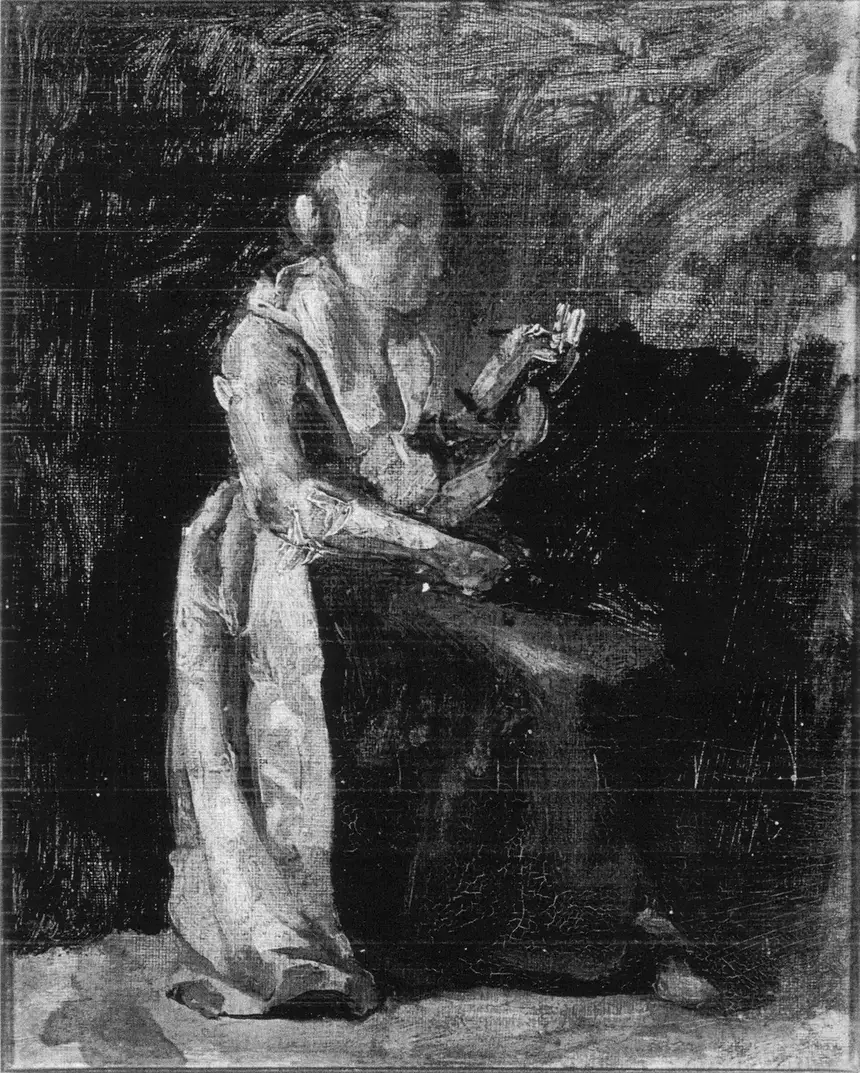
A printed interior looks like a photograph of a room. Study for the Old-Fashioned Dress in oil looks like being in one.
Objects are grouped by value, so the eye moves through the room instead of stopping at each one.
The darkest corner sets the key for the whole canvas, and it is painted first.
We keep the original's palette rather than brightening it, even where a modern eye would.
Our painter loads the brush differently for the near and far passages, and you can read the difference.
The hardest passage is the quiet one, where a small mistake has nowhere to hide.
It works best on a wall you pass rather than one you sit and stare at — the paint rewards a moving eye.
| Artist | Thomas Eakins |
|---|---|
| Title | Study for the Old-Fashioned Dress |
| Medium | Oil on canvas, hand-painted to order |
| What you receive | A hand-painted oil painting on canvas |
| Copyright | Public domain; the original is out of copyright |
What a print loses
Prints are good at information and bad at paint. This subject is mostly paint.
Edges are left soft where the form turns away and sharp where it does not. That single habit is what separates a painting from a copy.
| Aspect | Hand-painted oil | Printed canvas |
|---|---|---|
| Available sizes | Whatever you need, painted to order | What the printer can output |
| Surface | Hand-painted oil on canvas | Ink on canvas, flat |
| Depth | Built in layers, catches light from the side | Flat; highlights are printed as pale ink |
| Colour | Mixed for each passage, warm and cool versions | One flat value per area |
| Changing something | Tell us and the passage gets repainted | Usually means starting the file again |
The difficulty is restraint: leaving out most of what a photograph would show.
Every canvas is painted to order, so the quote follows your size, frame and destination rather than a fixed list. Tell us what you need on WhatsApp and we reply with an exact figure, usually within the hour. There is no agency in between; the studio that paints your canvas is the one answering your messages.
How it gets painted
The order of work matters as much as the work itself. Ours runs like this:
- We start with the canvas itself — stretched, sized and left to settle before any colour is mixed.
- Laying in the drawing — done by eye from the reference, not traced or projected.
- The big shapes are blocked in — thin paint, one colour at a time, the whole canvas at once.
- Getting the values right — the stage that decides whether the finished painting holds together.
- Colour is built up — warmer and cooler versions of each passage, laid over the underpainting.
- The detail and highlights go on — last, loaded, and left alone once they are down.
- Left to dry before varnish — nothing is photographed or packed until the surface is ready.
The difficult part is not the detail. It is keeping the whole canvas at the same stage of finish.
Framing
We can supply a simple floater frame, a traditional gilt, or nothing at all. It is your call.
We can supply a simple floater frame, a traditional gilt, or nothing at all. It is your call.
What goes into it
Varnish goes on only once the paint is properly dry, months after the last stroke, not before. We use cotton duck for most sizes and linen where the canvas is large or the client asks for it.
The ground is a proper acrylic sizing, so the oil does not rot the fabric over time. We buy pigment in tubes from the same suppliers the village has used for years, not in bulk drums.
Looking after it
Oil paint needs very little: no water, no cleaners, no sprays. A dry brush and a stable room.
Choosing a size
You are not choosing from a list; you are telling us a measurement. These are the common ones:
| Size (inches) | Size (cm) | Best for |
|---|---|---|
| 24 × 20 in | 60 × 50 cm | Study, home office, above a desk |
| 20 × 16 in | 50 × 40 cm | Bedroom, hallway, above a console |
| 16 × 12 in | 40 × 30 cm | A shelf, a small wall, a gallery group |
| 64 × 48 in | 163 × 122 cm | Villa scale, lobby, hospitality wall |
| 48 × 36 in | 122 × 91 cm | Large living room, stairwell, loft |
| 40 × 30 in | 102 × 76 cm | Living room focal wall, above a sofa |
Anything outside this table is fine — we paint to the number you give us. DAP terms: we pay the freight, you settle any duty or tax your country applies. We do not collect taxes on anyone's behalf.
Given the subject, this sits naturally in a living room or a study rather than a hallway.
Tell us where it will hang and how big it needs to be — we will price it properly.
💬 Get a Quote for Study for the Old-Fashioned DressTimeline and shipping
From order to finished canvas is 9–15 days. Freight appears as a separate line on the quote and is fixed before you pay.
Air freight runs about 7–10 business days, tracked, to your door. Rolled in a tube it travels cheaper and safer than framed; most overseas clients take it that way.
You see photographs of the finished painting before it ships, and you tell us what to adjust. Changes are handled by telling us what to change; we change it and send new photographs.
We quote DAP, so any duty or tax your country charges is settled by you at import. We do not add a tax line of our own.
A deposit starts the canvas and books the painter's time; the balance is due before the crate leaves. Damage in transit should be reported to us within 48 hours, with photographs. We pursue it with the carrier rather than promising a refund.
The practical questions
What if it does not look right to me?
We send photographs of the actual painting for your approval before anything ships. That is the moment to tell us what to adjust.
How do I clean and care for it?
Dust lightly with a dry, soft brush and keep it out of direct sun. Nothing else is needed for decades; oil paint is slow to change and easy to live with.
What size should I order?
You choose the size. Each canvas is cut to your measurements rather than pulled from stock, so tell us the wall dimensions and we will tell you what proportion works.
Will I see it before it ships?
Yes. We send photographs of the finished canvas and wait for your reply before packing.
Do you ship to my country?
We export to more than 20 countries. Tell us where you are and we will quote the freight as a separate line.
Do you take a deposit?
Work begins on a deposit and ships once the balance is paid. Nothing is charged that is not on the quote.
Who pays the import duty?
You do. We sell DAP, so any duty or tax your customs authority charges is settled by you at import. We do not collect it and we do not estimate it.
What does it cost?
Every canvas is quoted on size, frame and destination rather than a fixed list. Tell us what you need and we reply with an exact figure.
Is owning a reproduction legal?
Yes. Thomas Eakins died more than 70 years ago, so the work is in the public domain and owning a hand-painted version is legal anywhere. We never pass ours off as the original.
Does it come framed?
Framing is quoted separately, so you can decide once you have seen the finished painting in photographs.
Can you paint it from a different photograph of the same work?
Send your own reference image and we will paint from that instead.
Is it really painted by hand?
Yes — oil on canvas, brush and knife. There is no printing, no giclée and no canvas transfer at any stage.