Where this painting comes from
Because William Holman Hunt died in 1910, this work is in the public domain. We are painting a copy of a painting — we never pass it off as the original, and neither should anyone selling you one.
Every version we make is oil on canvas, painted by one painter from start to finish. No printing is involved at any stage.
The painting was made in the years before 1910, and what we reproduce is the record of it, not the object.
If you want something printed, we are the wrong workshop. We do not own a printer that touches canvas.
What to look at
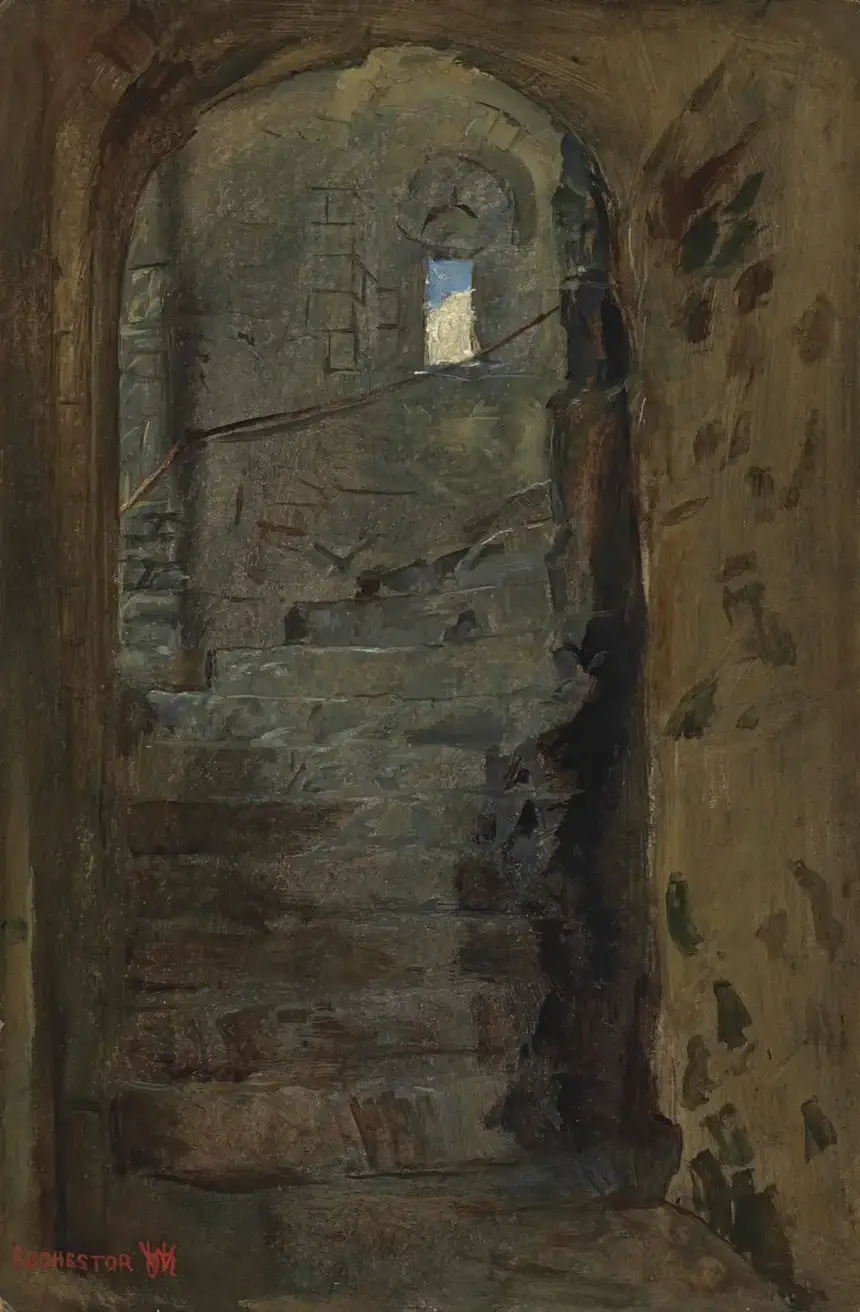
A staircase at Rochester Castle, Kent is about movement, and movement is something you have to leave in the brushwork.
The background is suggested rather than described, which is what keeps the animal forward.
Our painter works the light across the whole animal before finishing any part.
The darks are mixed, not blackened — black straight from the tube would kill the passage.
The brushwork is left visible, which is the whole argument for painting it by hand.
The passage that will take longest is the one that looks simplest.
Given the subject, this sits naturally in a living room or a study rather than a hallway.
| Artist | William Holman Hunt |
|---|---|
| Title | A staircase at Rochester Castle, Kent |
| Medium | Oil on canvas, hand-painted to order |
| Our version | Oil on canvas, painted by hand to order |
| Public domain | Yes — the artist died over 70 years ago |
Hand-painted, not printed
What you lose in a print is the air. A press lays ink flat; a painter builds depth in layers, and the depth is what you actually see.
Paint goes on in the original's order — thin first, thick last — so the surface behaves the way the painter intended.
| Aspect | Hand-painted oil | Printed canvas |
|---|---|---|
| Value over time | Can be re-stretched, cleaned and re-framed | Little value beyond the print |
| What it takes | One painter, several days, start to finish | A machine, a few minutes |
| Impasto | Real paint standing off the canvas | Flat ink, sometimes embossed to imitate |
| Lifespan | Slow to change; varnish can be refreshed decades later | Fades and cracks sooner |
| Sense of depth | Real, created by layers of paint | Simulated by darker ink |
The difficulty is restraint: leaving out most of what a photograph would show.
Every canvas is painted to order, so the quote follows your size, frame and destination rather than a fixed list. Tell us what you need on WhatsApp and we reply with an exact figure, usually within the hour. No resellers, no drop-shipper. The painter's studio handles your commission from first message to final crate.
How the canvas is built
This is how the painting is built, in the order our painters build it:
- We start with the canvas itself — stretched, sized and left to settle before any colour is mixed.
- Laying in the drawing — done by eye from the reference, not traced or projected.
- The first colour pass — thin and simple, establishing the main shapes only.
- Setting the key — how dark the darks go determines everything that follows.
- The colour passes — each area gets its own mixture rather than one colour used throughout.
- The detail and highlights go on — last, loaded, and left alone once they are down.
- It dries, then gets varnished — and only then is it photographed for you.
This one repaints badly, so our painter gets the values right early and leaves them.
Care and cleaning
Once the varnish has cured the surface can be cleaned by a conservator, but in a normal house it will not need it for decades.
On framing
Most clients wait for the photographs before choosing a frame, which is the sensible order.
If you are shipping, an unframed canvas rolled in a tube is considerably cheaper to move than a framed one.
Canvas, paint and varnish
The ground is a proper acrylic sizing, so the oil does not rot the fabric over time. Oil paint dries by oxidation, not evaporation, which is why a finished canvas needs weeks before it travels.
We use cotton duck for most sizes and linen where the canvas is large or the client asks for it. Linen is worth the extra cost above about a metre across, because it holds tension better in humid rooms.
Sizing it
The canvas is cut to your wall, not the other way round. For reference, these are the dimensions most often requested:
| Size (inches) | Size (cm) | Best for |
|---|---|---|
| 16 × 12 in | 40 × 30 cm | A shelf, a small wall, a gallery group |
| 64 × 48 in | 163 × 122 cm | Villa scale, lobby, hospitality wall |
| 48 × 36 in | 122 × 91 cm | Large living room, stairwell, loft |
| 40 × 30 in | 102 × 76 cm | Living room focal wall, above a sofa |
| 32 × 24 in | 81 × 61 cm | Living room, above a sideboard |
If your wall is an odd shape, send the measurement and we will work to it. Proportions from the original are kept unless you ask us to change them. Terms are DAP. Import duties and taxes, where they apply, are paid by the buyer on arrival — we never collect them in advance and never guess at the amount.
In a bedroom it works above a headboard, sized to about two-thirds of the furniture width.
Give us your size and framing preference and you will have a quote shortly.
💬 Get a Quote for A staircase at Rochester Castle, KentTimeline and shipping
Painting takes 9–15 days. Freight is quoted as its own line on the quote, agreed before you pay anything, and never added afterwards.
Transit is usually 7–10 business days, tracked all the way. We send photographs of the finished painting before it is packed, and again once it is boxed.
You see photographs of the finished painting before it ships, and you tell us what to adjust. Changes are handled by telling us what to change; we change it and send new photographs.
Import charges, where they exist, are the buyer's responsibility (DAP). We never add them to the quote and never guess what they will be.
You pay a deposit to start and the remainder before shipping. Nothing is hidden in between. Report any transit damage within 48 hours with photographs and we will deal with the carrier. We will not promise a payout, but we will not leave you to argue alone either.
What people ask us
How close will it be to the original?
The composition, colour and drawing follow the original closely; the brushwork carries the painter's own hand. The painter works freehand on a blank canvas, following the same logic as the original rather than copying a photograph.
What if my wall is an unusual shape?
That is normal for us. Send the measurements and we will work out a canvas proportion that suits the space.
Do you work from my own photograph?
Yes, though that is a separate service. This page is for a hand-painted version of {title}; for a photo-to-painting commission, send the image on WhatsApp.
Is it really painted by hand?
Yes — oil on canvas, brush and knife. There is no printing, no giclée and no canvas transfer at any stage.
Can you paint it from a different photograph of the same work?
Yes. If you have a better reference, send it on WhatsApp and we will work from yours.
How long does it take?
Allow 9–15 days for the painting itself, then roughly 7–10 business days in transit.
What if it arrives damaged?
Report damage within 48 hours with photographs. We deal with the carrier rather than leaving you to argue alone.
What is the canvas made of?
Cotton duck as standard, linen on request, artist-grade oil paint, and a final varnish once the paint is fully dry.
Who pays the import duty?
You do. We sell DAP, so any duty or tax your customs authority charges is settled by you at import. We do not collect it and we do not estimate it.
Can I change the size?
Any size you like. We paint to the number you give us rather than to a standard range.
Can you change the colours to suit my room?
Sometimes. We will adjust the palette if it can be done without ruining the picture, and say so if it cannot.
Will I see it before it ships?
Yes — photographs of the actual painting go to you first, and nothing is packed until you have seen them.