Where this painting comes from
William Holman Hunt died in 1910, so the work has been in the public domain for decades. Reproducing it by hand is legal, and so is owning one.
Ours is a painting made with brushes. There is no giclée, no canvas transfer and no digital underlayer anywhere in the process.
The painting was made in the years before 1910, and what we reproduce is the record of it, not the object.
If you want something printed, we are the wrong workshop. We do not own a printer that touches canvas.
Where the painting lives
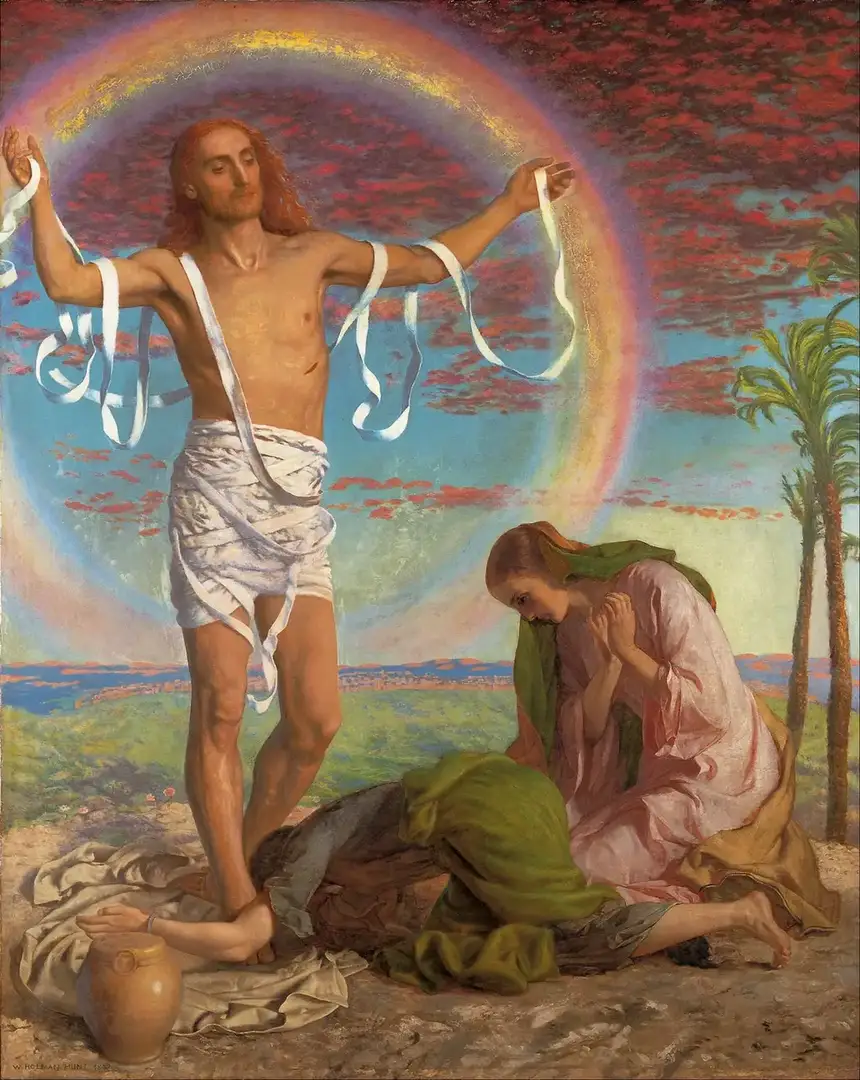
Our painter works in the traditional order — underpainting, then colour, then glazes — so Christ and the two Marys reads the way it should.
Our painter follows the traditional order: drawing, dead colour, then glazes.
Our painter uses glazes for the glow, which is the only way to get it.
Saturated colour is kept for a small area; the rest is deliberately knocked back.
Our painter uses a larger brush than you would expect, which is why the passages stay simple.
The passage that will take longest is the one that looks simplest.
It suits a room with warm, low light. Strong downlighting flattens the surface.
| Artist | William Holman Hunt |
|---|---|
| Title | Christ and the two Marys |
| Created (original) | 1847 |
| Medium | Oil on canvas, hand-painted to order |
| What you receive | A hand-painted oil painting on canvas |
| Copyright | Public domain; the original is out of copyright |
Why this one cannot be printed
A print reproduces the shapes and drops the substance. It is the substance you are buying.
Our painter follows the same logic rather than copying a photograph of it: the far distances go down cool and weak, the near ground stays loaded, and nothing is blended flat.
| Aspect | Hand-painted oil | Printed canvas |
|---|---|---|
| What it takes | One painter, several days, start to finish | A machine, a few minutes |
| Handling of colour | Mixed on the palette and finished on the canvas | Fixed by the colour profile |
| Corrections | We adjust it and repaint the passage | The file is reprinted or it is not |
| The surface | Built up with brushes and knives | Printed flat in one pass |
| Edge quality | Soft where the form turns, sharp where it does not | Uniformly sharp or uniformly blurred |
The risk with a religious subject is overworking, and the way to avoid it is knowing when to stop.
Every canvas is painted to order, so the quote follows your size, frame and destination rather than a fixed list. Tell us what you need on WhatsApp and we reply with an exact figure, usually within the hour. No resellers, no drop-shipper. The painter's studio handles your commission from first message to final crate.
From blank canvas to finished painting
Here is what actually happens between your message and the crate:
- The canvas is stretched and primed — cotton or linen, sized and ready before any paint goes near it.
- Laying in the drawing — done by eye from the reference, not traced or projected.
- The first colour pass — thin and simple, establishing the main shapes only.
- The values are established — this is the stage that decides whether the painting works.
- The colour passes — each area gets its own mixture rather than one colour used throughout.
- Detail and highlights last — put on thickly and then not touched again.
- Left to dry before varnish — nothing is photographed or packed until the surface is ready.
Matching the original's degree of finish is harder than matching its colours.
Frames
Frames are priced once you have chosen them, not estimated in advance.
Frames are priced once you have chosen them, not estimated in advance.
Canvas, paint and varnish
The paint is built in layers, fat over lean, which is what stops it cracking later. Stretcher bars are kiln-dried and wedged, so the canvas can be re-tensioned years later.
The ground is a proper acrylic sizing, so the oil does not rot the fabric over time. Each painter works on one canvas at a time — the painting you ordered is not shared with another order.
Keeping it
Oil paint needs very little: no water, no cleaners, no sprays. A dry brush and a stable room.
Choosing a size
You are not choosing from a list; you are telling us a measurement. These are the common ones:
| Size (inches) | Size (cm) | Best for |
|---|---|---|
| 24 × 20 in | 60 × 50 cm | Study, home office, above a desk |
| 20 × 16 in | 50 × 40 cm | Bedroom, hallway, above a console |
| 16 × 12 in | 40 × 30 cm | A shelf, a small wall, a gallery group |
| 64 × 48 in | 163 × 122 cm | Villa scale, lobby, hospitality wall |
| 48 × 36 in | 122 × 91 cm | Large living room, stairwell, loft |
| 40 × 30 in | 102 × 76 cm | Living room focal wall, above a sofa |
If your wall is an odd shape, send the measurement and we will work to it. Proportions from the original are kept unless you ask us to change them. We sell DAP: the price covers the painting and the freight, and any import duties or taxes are the buyer's to settle with customs. We do not collect them and we do not estimate them.
Given the subject, this sits naturally in a living room or a study rather than a hallway.
Give us your size and framing preference and you will have a quote shortly.
💬 Get a Quote for Christ and the two MarysOrder, painting, shipping
Allow 9–15 days for the painting itself. Shipping is a separate line on your quote — you see it before payment, not after.
Transit is usually 7–10 business days, tracked all the way. Unframed canvases are rolled face-out on a tube; framed ones are corner-protected and crated.
You see photographs of the finished painting before it ships, and you tell us what to adjust. Adjustments are part of the process. Say what you want different and it gets done.
Shipments go out DAP. If your customs office charges duty or tax on arrival, that is between you and them — we do not collect it and we do not put a number on it.
You pay a deposit to start and the remainder before shipping. Nothing is hidden in between. If a crate arrives damaged, send us photographs within 48 hours and contact us directly — we will sort it out with you.
The practical questions
When will it actually arrive?
Studio time is 9–15 days, then a few more days for the oil to set before we can photograph and pack it. We tell you where your canvas is at each stage.
What size should I order?
You choose the size. Each canvas is cut to your measurements rather than pulled from stock, so tell us the wall dimensions and we will tell you what proportion works.
What if it does not look right to me?
We send photographs of the actual painting for your approval before anything ships. That is the moment to tell us what to adjust.
Can you change the colours to suit my room?
We can shift the palette, but we will tell you honestly when a change would spoil the painting.
Will I see it before it ships?
Yes. We send photographs of the finished canvas and wait for your reply before packing.
Is it really painted by hand?
Yes. One painter, oil paint, brushes. We do not own a printer that touches canvas.
Does it come framed?
Frames are priced on their own line. Most clients choose after seeing the photographs.
How long does it take?
Allow 9–15 days for the painting itself, then roughly 7–10 business days in transit.
How do I hang it?
Centre it at about 145 cm from the floor, or two-thirds the width of the furniture below it. We will tell you the exact number for your wall.
What is the canvas made of?
Cotton duck as standard, linen on request, artist-grade oil paint, and a final varnish once the paint is fully dry.
Who pays the import duty?
You do. We sell DAP, so any duty or tax your customs authority charges is settled by you at import. We do not collect it and we do not estimate it.
Do you ship to my country?
We export to more than 20 countries. Tell us where you are and we will quote the freight as a separate line.