Where this painting comes from
William James Müller died in 1845. That puts the painting well outside copyright, which is why we can paint it and you can own it anywhere in the world.
Every version we make is oil on canvas, painted by one painter from start to finish. No printing is involved at any stage.
The painting was made in the years before 1845, and what we reproduce is the record of it, not the object.
You are buying a painting, not a file. That distinction is the whole business we are in.
What the painting is doing
Our painter works from the reference the way the original painter worked from the motif: in passes, thin first, loaded last.
Scale comes from the size of the marks, not from the size of the canvas — which is why enlarging it works.
Value does the modelling; outline does almost nothing.
Colour here is mixed for the passage, not for the object, which is why nothing looks like it was filled in.
Our painter loads the brush differently for the near and far passages, and you can read the difference.
What takes time here is the number of separate decisions, not the size of the canvas.
A plain wall is better than a busy one; the painting supplies the interest.
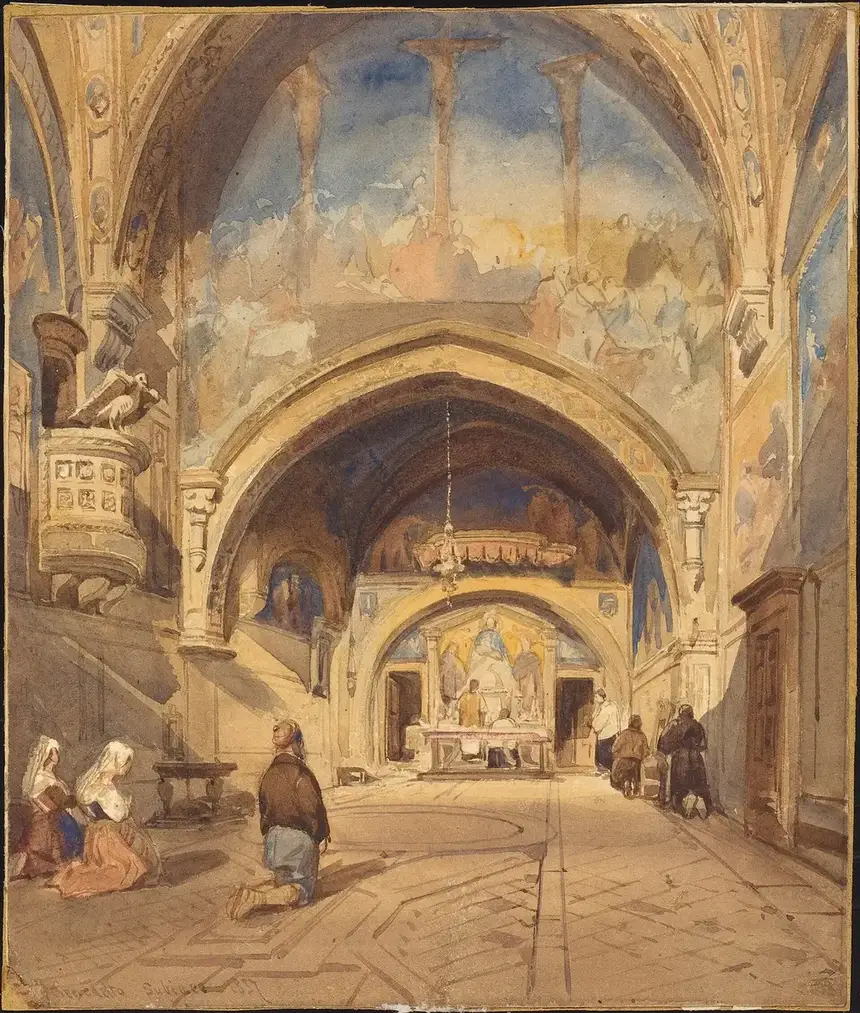
| Artist | William James Müller |
|---|---|
| Title | Interior of the Church of |
| Created (original) | 1837 |
| Medium | Oil on canvas, hand-painted to order |
| How it is made | Painted by hand in oil on canvas, to your size |
| Public domain | Yes — the artist died over 70 years ago |
Why this one cannot be printed
What you lose in a print is the air. A press lays ink flat; a painter builds depth in layers, and the depth is what you actually see.
Where the original is loaded, ours is loaded. Where it is thin, ours is thin. Matching the weight of the paint matters more than matching the colour.
| Aspect | Hand-painted oil | Printed canvas |
|---|---|---|
| Edges | Chosen by the painter, passage by passage | Whatever the file happens to contain |
| Lifespan | Slow to change; varnish can be refreshed decades later | Fades and cracks sooner |
| Sense of depth | Real, created by layers of paint | Simulated by darker ink |
| Impasto | Real paint standing off the canvas | Flat ink, sometimes embossed to imitate |
| Value over time | Can be re-stretched, cleaned and re-framed | Little value beyond the print |
Matching the original's degree of finish is harder than matching its colours.
Every canvas is painted to order, so the quote follows your size, frame and destination rather than a fixed list. Tell us what you need on WhatsApp and we reply with an exact figure, usually within the hour. You are talking to the people who will actually paint it, not a middleman.
How it gets painted
This is how the painting is built, in the order our painters build it:
- The canvas is stretched and primed — cotton or linen, sized and ready before any paint goes near it.
- A loose underdrawing — proportions checked by eye against the source image.
- The first colour pass — thin and simple, establishing the main shapes only.
- Setting the key — how dark the darks go determines everything that follows.
- Building the colour — a warm and a cool version of each passage, put down in order.
- Finishing passes — the loaded highlights go on at the end and stay there.
- Drying and varnishing — the final varnish goes on once the paint has set, before we photograph it.
The difficulty is restraint: leaving out most of what a photograph would show.
Whether to frame it
Most clients wait for the photographs before choosing a frame, which is the sensible order.
Frames are priced once you have chosen them, not estimated in advance.
Materials
The varnish is removable, so a conservator can clean the painting in fifty years without touching the paint. We use a neutral-sized ground so the whites stay warm rather than going blue over time.
We buy pigment in tubes from the same suppliers the village has used for years, not in bulk drums. Each painter works on one canvas at a time — the painting you ordered is not shared with another order.
Care and cleaning
Once the varnish has cured the surface can be cleaned by a conservator, but in a normal house it will not need it for decades.
Canvas sizes
Any size is possible. These are simply the ones that come up most often in quotes:
| Size (inches) | Size (cm) | Best for |
|---|---|---|
| 40 × 30 in | 102 × 76 cm | Living room focal wall, above a sofa |
| 32 × 24 in | 81 × 61 cm | Living room, above a sideboard |
| 30 × 24 in | 76 × 61 cm | Dining room, bedroom feature wall |
| 24 × 20 in | 60 × 50 cm | Study, home office, above a desk |
| 20 × 16 in | 50 × 40 cm | Bedroom, hallway, above a console |
Tell us the wall width and we will tell you what looks right rather than what is standard. Our terms are DAP, meaning the freight is paid by us and any import charges are yours to settle. We will not estimate them, because the figure is your customs authority's to set.
For a stairwell or a double-height space, go larger than you think — the composition was built for distance.
Message us the dimensions you have in mind and we will come back with a figure.
💬 Get a Quote for Interior of the Church of San Benedetto, SubiacoHow it reaches you
Painting takes 9–15 days. Freight is quoted as its own line on the quote, agreed before you pay anything, and never added afterwards.
Air freight runs about 7–10 business days, tracked, to your door. Every shipment goes out with tracking. We do not send anything untracked.
Nothing ships before you have seen it. Photographs of the finished painting go to you first. Changes are handled by telling us what to change; we change it and send new photographs.
We quote DAP, so any duty or tax your country charges is settled by you at import. We do not add a tax line of our own.
Work begins on a deposit and ships on the balance. Both figures are on the quote. If a crate arrives damaged, send us photographs within 48 hours and contact us directly — we will sort it out with you.
What people ask us
Will it look exactly like the image?
Not exactly, and that is the point — it is a painting, not a scan. Composition, colour and drawing follow the original closely; the surface is where a painter's own decisions show.
Does changing the size change the composition?
No — we keep the original's proportions and scale from there, rather than cropping the image to fit a standard frame.
Does it come framed?
Framing is quoted separately, so you can decide once you have seen the finished painting in photographs.
What does it cost?
There is no price list, because the number depends on your size and frame. Message us and we will quote exactly.
How do I hang it?
Roughly 145 cm from floor to centre works for most rooms. Tell us your wall and we will give you the measurement.
Do you take a deposit?
A deposit starts the canvas and the balance falls due before it ships. Both figures appear on the quote.
How long does it take?
From order to finished canvas is 9–15 days; delivery adds about 7–10 business days by air.
Do you ship to my country?
We export to more than 20 countries. Tell us where you are and we will quote the freight as a separate line.
Is it really painted by hand?
Yes. One painter, oil paint, brushes. We do not own a printer that touches canvas.
Can you paint it from a different photograph of the same work?
Send your own reference image and we will paint from that instead.
Will I see it before it ships?
Yes — photographs of the actual painting go to you first, and nothing is packed until you have seen them.